 Mark Stücklin
Heads-up: the latest figures from the Spanish Notaries’ Association have just landed, giving us the full picture of foreign demand for Spanish property in 2025—and the headline is a market that held steady overall but shifted beneath the surface.
A total of 138,254 property purchases in Spain involved a foreign buyer in 2025, down just 0.6% compared to the previous year. In other words, foreign demand barely moved.
That stability looks more impressive when placed in context. Purchases involving foreign buyers remain around 22% above the ten-year average and almost 80% higher than five years ago—clear evidence of how much the international segment has expanded since the pandemic.
However, foreign demand lost some ground within the overall market. Spanish buyers increased their activity by 6.7% to 596,538 purchases, meaning the foreign market share slipped to 18.8%, down from 19.9% a year earlier. The foreign share remains well within the range seen over the last decade but clearly eased in 2025.
British still number one—but declining
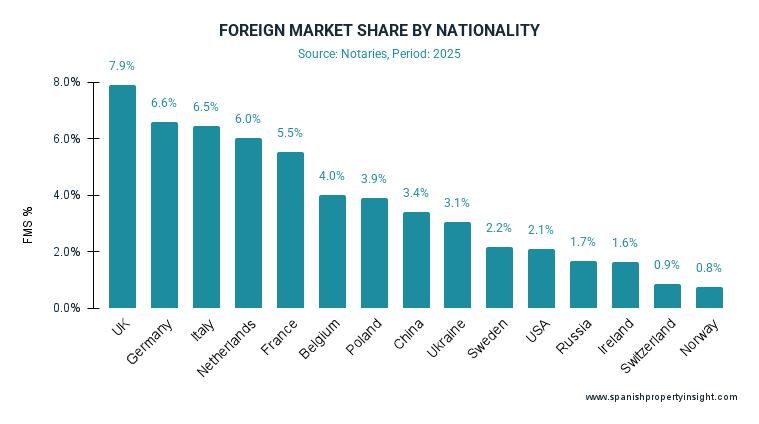
By nationality, the UK remains the biggest foreign market, with 10,925 purchases, though British demand fell by 8.3% year-on-year. Germans remained in second place with 9,126 purchases, also down slightly.
Italy moved into third place with 8,948 purchases after growing 6.5%, while Dutch buyers continued their impressive expansion, rising 12.3% to 8,354 transactions. The Netherlands is now one of the fastest-growing segments of the foreign market.
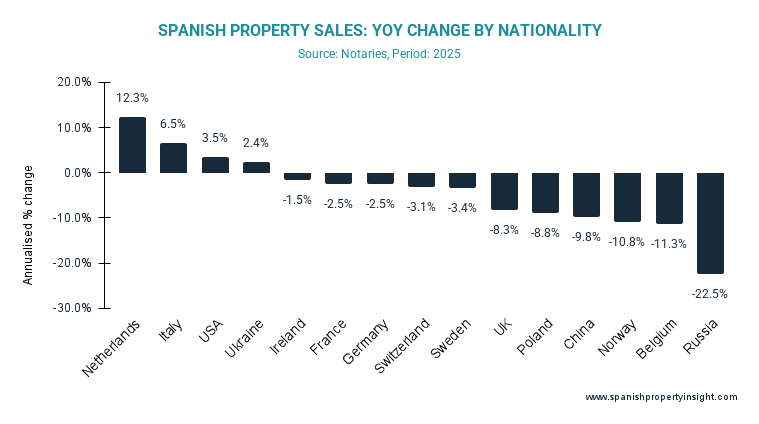
French buyers, historically one of Spain’s largest groups, declined slightly to 7,654 purchases.
Further down the ranking, several markets had a difficult year. Belgian demand fell by 11%, Polish demand dropped nearly 9%, and Chinese buyers declined almost 10%. Russian demand continued its long contraction, plunging 22%.
On the positive side, Portuguese buyers surged 20%, while Americans increased purchases by 3.5% and Ukrainians by 2.3%.
Valencian Region dominates the map as usual
By region, the Valencian Community remained the undisputed centre of foreign demand with 39,338 purchases—almost 29% of the entire foreign market—despite a 5% year-on-year decline.
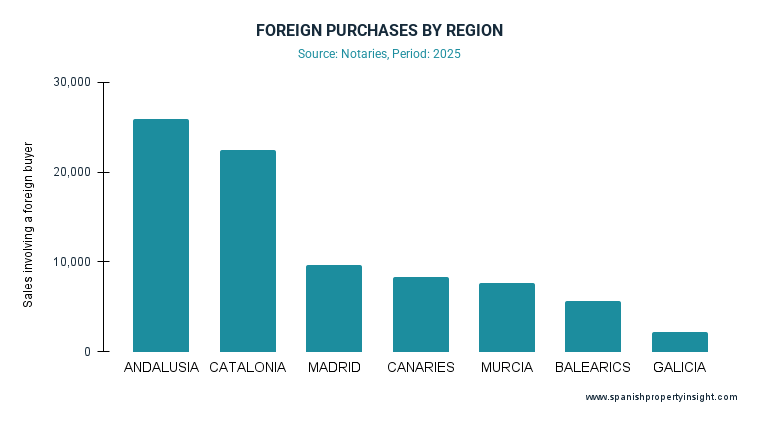
Andalusia came second with 25,947 purchases, and was one of the few large regions to grow, edging up 1.5%.
Catalonia also performed well, rising 4.3% to 22,465 purchases.
Elsewhere the picture was weaker. Madrid saw foreign purchases drop almost 9%, while both the Canary Islands and the Balearic Islands also recorded notable declines.
One small standout was Galicia, where foreign purchases jumped 12%, albeit from a relatively low base.
Momentum fading in the second half
Taken together, the latest figures suggest a foreign market that remains large and resilient but is clearly evolving. Demand is holding up overall, but growth is becoming more selective—both by nationality and by region.
However, the full-year numbers hide a weakening trend as the year progressed. Looking just at the second half of 2025, foreign purchases were down 4.4% year-on-year, with double-digit declines from several key markets including Belgium, the UK, Russia and China. Only a handful of countries—most notably Italy and the Netherlands—managed to record growth during this period.
In other words, the relatively solid annual result was flattered by a strong first half that offset a noticeably weaker second half. The momentum going into 2026 therefore appears to have been fading rather than strengthening.
