 Mark Stücklin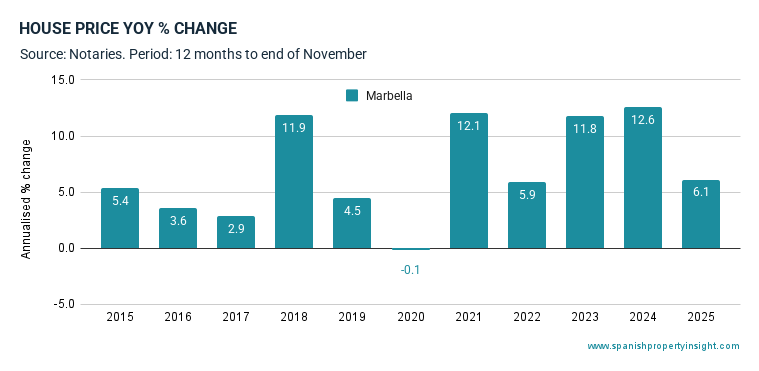
With one month of data still to come, Marbella’s housing market picture for last year is already clear: prices high and rising, demand solid, and sellers in the driving seat.
Below is a snapshot of Marbella’s market based on completed transactions up to November as recorded and published by the notaries’ association. December will add detail, not change the story.
Prices: high, stable, and still edging up
The average price paid in Marbella over 12 months to the end of November sat at around €4,300 per square metre, confirming the town’s position at the top end of the Spanish market. Prices have risen by just over 6% year on year, a healthy but not overheated rate for a mature, international market, and significantly lower than a year before, suggesting that house price growth in Marbella is cooling down.
Monthly prices have fluctuated, as they always do in a relatively thin, high-value market, but the trend is clear enough: Marbella is not getting cheaper. For buyers, waiting for a meaningful price correction looks optimistic at best. For sellers, pricing power remains firmly on your side—provided expectations stay realistic.
Sales volumes: strong but not frantic
Roughly 4,300 homes changed hands in the last 12 months, a robust level of activity for a market dominated by second homes and discretionary purchases. Volumes dipped during the quieter summer months, then recovered into early autumn, following a familiar seasonal pattern.
This is not a boom driven by desperation or cheap credit. It is steady demand from buyers who, by and large, can afford to wait, negotiate selectively, and complete without drama. That tends to keep the market resilient when conditions elsewhere soften.
What buyers are actually buying
The average Marbella home sold this year cost around €718,000 and measured about 167 square metres. This is not a mass-market town, and the figures underline that reality.
Over 90% of transactions involved resale property rather than new builds, reflecting the limited supply of new homes and the dominance of established urbanisations. Apartments accounted for the bulk of sales, while houses made up a smaller but still significant share—typically at much higher price points.
Who is driving demand
Foreign buyers remain the backbone of the Marbella market, accounting for more than 60% of purchases. British buyers are still number one (with a 13% foreign market share), alongside northern Europeans such as Swedes, Dutch, and Germans, with a long tail of other nationalities filling out the picture.
The typical buyer is in their late 40s or early 50s, buying as an individual rather than through a company, and often with lifestyle rather than pure investment in mind.
Bottom line
Based on the data to November last year, Marbella looks exactly like a prime market should: expensive, stable, and underpinned by international demand. Buyers should expect competition for well-priced property and limited scope for bargains. Sellers can take comfort from strong fundamentals—but only if they price for today’s market, not yesterday’s headlines.
