
Costa de Almeria housing market report – H1 2025
This report provides a data-driven overview of the housing market in Costa de Almería and the wider Almería province during the first half of 2025. It draws on official sources to analyse sales activity, prices, mortgage lending, and construction trends, offering insight into both short-term performance and longer-term structural changes.
Sales performance
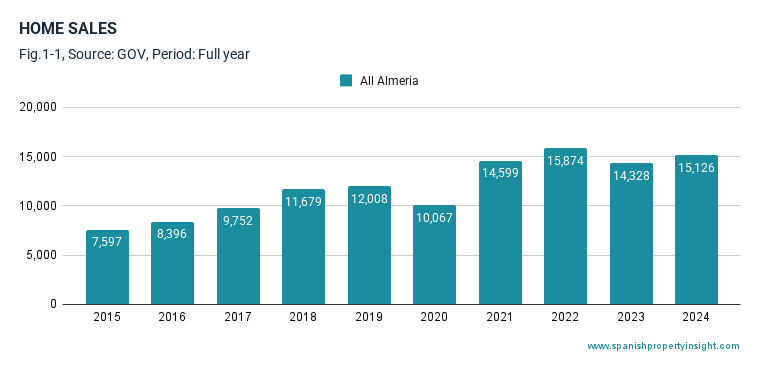
There were 9,167 home sales in Almería province during the first half of 2025 (Fig. 1-1), representing a strong year-on-year increase of 27%. Compared to the ten-year average, sales were 58% higher, and over the last decade volumes have increased by 153%, underlining a sustained expansion in market activity.

Foreign demand remained an important driver. There were 2,186 purchases by buyers from abroad, up 15% year-on-year. Compared to the ten-year average, foreign purchases were 46% higher, and over ten years they have increased by 150%. By residency status (Fig. 1-2):

- 1,460 homes were bought by foreigners living in Spain (expats), up 16% year-on-year
- 726 homes were bought by foreign non-residents (FNRs), an increase of 13%
Over the past decade, purchases by expats have risen by 312%, while FNR purchases are up 39%, highlighting the growing structural importance of resident foreign demand.
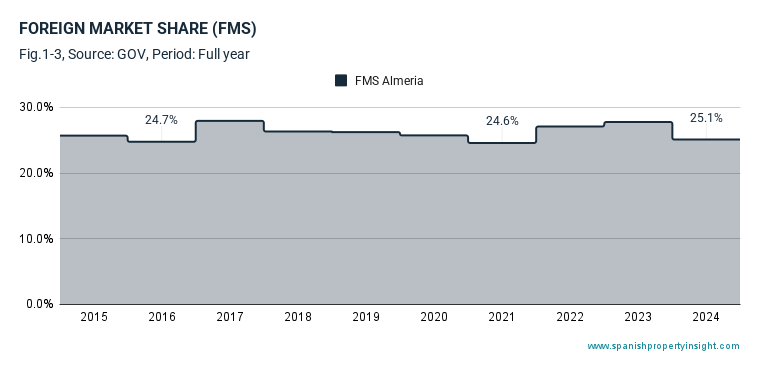
The market share of foreign buyers stood at 24% (Fig. 1-3), down from 27% in the same period a year earlier, and below the peak levels recorded over the last ten years. This suggests that while foreign demand continues to grow in absolute terms, domestic demand has expanded more rapidly in the latest period.

Sales of new-build homes reached 1,061 transactions, surging by 151% year-on-year (Fig. 1-4). This was 82% above the ten-year average, though over the decade new-build sales are up a more modest 64%, reflecting a cyclical rebound following several years of limited development.

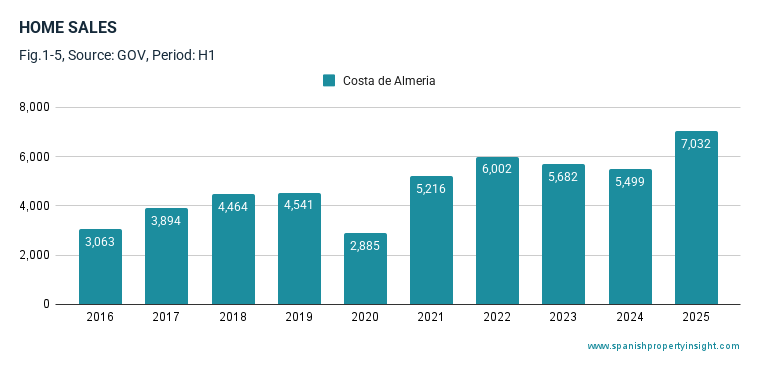
Focusing specifically on the Costa de Almería municipalities, there were 7,032 home sales, representing a 28% year-on-year increase (Fig. 1-5). Compared to the ten-year average, sales were 46% higher, and over ten years volumes have risen by 130%, confirming the coast as the province’s most dynamic submarket.
Prices
According to the Spanish Housing Ministry, the average price of homes sold in Almería province during the period was €121,981 (Fig. 2-1), an annualised increase of 8%. The average price of newly-built homes stood at €185,049, up 9% year-on-year.

A ten-year price index shows that overall prices have risen from 100 to 118, while new-build prices have increased far more sharply, from 100 to 160 (Fig. 2-2). This indicates that new property prices have grown significantly faster than resale values, likely reflecting higher construction costs, land constraints, and stronger demand for modern, energy-efficient homes.

Over the last five years, prices for all property types are up 27%, while new-build prices have increased by 22%, suggesting that recent price growth has become more balanced across segments.
Asking-price data for Mojácar Playa illustrates these trends at a local level (Fig. 2-3). Average asking prices rose from €917/m² in 2015 to €1,811/m² in 2025, representing a 98% increase over ten years and a 45% rise over the last five years. Growth has accelerated since 2022, highlighting renewed demand for prime coastal locations.

Mortgage lending
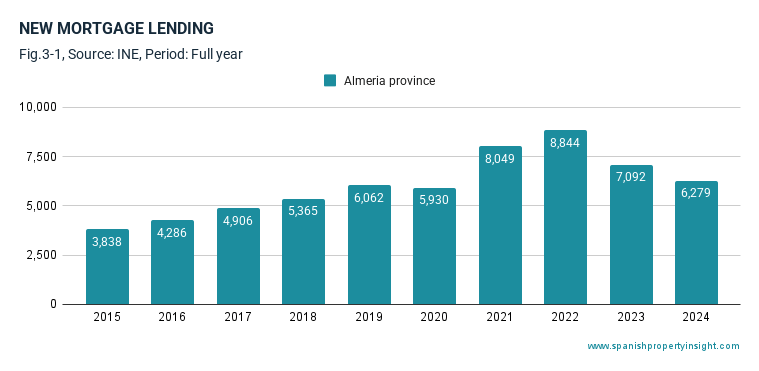
There were 4,538 new mortgages signed in Almería province during H1 2025 (Fig. 3-1), an annualised increase of 36%. Compared to the ten-year average, mortgage lending was 48% higher, and over the decade volumes have risen by 145%, indicating a strong recovery in credit-supported demand.

The average Euribor rate during the period was 2.27% (Fig. 3-2), down 38% year-on-year. Over the last ten years, Euribor peaked at 3.69% in 2023 and fell to a low of -0.49% in 2021. Current levels sit well below the recent peak but remain above the ultra-low rates seen earlier in the decade. The downward trend reflects the European Central Bank’s shift away from aggressive tightening, with markets increasingly pricing in further rate cuts later in 2025.

Housing starts
There were 1,392 housing starts based on planning approvals in the period (Fig. 4-1), representing a sharp 149% year-on-year increase. Compared to the ten-year average, this was 134% higher, and over ten years housing starts have increased more than six-fold, signalling a decisive recovery in development activity in response to strong sales and rising new-build prices.

Outlook
Costa de Almería entered the second half of 2025 with strong momentum. Sales volumes, new-build activity, and mortgage lending all point to a robust market, while price growth remains firm, particularly in established coastal locations. Although the market share of foreign buyers has eased, absolute demand continues to rise, supported by improving financing conditions and renewed developer confidence.
Previous reports
The Costa de Almería property market in 2024 demonstrated steady growth, underpinned by resilient demand, a strong sales base, and ongoing development activity. Overall home sales increased from the previous year, with domestic buyers playing a more prominent role as the share of international purchasers declined slightly. Property prices continued their long-term upward trend, although the new-build segment saw a temporary dip in average values. Mortgage activity remained robust despite higher borrowing costs, and construction starts, while lower year-on-year, continued to reflect a solid long-term recovery. This report offers a detailed analysis of the Costa de Almería housing market in 2024, highlighting key indicators such as sales performance, pricing dynamics, lending trends, and housing supply.
Sales performance
In 2024, the housing market in Costa de Almería recorded a total of 15,126 home sales (Fig. 1-1), representing a modest year-on-year increase of 6%. Compared to the ten-year average, this volume was 27% higher, and nearly double that recorded a decade ago.
Among these transactions, 3,704 involved foreign buyers, reflecting a 4% decline compared to the previous year. However, this figure remains 22% above the ten-year average and nearly 95% higher than ten years ago, underlining the long-term significance of international buyers (Fig. 1-2).
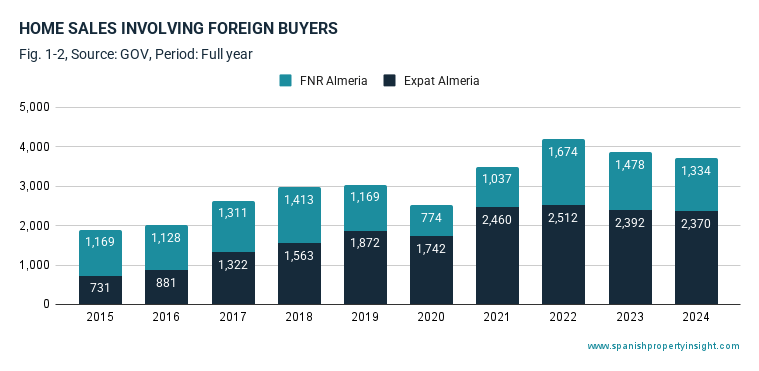
Breaking down international purchases:
- 2,370 homes were bought by foreigners living in Spain (expats), down by 1% year-on-year, but up 224% compared to a decade ago.
- 1,334 sales involved foreign non-residents (FNRs), such as second-home buyers and investors. This segment fell by 10% annually, though it still shows a long-run gain of 14%.
The share of foreign buyers in the Costa de Almería market fell to 25% in 2024 from 28% in the previous year (Fig. 1-3), indicating a relative slowdown in international interest, potentially due to higher financing costs and global uncertainties.
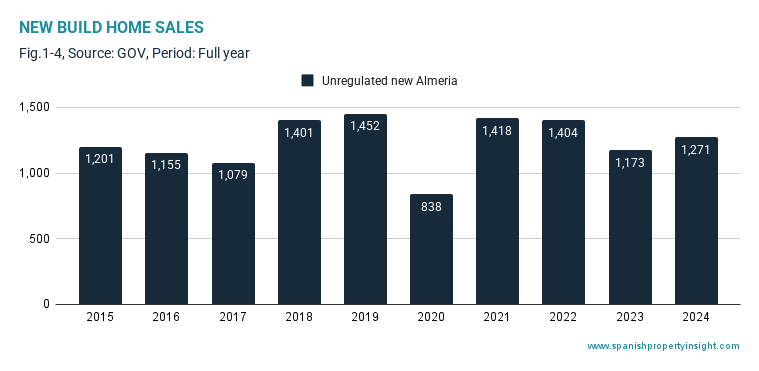
Sales of new builds totalled 1,271, a year-on-year rise of 8% (Fig. 1-4), suggesting growing demand despite a challenging year for supply chains and approvals. This figure is still only 3% higher over the past decade, indicating that new construction has not kept pace with broader sales growth.
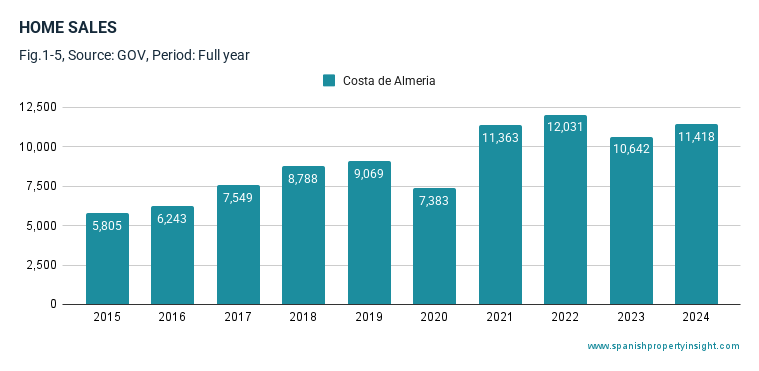
Focusing specifically on key Costa de Almería municipalities, 11,418 homes were sold (Fig. 1-5), showing an annual increase of 7% and a decade-long rise of 97%, highlighting the region’s growing popularity.
House price trends
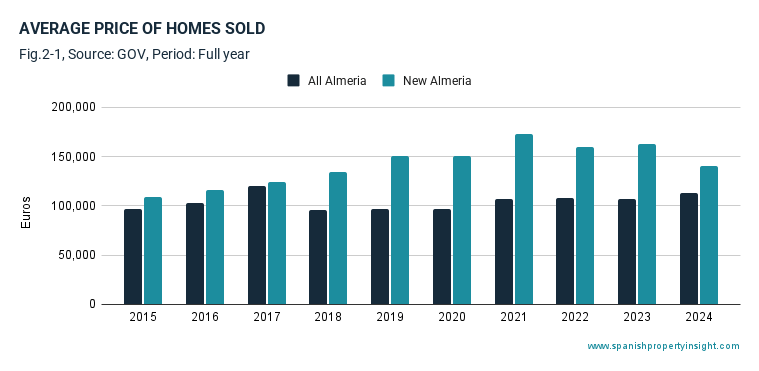
The average property price in Almería during 2024 stood at €113,304 (Fig. 2-1), reflecting a 6% year-on-year increase. In contrast, new-build homes averaged €140,063, representing a 14% decline compared to the previous year, pointing to possible market corrections, builder incentives, or product mix shifts.
Over the past decade, price indices show that all property types have grown, but at differing rates. The all-property index rose from 100 to 116.9 (Fig. 2-2), indicating a 17% rise over the ten-year period. However, new properties saw prices increase from 100 to 128.1 — a 28% growth — suggesting stronger appreciation in the new-build segment over the long haul. This trend may be linked to better energy efficiency, updated designs, and higher demand for turnkey homes, even as short-term prices softened.
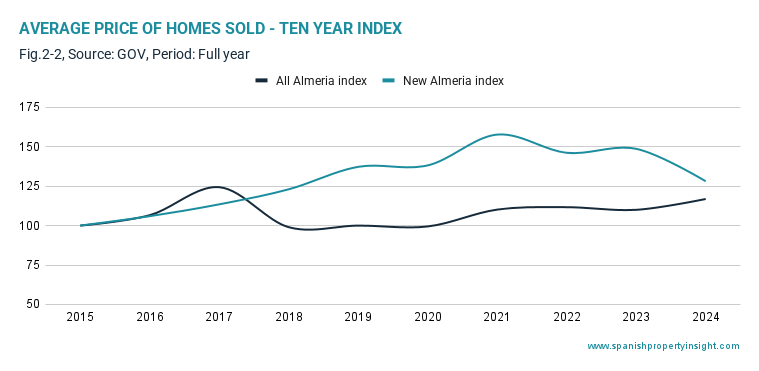
Over the last five years, average prices for all property increased by 17%, while new-builds declined by 7%, again reinforcing the narrative of recent softness in the latter.
Mojácar Playa case study
In Mojácar Playa, a popular coastal destination within the area, average asking prices reached €2,319.75 per square metre, up 10% over the previous year (Fig. 2-3). Over five years, asking prices here climbed 20%, reflecting strong buyer interest and limited supply.
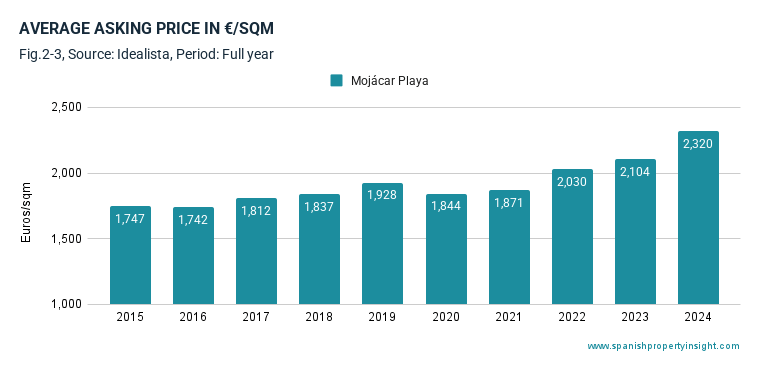
A ten-year index of asking prices rose from 100 to 132.8, meaning that advertised prices in the region have increased by nearly 33% over the decade. This underscores a significant shift in the perceived market value of property in the area and reflects increasing demand, especially in desirable seaside locations.
Mortgage market
In 2024, there were 6,279 new mortgages signed in the province of Almería (Fig. 3-1), 11% fewer than the previous year. Despite the short-term decline, this total is 4% above the ten-year average and 64% higher than a decade ago, showing a long-term rise in mortgage activity.
The average Euribor rate, which serves as the benchmark for most Spanish mortgages, was 3.27% during the period (Fig. 3-2), down from 3.87% in 2023. This decrease of 15% year-on-year suggests easing financing conditions. However, it still remains markedly above ultra-low levels observed in the early 2020s, such as the -0.49% level recorded in 2021.
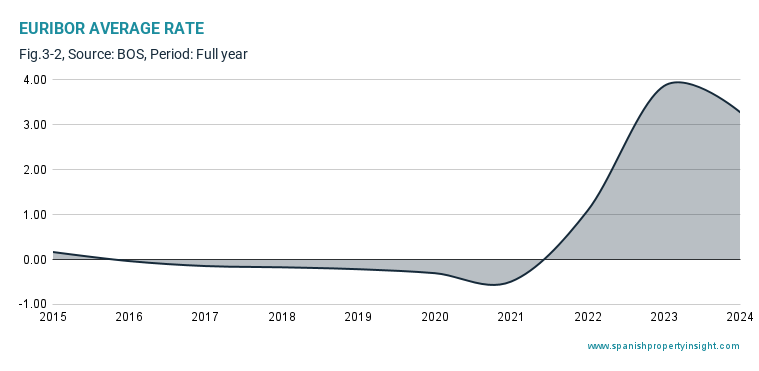
Euribor trends have been heavily influenced by European Central Bank (ECB) policies. The ECB’s 2022–2023 cycle of interest rate hikes, aimed at curbing inflation, peaked by late 2023. Since then, inflationary pressures have eased, and the ECB has signalled a more dovish stance. Market participants now expect rate cuts through 2024–2025, which could support demand and boost affordability in the housing market.
Housing starts
There were 1,279 new housing starts in the Costa de Almería region during 2024 (Fig. 4-1), based on planning approvals. This figure is 27% lower than the previous year, reflecting a substantial slowdown in new development — possibly linked to higher construction costs, cautious builder sentiment, and supply chain challenges.
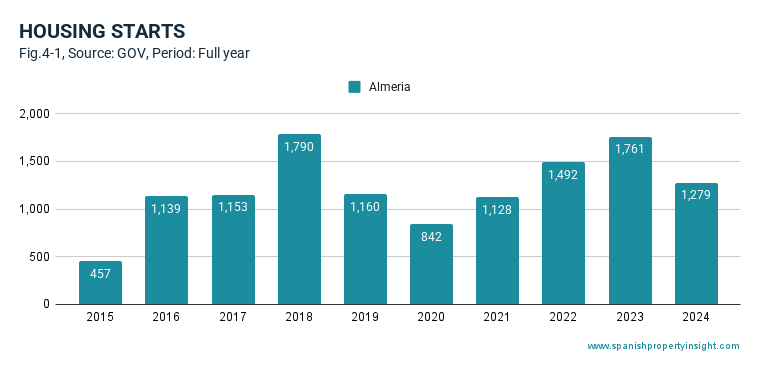
Despite the recent downturn, housing starts remain 5% above their ten-year average and nearly 180% higher than a decade ago, confirming a strong long-run trend in new residential development.
Summary
- Overall property sales in the Costa de Almería area rose 6% in 2024 and are nearly double those of a decade ago.
- Foreign buyer transactions declined 4% year-on-year, especially among non-resident buyers, yet remain significantly above long-term levels.
- Prices for all properties are up 6%, but new-build prices show a 14% decline, highlighting market divergence.
- Mortgage activity dropped 11% annually, although decade-long growth remains strong. A falling Euribor suggests improved future affordability.
- New housing starts fell 27%, potentially signalling constraints in future new-build supply.
Conclusion
The Costa de Almería housing market in 2024 displayed overall resilience despite shifting dynamics among segments. General sales continue to rise, pricing shows long-term appreciation, and demand from international buyers, while easing, remains a vital component of the market.
The fall in new-build prices and housing starts highlights a cautious construction sector, influenced by cost pressures and economic uncertainty. However, falling interest rates and renewed buyer interest — particularly if the ECB begins cutting rates — could spark renewed activity in both sales and new home development in 2025.
Investors and buyers should monitor mortgage costs, project launches, and international demand closely, as these will continue to shape the short-to-medium-term trajectory of this growing coastal housing market.
