
Periodic reports on the property market of Barcelona, the Catalan capital
This page offers data-driven reports on the property market in Barcelona city, consolidating key data from public sources to highlight the latest trends and developments. Illustrated with charts and infographics, these reports provide critical insights into Barcelona’s residential real estate market. These reports are written for foreign investors, property buyers, vendors, professionals, and journalists looking for insight into the Barcelona property market to help inform big decisions with important financial consequences.
Barcelona property market overview
Barcelona is a prime destination for international property buyers seeking second homes, urban apartments, or investment opportunities. Renowned for its vibrant cultural scene, stunning architecture, and Mediterranean lifestyle, the city attracts a significant share of Spain’s foreign property transactions. As one of the most dynamic housing markets in the country, a focused report on the Barcelona property market is invaluable for anyone with an interest in this iconic city.
Located on the northeastern coast of Spain, Barcelona offers a diverse range of housing options, from historic apartments in centuries-old buildings to modern developments that embrace contemporary design. Its strong international appeal, thriving economy, and cultural richness make Barcelona a standout market within Spain, offering unique opportunities for property buyers and investors alike.

The reports cover a wide range of topics to provide a comprehensive understanding of the market, including:
- Home sales across Barcelona city.
- Foreign buyers: market share, residency status, and second-home investments.
- New-build properties: sales, pricing trends, and index data.
- House prices: general trends and specific insights into Barcelona city.
- Mortgage lending: base rates, borrowing costs, and their influence on the market.
- Housing starts and key factors affecting supply and demand.
Want one-time access to the latest report without subscribing?
Fill in the form below to get access to this valuable report without subscribing. A secure link and password will be sent to you by email.
2025 H1
Barcelona city housing market report – H1 2025
Fill in the form above for one-off access without subscribing.
2024 Full Year
The Barcelona housing market in 2024 displayed steady resilience, underpinned by stable sales volumes, sustained foreign interest, and moderate price appreciation across most segments. The market continued to attract a significant share of international buyers, contributing to nearly a quarter of all home purchases, though the growth in foreign demand tapered slightly compared to previous years. Newly-built homes saw strong transactional growth, but average prices softened, reflecting potential shifts in buyer expectations or increased stock availability. Resale prices continued to rise, albeit at a slower pace, while housing starts declined, suggesting possible future supply constraints. This report explores the key trends and performance metrics that defined Barcelona’s residential real estate market over the course of 2024.
Sales performance
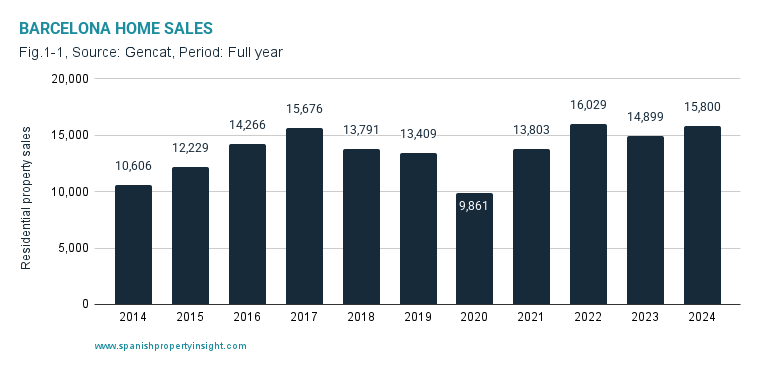
In 2024, the Barcelona housing market recorded a total of 15,800 residential property sales (Fig. 1-1), reflecting a modest year-on-year increase of 6%. This figure also stands 13% above the ten-year average, and nearly 49% higher than total sales a decade ago, indicating a strong long-term recovery in transaction volumes.
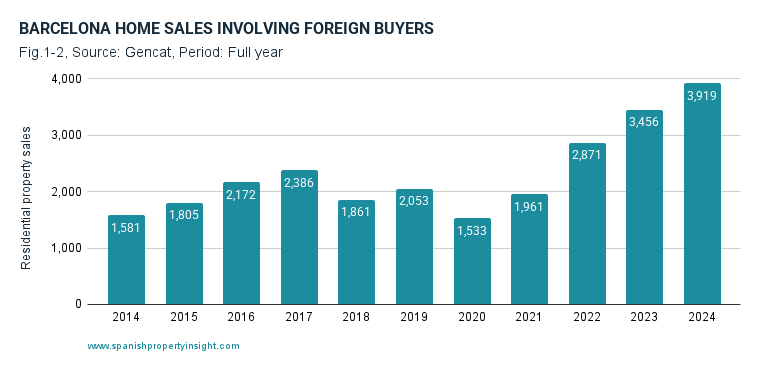
Foreign buyers were a key driver of this growth, accounting for 3,919 transactions during the year (Fig. 1-2). This segment grew by 13% compared to 2023 and by 63% against the ten-year average. Over the last decade, foreign buyer transactions have surged by approximately 149%, underscoring Barcelona’s ongoing appeal to international property investors and lifestyle buyers.
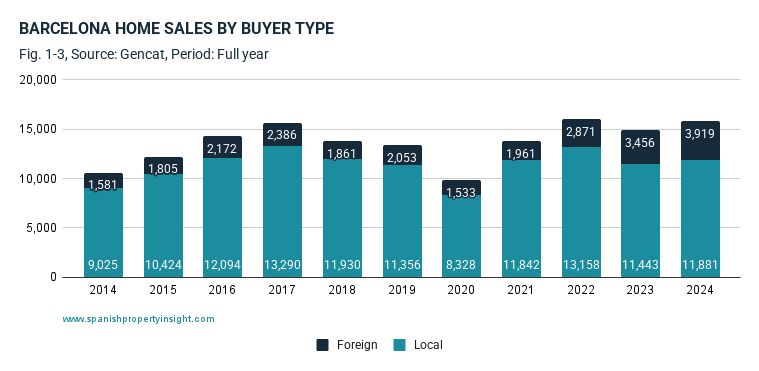
Foreign demand has steadily gained ground in recent years (Fig.1-3). The Barcelona housing market continues to attract international interest, with foreign buyers maintaining a strong presence despite signs of stabilisation in growth.
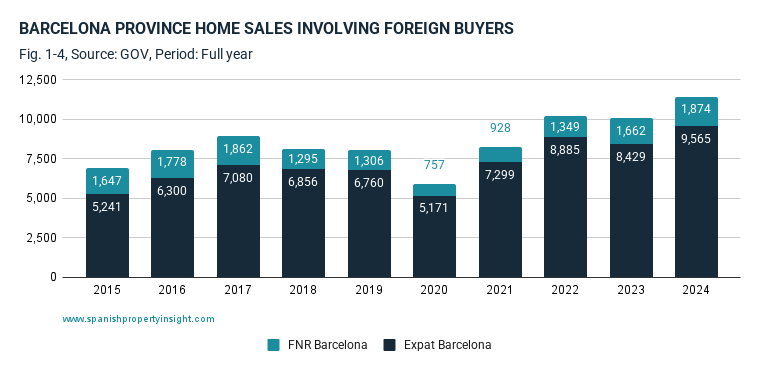
Foreign demand is composed of both foreign residents (expats) and foreign non-residents (FNRs) purchasing second homes or investment properties (Fig. 1-4). Although the data reflects the wider province, it offers valuable insights into the dynamics of Barcelona city, where the majority of foreign buyers are concentrated.
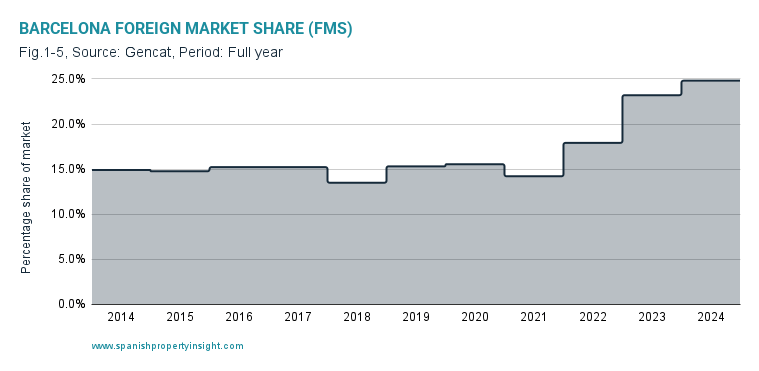
In 2024, foreign buyers accounted for nearly 25% of all home sales—up from 23% the previous year and well above the ten-year average of 17% (Fig. 1-5). This sustained increase in foreign market share underscores Barcelona’s ongoing appeal as a global property destination.
New-build sales
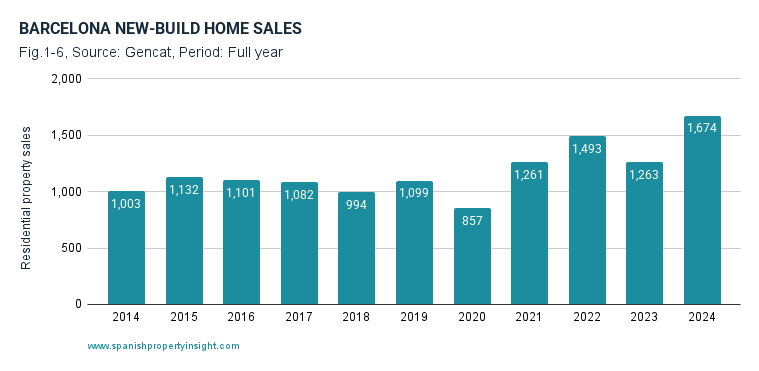
New-build transactions also performed strongly, reaching 1,674 in 2024. This represents a 33% increase year-on-year, 40% above the ten-year average, and 67% higher than in 2014 (Fig. 1-6). Demand for modern homes remains strong both among locals and foreign buyers, particularly in the face of tight resale inventory in prime areas.
House price trends
The average sale price in the Barcelona market in 2024 reached €4,476 per square metre (Fig. 2-1), registering a modest annual increase of 2%. Over the past decade, prices have risen by 62%, demonstrating solid and sustained appreciation.
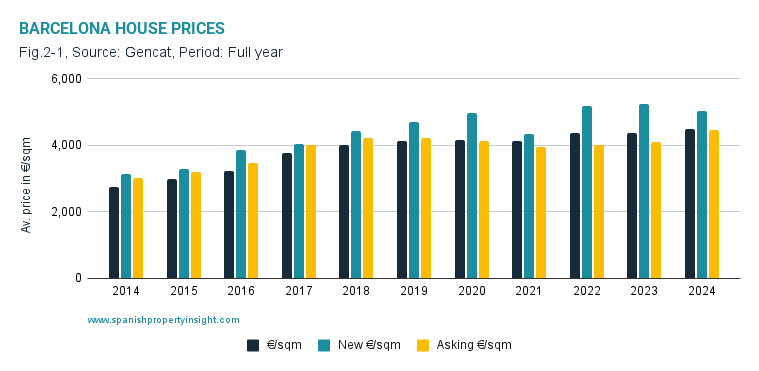
For newly-built homes, the average price was higher at €5,024 per square metre, despite recording a 4% decline compared to last year. Over ten years, however, prices have risen by 60%. Why are new-build prices falling in a city facing an acute shortage of new housing? The likely explanation lies in data volatility. With new home building at historically low levels, the volume of sales is so limited that average prices are easily skewed by one-off events—such as the launch of a project aimed at lower-budget buyers—which may not reflect the broader market trend.
According to the property portal Idealista, average asking prices reached €4,467 per square metre in 2024—an annual increase of 9% and 48% higher than a decade ago. The divergence between asking prices and actual sale prices suggests sellers’ expectations remain confident, even in a shifting interest rate environment.
In absolute terms, the average new-build property now sells for €424,550, up 47% from 2014. Resale homes averaged €370,175, an increase of 46% over the decade. Despite coming from a lower base, resales have kept pace with new-builds in terms of price growth, showing healthy demand across all market segments.
Mortgage market
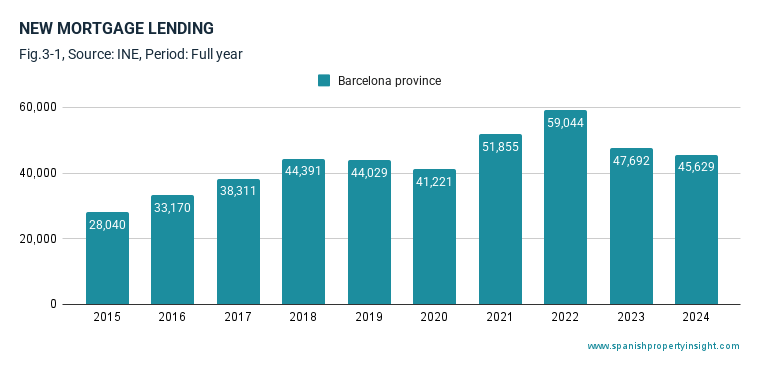
In 2024, a total of 45,629 new mortgages were signed in the Barcelona province (Fig.3-1). This represents a yearly decline of 4%, reflecting a softening in the mortgage market following a period of elevated interest rates. Despite the annual decrease, the number of new loans was still 5% higher than the ten-year average and 63% above 2014 levels—indicating that underlying mortgage activity remains relatively strong from a longer-term perspective.
Euribor, the key reference rate for most variable-rate mortgages in Spain, averaged 3.27% in 2024 (Fig. 3-2). This figure represents a slight decline of 15% compared to the previous year, when Euribor reached a peak average of 3.86%—its highest level in the past decade. In contrast, the lowest level was recorded in 2021, when Euribor was in negative territory at -0.49%.
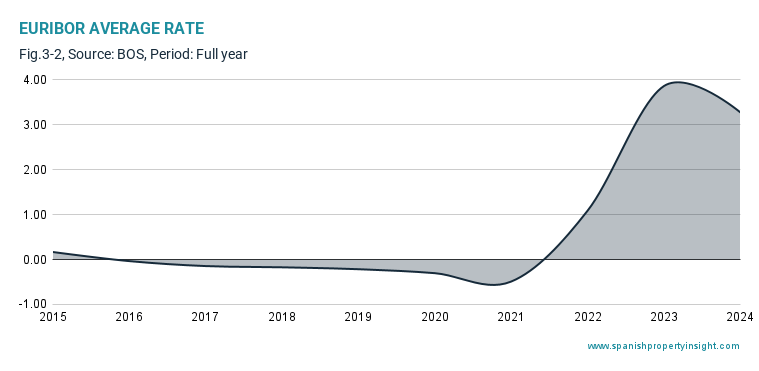
The current rate positions Euribor toward the higher end of its recent historical range, though the decline from 2023 suggests that upward pressure has begun to ease. This shift is closely tied to broader European Central Bank (ECB) monetary policy trends. After a prolonged cycle of interest rate hikes aimed at curbing inflation, the ECB paused further increases in the second half of 2024. With inflation trends cooling across the eurozone, market expectations are now pointing toward a potential series of rate cuts in 2025, which could bring mortgage rates down and further support housing demand.
Housing starts
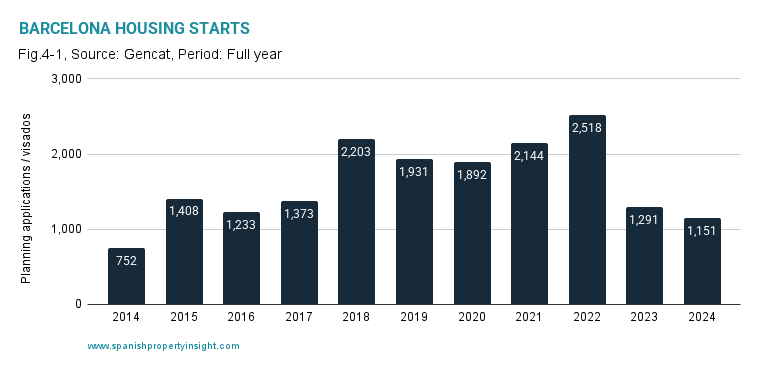
A total of 1,151 housing starts were recorded in 2024, based on planning approvals (Fig. 4-1). This marks an 11% decline compared to 2023 and a 33% drop relative to the ten-year average. The continued slowdown in construction starts could restrict housing supply in the coming years and may contribute to upward pressure on prices, particularly in high-demand segments.
Summary
- Total property sales in Barcelona reached 15,800 in 2024, up 6% year-on-year.
- Foreign buyers made up nearly 25% of the market, with foreign demand rising 13% annually.
- New-build sales grew 33% and were 67% higher than in 2014.
- Average property prices rose by 2% to €4,476/m², and by 62% over the decade.
- Asking prices increased by 9% year-on-year, reaching €4,467/m².
- Housing starts declined 11% annually and were 33% below the ten-year average.
Conclusion
The Barcelona housing market closed 2024 on a strong footing, sustained by robust foreign demand. However, there are warning signs suggesting challenges ahead. While prices continued to rise and sales grew moderately, the sharp decline in mortgage lending—crucial for local buyers, who typically rely on financing—raises concerns. Foreign buyers, more likely to purchase with cash, are less affected by borrowing costs, but the crash in new home building exacerbates an already tight supply, particularly for new-build homes in central areas. If current levels of demand persist, the resulting imbalance could continue to push prices higher in the years to come.
For both international and local buyers, Barcelona remains an appealing market for now, but risks are growing. Mounting local frustration over affordability may trigger political or regulatory responses, while increasing reliance on property as a fiscal target raises the risk of higher taxes on ownership and transactions.
2024 H1
First half of 2024
Barcelona home sales performance
The Barcelona city housing market recorded 7,584 home sales in the first half of 2024, reflecting a year-on-year decline of 8% (Fig. 1-1). Despite this drop, sales were marginally higher than the ten-year average, with a 5% increase. Over a decade, sales have grown by 19%, indicating long-term resilience.

Foreign buyers (Fig. 1-2) accounted for 1,836 sales, a 6% year-on-year increase, and an impressive 55% rise compared to the ten-year average. Over the past decade, foreign buyer transactions have increased by 106%, highlighting their growing importance.

Figures 1-3 and 1-4 show a decline in local buyer activity contrasted by a rise in foreign demand. Among foreign buyers, expats dominated with 84% of sales, while foreign non-residents (FNRs) contributed 906 transactions, their second-highest level on record. This growth demonstrates the strong appeal of Barcelona for international buyers, particularly as a destination for expats.


Due to the recent surge in demand for homes in Barcelona from international buyers, foreign purchasers now account for 24% of the market (Fig. 1-5), the highest level in a decade, compared to 21% a year ago.

The new-build segment performed relatively well given supply constraints, with 768 new home sales, reflecting 12% year-on-year growth (Fig. 1-6). Compared to the ten-year average, new-build sales increased by 26%, underscoring robust demand for modern housing stock despite the recent collapse in the pipeline of new projects. Barcelona’s new-build home sales are set to decline in future when current projects sell out and there is little in the pipeline to replace them.

Barcelona house pricing trends
The average sales price in Barcelona city was €4,399 per sqm, with a year-on-year increase of 3% (Fig. 2-1). For new builds, the average price was €5,015 per sqm, up 5% year-on-year. Asking prices based on Idealista data stood at €4,349 per sqm, growing by 7% year-on-year.

Price indices reveal a steady rise since 2015 (Fig. 2-2):
- Overall sales price index: 151.
- New-build price index: 169.
- Asking price index: 139.

The higher growth in the new-build segment reflects the premium buyers are willing to pay for modern properties in Barcelona. The divergence between sales prices and asking prices suggests a potential ceiling for buyer affordability, despite steady demand.
Barcelona province mortgage activity
There were 25,390 new mortgages signed in Barcelona province during H1 2024 (Fig. 3-1), a modest decline of 2% year-on-year. However, this still marked the third strongest H1 in a decade, driven by post-pandemic momentum. Compared to the ten-year average, mortgages rose by 13%.

The average Euribor rate was 3.67% during the period (Fig. 3-2), close to its ten-year high of 3.69% in H1 2023, reflecting a sharp rise from negative rates as recently as 2021. The European Central Bank’s monetary tightening to combat inflation has resulted in increased borrowing costs, moderating demand. However, the robust mortgage activity suggests resilience in the face of higher interest rates.

Barcelona housing starts
Barcelona city approved 405 housing starts in H1 2024 (Fig. 4-1), a 25% year-on-year increase. However, this figure remains 44% below the ten-year average, indicating significant constraints on new construction.

Key factors influencing housing starts include City Hall policies that impose significant red tape, delays, and requirements for developers to allocate 30% of projects to social housing. These policies have curbed developer activity, despite a stated intention by the current administration to reduce barriers.
Barcelona property market in H1 2024 summary
- Home sales: 7,584 transactions, down 8% YoY but slightly above the ten-year average.
- Foreign buyers: Market share reached a decade-high 24%, with expat purchases dominating.
- New builds: 12% YoY growth, showing strong demand for modern properties.
- Prices: Sales prices grew by 3%, while new-build prices rose by 5%.
- Mortgages: The third-strongest H1 in a decade, despite rising interest rates.
- Housing starts: Increased 25% YoY but remained constrained by regulatory hurdles.
Barcelona property market in H1 2024 conclusion
The Barcelona city housing market in H1 2024 exhibited resilience amid challenging conditions. Sales volume softened, but long-term trends remain positive, especially in the foreign buyer segment, which now accounts for nearly a quarter of all transactions. Prices continue to rise moderately, led by the new-build segment, reflecting sustained demand for quality housing.
While mortgage activity remains robust, higher borrowing costs due to elevated Euribor rates may temper demand in the future. Housing starts show tentative growth, but regulatory barriers continue to stifle supply, adding pressure to the market. Overall, the Barcelona property market remains a sought-after destination, with strong international appeal balancing local challenges. The outlook is cautiously optimistic, contingent on policy reforms and broader economic conditions.
Disclaimer
These reports are prepared in good faith using publicly available data. While efforts are made to ensure accuracy, no guarantees are provided regarding the completeness, reliability, or suitability of the information for any purpose. Use of this information is at your own risk.
The author accepts no liability for errors, omissions, or actions taken based on the content. Information is subject to change without notice.
These reports are for informational purposes only and do not constitute professional advice. Readers should conduct their own research and consult qualified professionals before making investment or business decisions.
By using this resource, you agree the author is not liable for any direct, indirect, incidental, or consequential losses arising from its use.
