Mark Stücklin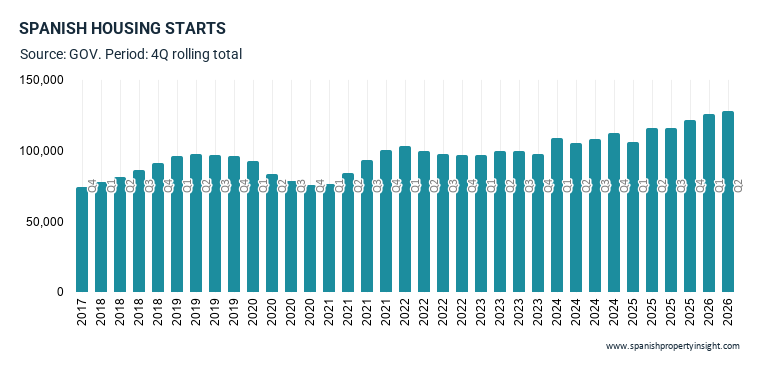
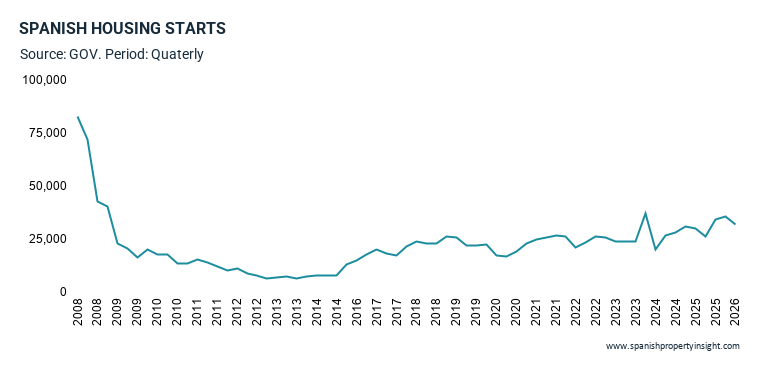
New government figures show housing starts rising to their highest level in a decade, but Spain is still building nowhere near enough homes, especially in the places where they are most desperately needed.
The latest figures from the Ministry of Housing show that construction started on 67,564 new homes in the first half of 2026, an increase of 11% compared to the same period last year, and the highest first-half figure in at least a decade.
The rolling 12-month total reached 128,301 homes at the end of June, up 10.5% year-on-year. That is encouraging progress, but still a long way short of the hundreds of thousands of new homes Spain needs annually to address its housing deficit.
Building in the wrong places
The national increase also disguises some worrying regional differences. Housing starts rose by just 1% in Barcelona province, where the shortage of affordable homes is acute, and fell by 30% in the Madrid region, another major centre of housing demand.
In Barcelona city itself, new private residential development has been strangled by a municipal requirement to reserve 30% of new projects for social housing. The policy has made many developments economically unviable, helping to explain why new construction has been so scarce in recent years.
The hard-left politicians behind the policy apparently haven’t grasped a simple mathematical reality: 30% of zero is zero. A policy designed to deliver affordable housing is unlikely to achieve much if it prevents homes from being built in the first place.
The Balearics are a notable exception, with housing starts up 51% in the first half. This might reflect the regional government’s greater focus on tackling the housing shortage by encouraging development.
Meanwhile, construction is performing better in popular foreign-buyer destinations such as Málaga, home to the Costa del Sol, and Murcia.
Why developers prefer luxury homes
There is another problem lurking beneath the headline figures. Rising construction costs, planning delays, regulatory requirements and taxes have made affordable housing development increasingly unattractive.
Developers naturally gravitate towards projects offering the best risk-adjusted returns. When the costs and bureaucratic obstacles are broadly similar, building expensive homes for wealthy buyers can offer much better margins than building affordable homes for ordinary households.
But there is a hidden risk here. If too many developers independently reach the same rational conclusion, they could end up oversupplying the luxury segment, pushing down prices and returns whilst the affordable housing shortage remains unresolved.
More homes where people need them
Spain’s housing crisis is fundamentally a problem of insufficient supply in the places where people need to live and work. The solution requires much more residential development in and around major cities and provincial capitals, particularly at affordable price points.
That also means investing in transport infrastructure so people can realistically live further from expensive city centres without facing impossible commutes.
The latest housing-start figures are moving in the right direction nationally, but the pace remains woefully inadequate, and the geographical distribution is troubling. Until Spain makes it easier and more profitable to build ordinary homes where they are needed, the housing crisis will continue, regardless of how many new regulations politicians dream up.