 Mark Stücklin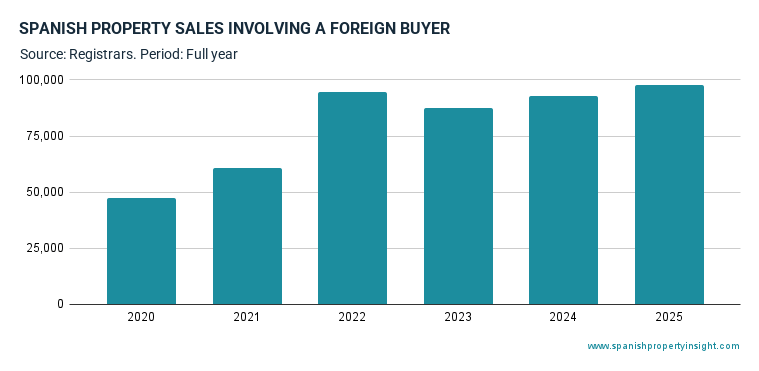
Foreign demand for Spanish property hit a new record in 2025, but the final quarter suggests the boom may be losing steam.
According to the latest figures from the Land Registrars’ Association, sales involving a foreign buyer rose by around 5% last year to an all-time high of 97,515 transactions. However, purchases fell by 4% year-on-year in the fourth quarter, a clear sign that demand cooled as the year progressed. With Q4 typically a good barometer of momentum, 2025 may turn out to be the peak of this particular foreign-buyer cycle.
A softer finish to a strong year
In Q4 there were just over 24,100 home purchases involving a foreign buyer, down 4% year-on-year. The foreign market share (FMS) slipped to 13.5%, from 14.5% a year earlier, and well below the post-pandemic highs seen in 2022–23. By historical standards foreign demand remains elevated, but it is no longer accelerating.

One important nuance is that the fall in foreign market share does not mean foreigners were buying fewer homes in absolute terms over the year. Rather, Spanish demand grew faster. Total transactions rose by around 12% in 2025, comfortably outpacing foreign growth and pushing the FMS down for the year as a whole.
The usual suspects – and one standout
At an annual level, the familiar hierarchy at the top remains largely intact. British buyers were once again the largest foreign group, a position they have held almost uninterruptedly since records began, with Germany in second place. But below them the order shifted. The Netherlands climbed into third place for the first time on record, overtaking France.
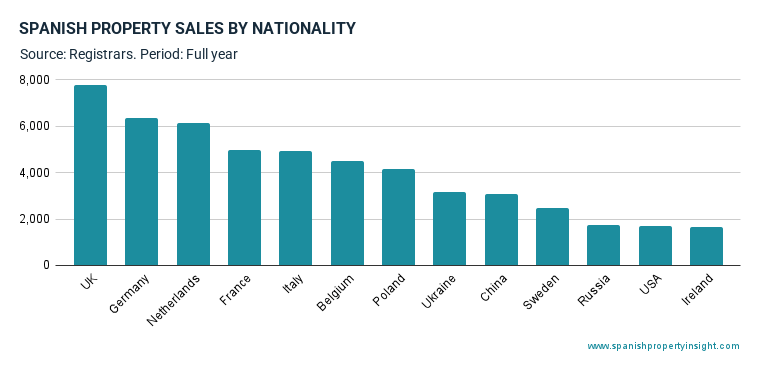
The big story of 2025, then, was the Dutch surge. Purchases from the Netherlands jumped by nearly 24% year-on-year, by far the strongest growth of any major market. And in the fourth quarter alone the Dutch went one step further, rising into second place for the first time, even overtaking the Germans.

Unlike demand from Ukraine or Poland, which can plausibly be linked to Russia’s invasion of Ukraine – and unlike the sharp decline in Russian purchases – the Dutch surge has no obvious geopolitical trigger. It has instead become one of the quiet success stories of Spain’s post-pandemic housing market.
American buyers lost purchasing power with the Dollar
Buyers from the United States have also been a notable feature of recent years. Purchases have surged since the pandemic, and numbers rose by around 10% in 2025, often attributed to lifestyle migration and political uncertainty back home.
Yet here too the fourth quarter told a different story. US purchases fell by more than 11% year-on-year in Q4. Some of the wind appears to have gone out of this market’s sails, possibly reflecting currency effects: the dollar weakened through the second half of the year and ended 2025 roughly 10% lower against the euro.
What it means
In short, 2025 was a record year for foreign demand, but not an unambiguously bullish one. The annual figures still look strong, yet the late-year slowdown and falling market share suggest that foreign buyers are no longer driving the market forward as they were in the immediate post-pandemic years. If domestic demand stays robust, foreign demand may increasingly look like a stabilising force rather than the engine of growth.
