 Mark Stücklin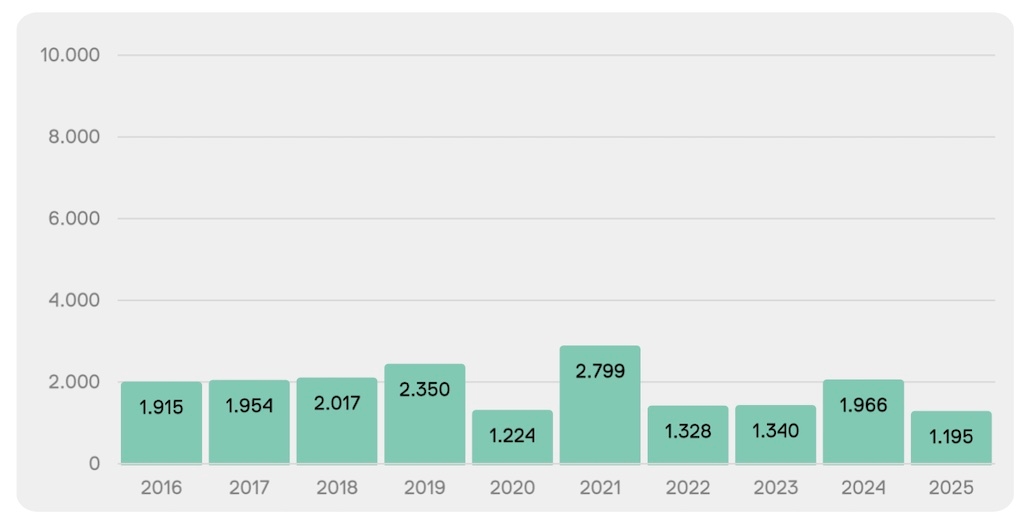
Barcelona is desperate for more homes, yet local policy is driving developers away and construction to decade lows, turning an already severe housing shortage into a self-inflicted crisis.
Barcelona is facing a full-blown housing crisis, yet the latest official figures show that new home building in the city has slumped to its weakest level in a decade. The numbers, just released by the Catalan College of Architects (COAC), underline how local housing policy is actively choking off supply at the worst possible moment.
New figures confirm a decade low
According to COAC’s annual analysis of building permits, just 1,195 new homes were approved in Barcelona in 2025 (chart above). That represents a year-on-year collapse of around 39% and is the lowest figure recorded in the city over the past ten years. It is even lower than in 2020, when Covid paralysed construction activity for months.
These permits cover projects that must be formally approved before construction can begin, including new developments and major refurbishments. As COAC itself notes, this data offers the most reliable forward-looking snapshot of what will actually be built in the near future.
In a city where demand for housing continues to outstrip supply, the signal could hardly be clearer: far fewer homes are in the pipeline.
Private development dries up
The figures also expose how dependent Barcelona has become on public-sector housing just to stop construction from falling off a cliff. Of the 1,195 homes approved last year, almost half (597) were protected housing. Much of this came from municipal initiatives, without which the overall decline would have been even sharper.
Within the private sector, the diagnosis is blunt. Developers have lost the appetite to build in Barcelona, and investment has been redirected elsewhere. The main reason cited is the city’s requirement that 30% of new residential developments be set aside for protected housing, a policy introduced during the mayoralty of Ada Colau.
In theory, the rule is designed to boost affordable housing. In practice, it has made many projects financially unviable, particularly in a city with high land and construction costs. In 2025, the rule affected just 16 developments and delivered only 52 protected homes. The cost, however, has been a much broader collapse in private-sector activity.
A supply crisis made worse by policy
COAC’s leadership has been clear about what is needed. Guillem Costa Calsamiglia, the college’s dean, has argued that Barcelona must “flood the market” with all types of housing, including new builds, rehabilitation, and social housing, to respond to the housing emergency and ongoing population growth.
Yet the data shows the opposite is happening. Both new construction and major renovation projects in the city are running below last year’s levels, despite record housing stress.
The uncomfortable conclusion is that Barcelona’s housing crisis is no longer just the result of strong demand or demographic pressure. It is being aggravated by local policies that punish private developers while delivering very little additional affordable housing in return. Until that approach changes, the city risks deepening a crisis of its own making.
