 Mark Stücklin
Barcelona’s rent controls have kept official rental prices in check, as intended. But the latest figures for H1 2026 reveal a rental market still struggling to recover from a collapse in new contracts, leaving thousands of prospective tenants unable to find a home.
The Catalan government (Generalitat) has published the latest INCASÒL rental statistics for the first half of 2026, offering another opportunity to assess Barcelona’s rent control experiment, introduced in March 2024.
And, predictably, the Generalitat is celebrating the results. Rents are under control, we’re told. Unfortunately, that tells us remarkably little about whether people can actually find somewhere to live.
Controlled rents are controlled. What a surprise.
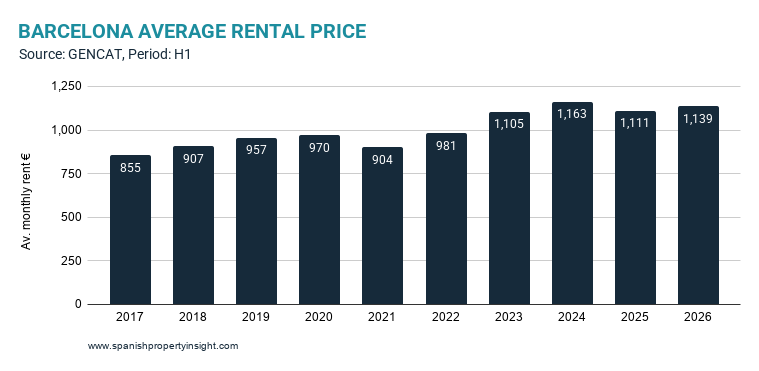
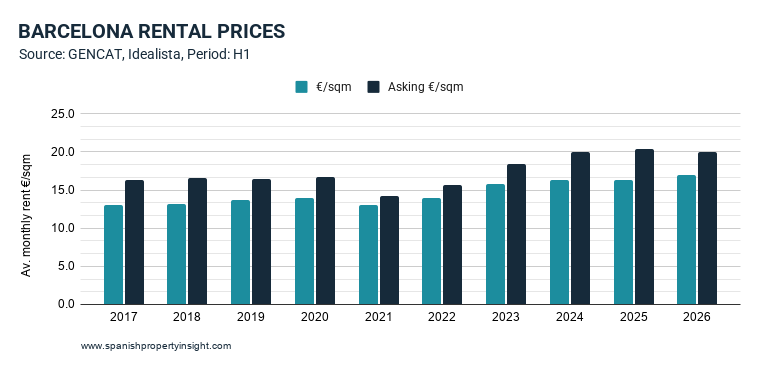
According to the latest figures, Barcelona’s average monthly rent increased by 2.5% year-on-year to €1,139 in H1 2026, whilst the price per square metre rose by 3.9% to €17.
The government presents this restraint as evidence of success. But when rental prices are controlled by law, it’s hardly surprising that the prices declared in official contracts remain constrained.
The real question is what happens to the market when prices are no longer allowed to balance supply and demand.
The collapse in rental contracts tells a different story
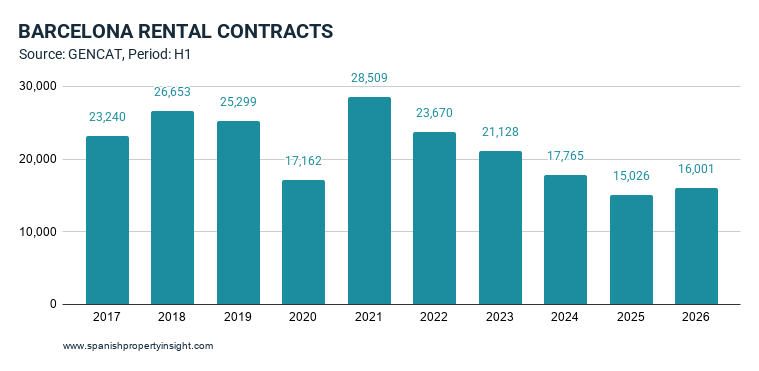
The number of new rental contracts increased by 6.5% to 16,001 in H1 2026, suggesting that the relentless decline following the introduction of rent controls may finally have bottomed out.
But before the politicians start opening the champagne, some perspective is needed.
There were 26,653 contracts signed in H1 2018, compared to just 16,001 this year—a decline of 40%. Even compared to the ten-year average, the number of contracts remains 27% lower.
In Q2 alone, just 7,845 contracts were signed, compared to 13,672 in the same quarter of 2018—a collapse of 43%.
And these figures refer to residential rental contracts lasting more than a year. Seasonal rentals are recorded separately by the Generalitat, so they cannot explain away the decline in ordinary rental contracts.
Asking prices fall, but what is really available?
Meanwhile, advertised rents on Idealista fell by 2% year-on-year to €20/sqm, narrowing the gap with official contract prices, which had widened dramatically after rent controls were introduced.
That is an interesting development, but asking prices are becoming an increasingly questionable guide to market conditions when so little accommodation is genuinely available.
A rough search of Idealista suggests around 2,000 rental listings in Barcelona, of which perhaps 650 are for long-term accommodation. And even an advertised flat is no guarantee of availability. Enquire about one and you may discover it has conveniently just gone, but the agent will happily add you to a waiting list.
In such a starved market, listings can serve as much to generate enquiries as to advertise genuinely available homes.
Meanwhile, the widening gap between asking and declared rents in recent years raises another uncomfortable question: how much rent is now being paid unofficially, including cash payments that never appear in INCASÒL statistics? The figures cannot tell us, but the incentives for undeclared payments are obvious.
The people who don’t appear in the statistics
The index chart below illustrates the bigger picture. Since 2016, contract rents per square metre and asking rents have both risen by around 44%, whilst new rental contracts have fallen by 21%.
More strikingly, rental transactions have plunged since 2022, whilst prices have continued rising.
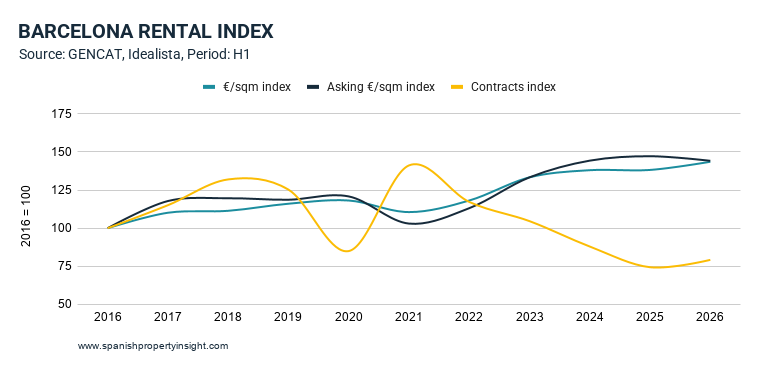
The people most disadvantaged by this situation don’t appear in the rental-price statistics at all. They are the prospective tenants who cannot find a home, even if they could afford a higher rent.
Rent controls favour sitting tenants and applicants with impeccable financial profiles. But when landlords have dozens of applicants competing for the same property at a controlled price, why take a chance on anyone with a less-than-perfect profile?
The least fortunate get pushed to the back of the queue, which is a strange outcome for a policy supposedly designed to help the vulnerable.
A government victory lap around a shrinking market
The Generalitat boasts that rent increases remain below inflation and that the overall stock of active rental contracts is growing. But that can happen simply because sitting tenants stay put for longer, reducing turnover and opportunities for newcomers.
Two years into Barcelona’s latest experiment with rent controls, the picture is becoming clear. The fall in new contracts may have stabilised, but rental opportunities remain dramatically below historical levels, whilst official rents are rising again.
Politicians can control what landlords charge on paper. They cannot legislate homes into existence.
And for the thousands of people who cannot find anywhere to rent, the government’s celebrated price containment is of precisely no use whatsoever.
