 Mark Stücklin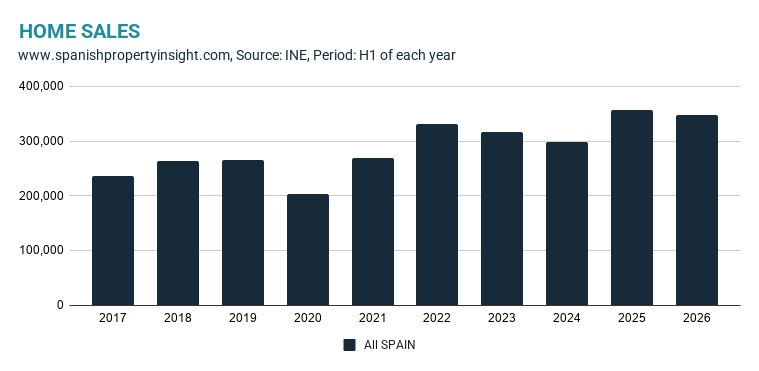
Spanish bank BBVA expects home sales to fall this year despite strong demand, as a chronic shortage of housing pushes prices up by 12% and leaves buyers competing for insufficient supply.
According to the latest forecasts from BBVA Research, home sales will fall by 7.3% in 2026, after activity in the first months of the year proved weaker than expected. Sales were down by 3% in the first half, according to the National Institute of Statistics (illustrated in the chart above).
The problem is not a lack of buyers. Demand continues to benefit from relatively low interest rates, employment and real wage growth, strong household formation driven by immigration, and significant foreign demand. Instead, BBVA identifies the shortage of available homes as the main constraint on transactions.
Despite the forecast decline, sales are expected to remain high by historical standards. BBVA expects a modest recovery of 0.6% in 2027, taking transactions back above 700,000.
Prices forecast to rise 12%
The imbalance between supply and demand is expected to keep pushing prices higher even as fewer homes change hands.
BBVA forecasts Spanish house prices will rise 12% in 2026, followed by another 5.7% in 2027.
That combination – falling sales and double-digit price inflation – is a useful reminder that transaction volumes and prices do not necessarily move in the same direction. In a supply-constrained market, fewer sales can simply mean there are not enough homes available at prices buyers can afford.
More construction, but not enough
Housing construction is increasing, but nowhere near fast enough to close the gap.
BBVA expects housing starts to rise from 139,000 in 2025 to 153,000 this year and 170,000 in 2027. Yet Spain is expected to create around 223,000 new households this year and another 217,000 next year.
On BBVA’s estimates, the accumulated housing deficit could therefore reach 885,000 homes by 2027.
The obstacles to building more include shortages of development-ready land and labour, regulatory uncertainty, cumbersome planning procedures and, increasingly, limitations in electricity-grid capacity. More than 80,000 planned homes are reportedly dependent on new electricity infrastructure.
BBVA is broadly positive about the Government’s State Housing Plan, including measures intended to increase public housing and encourage development, but concludes that it will not be enough to solve the shortage.
For the Spanish property market, the central story therefore remains much the same: demand is holding up remarkably well, but supply is failing to keep pace. If BBVA is right, the result this year will be fewer sales, but significantly higher prices. It might be a good time to sell.
Are you thinking of selling your property in Spain?
Whether you are thinking of selling or simply want to understand the market around one of your most valuable assets, an SPI personalised market report gives you unique, expert insight into your local market segment and what it means for you, so you can make informed decisions. Fill in this form to find out more.
