 Mark Stücklin
Spain’s coastal housing problem is not too many holiday homes, but too little housing supply. Restricting second homes and tourist accommodation won’t fix that — making it easier and cheaper to build might.
Appraisal-company Tinsa has done some research into the question of housing supply, demand and prices on the Spanish coast in its new Housing on the Coast 2026 report. The numbers are interesting. The interpretation deserves a closer look.
Coastal house prices rose 13.5% year-on-year in the first quarter of 2026, whilst new-build permits increased 21.7% last year. Demand remains strong, though there are signs of it losing momentum in some areas.
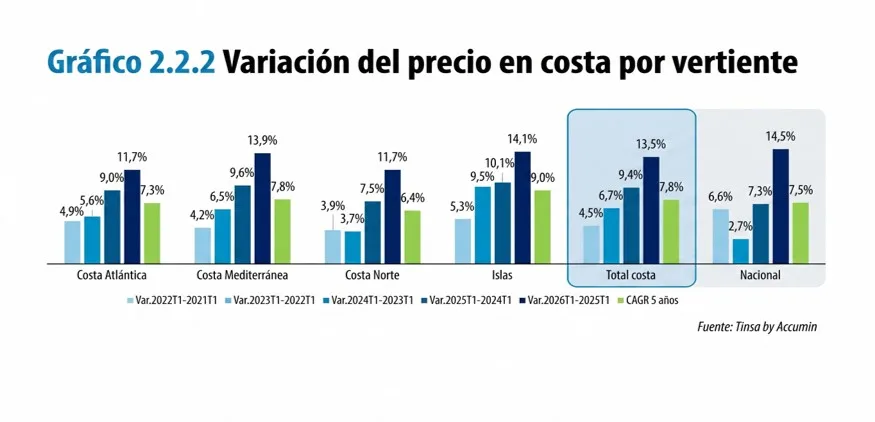
Much of the report is framed around another finding: homes on the coast are increasingly unaffordable for people on local incomes, with the theoretical cost of buying reaching 40% of average disposable household income. From there it is a short step to the familiar narrative about second homes, holiday lets and tourist demand squeezing locals out of the market.
But there is another way of reading the same numbers.
A second-home market is supposed to attract second-home buyers
Large stretches of the Spanish coast are primarily holiday, retirement and second-home markets. Comparing local salaries with the price of villas and apartments bought by wealthier households from Madrid, northern Europe or elsewhere tells us something interesting about those markets, but it does not necessarily identify Spain’s main housing problem.
The more serious affordability problem is where households need homes close to employment and services, particularly in and around major cities and other high-demand economic centres.
And here the evidence increasingly points back to supply.
The Bank of Spain describes the rigidity of Spanish housing supply as structural, citing problems developing build-ready land and the complexity of planning and land-management procedures. It says these constraints prolong construction times and identifies supply inelasticity as the main cause of housing affordability problems.
The OECD similarly identifies limited buildable land, lengthy and uncertain planning procedures, rising construction and labour costs, and regulatory uncertainty as barriers to new supply, particularly for lower-margin affordable and rental housing.
Builders follow the money
That helps explain another revealing feature of the coastal market. Although construction is increasing, much of it is concentrated on holiday homes, where developers can earn better margins. The report itself notes that new construction remains constrained by land availability, building costs, labour shortages and regulatory uncertainty, while developers favour more profitable holiday housing.
That should hardly come as a surprise. When housing is expensive, slow and risky to produce, developers have an obvious incentive to build for buyers with the deepest pockets.
Nor is restricting tourist and holiday accommodation necessarily turning those properties into ordinary homes. Despite a significant increase in regulation, the report acknowledges that this has not so far produced either more housing for permanent residents or lower prices.
The bigger story suggested by these numbers is therefore not that Spain has too many holiday homes. It is that housing supply struggles to respond to demand. The coastal luxury market is one very visible consequence of that problem, rather than necessarily its cause.
