 Mark Stücklin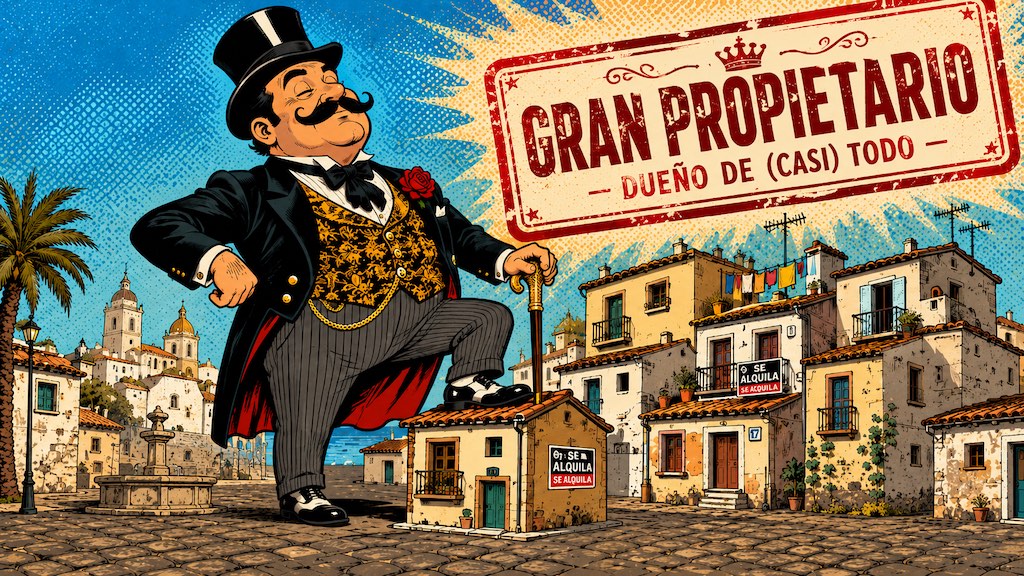
Spain has a housing crisis, so naturally some politicians have decided the answer is to make housing investment more confusing, less attractive, and morally suspect. Catalonia has turned this into something of an art form.
The legal battle over who qualifies as a “major landowner” in Spain has become one of the great absurdities of the rental market. Under the state Housing Law, the general threshold is more than ten residential properties, though this can fall to five in stressed housing markets. In Catalonia, where housing policy often appears to be written with a clenched fist, the concept has been pushed even further into farce.
In practice, depending on the rule, the authority, and the phase of the moon, someone with interests in five modest properties can be treated as a “gran tenedor” — a major landowner — with all the stigma, obligations, restrictions, fiscal punishment and reduced property rights that now come attached to the label.
This is where the policy becomes ridiculous. A person with four properties worth €10 million can remain an ordinary citizen. Someone else with minority interests in five modest homes worth a fraction of that can find themselves bundled into the same category as large landlords and investment funds. Not so much robber baron as unlucky aunt with inherited shares in flats in a family-owned building.
A policy built on suspicion
The phrase “major landowner” sounds as if it was designed to conjure up cigar-chomping speculators hoarding homes from the poor. In reality, the net can catch private individuals, families, accidental landlords, small investors and heirs who have done nothing more sinister than own, inherit, or invest in property.
Catalonia has also doubled down fiscally. Recent measures have raised the transfer tax burden on major landlords to 20% in certain cases, while rent controls, registration requirements, extended contract obligations and other interventions pile up around the same concept. The message is not subtle: own too much property — however that is defined this week — and the state will treat you as part of the problem.
Lawyers now warn that the state and Catalan definitions do not align, while questions over co-ownership, company holdings, cadastral records, land registry data and surface area create a fog of uncertainty. When professionals struggle to explain the rules, ordinary owners can hardly be expected to navigate them with confidence.
Less investment, less housing
This might be tolerable if the policy produced more homes. But Spain’s housing crisis is, above all, a shortage crisis. The country needs more rental supply, more renovation, more professional management, more private capital and more confidence. Public authorities do not have the money, speed, competence or land pipeline to replace the investment they are busy discouraging.
Instead, the system tells owners that putting homes on the rental market may mean longer contracts, tighter rent limits, more bureaucracy, higher tax, less control and greater political hostility. Then everyone acts surprised when supply falls, investment cools, and owners look for ways out of the long-term rental market.
The great irony is that policies aimed at punishing “major landowners” often hit the very people needed to increase supply: small and medium-sized investors willing to buy, renovate and rent homes. Treating them as villains may satisfy the politics of resentment, but it does not house anyone.
