 Mark Stücklin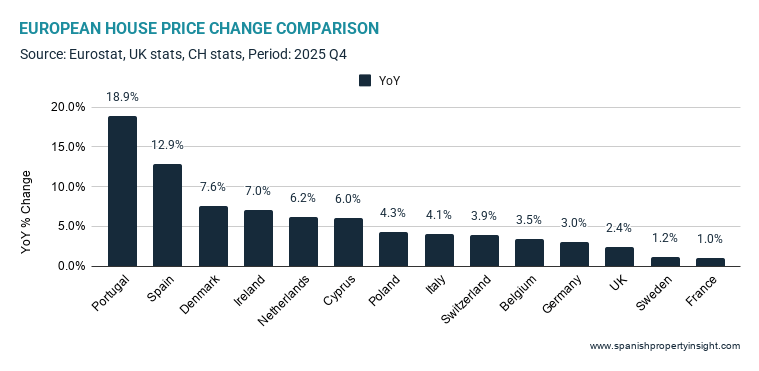
Spain continues to outperform most of Europe when it comes to house price growth, underlining just how strong demand remains for Spanish property despite affordability pressures and political noise around housing.
The latest European house price data for Q4 2025 shows Spain near the top of the continental rankings for annual price growth, beaten only by Portugal in this comparison of major markets (see chart above).
According to data from Eurostat and national statistics offices, Spanish house prices were up 12.9% year-on-year in Q4 2025, comfortably ahead of countries like Germany (3%), France (1%), Italy (4%), and the UK (2.4%).
Only Portugal, with annual growth of almost 19%, posted stronger gains in this group of countries.
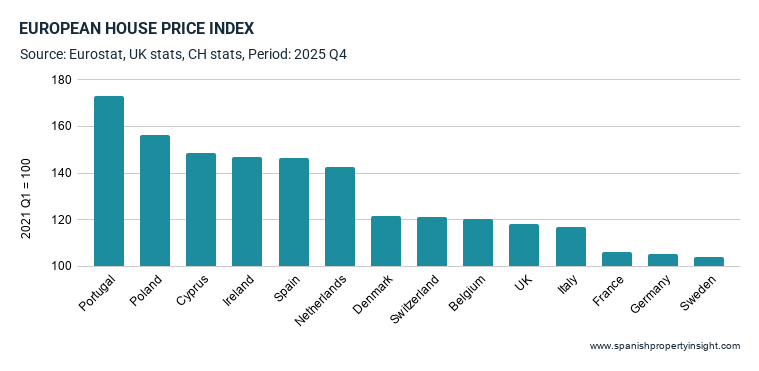
Looking at the bigger picture over five years, Spain has also been one of Europe’s strongest performers. Since Q1 2021, Spanish house prices have risen by around 46%, meaning Spain has almost kept pace with Ireland and Cyprus, and significantly outperformed France, Germany, Italy, Sweden, and the UK.
That tells an important story about the European property market since the pandemic.
Southern Europe has become Europe’s property growth engine
The strongest performers over the last five years are typically in Southern and Eastern Europe:
- Portugal: +73%
- Poland: +56%
- Cyprus: +49%
- Spain: +46%
Meanwhile, some of Europe’s traditional heavyweight markets have barely moved:
- Sweden: +4%
- Germany: +5%
- France: +6%
Germany and Sweden, which both experienced housing downturns after interest rates surged in 2022, still look surprisingly weak in five-year terms.
France stands out in particular. Once viewed as one of Europe’s safest and most stable housing markets, French house prices are now barely above where they were five years ago. That matters for Spain because France is both a competitor destination and an important source of demand for Spanish property, especially in Catalonia and the Costa Brava.
What does this mean for Spain?
For one thing, Spain increasingly looks like a relative winner in the European lifestyle and second-home market.
Compared to France, Germany, the UK, or Sweden, Spain offers:
- Better climate and lifestyle appeal
- Stronger economic momentum
- Higher inflation-driven nominal growth
- Relatively attractive prices in many regions
- A booming tourism economy supporting rental demand
That helps explain why demand from buyers in countries like the Netherlands, Germany, and the UK has remained resilient despite higher interest rates and economic uncertainty.
The Dutch housing market has also boomed over the last five years, with prices up more than 42%, potentially giving Dutch buyers plenty of housing equity to recycle into holiday homes in Spain.
British buyers, meanwhile, continue to come from a market that has seen much weaker growth, but where Spain still offers compelling lifestyle value compared to southern England.
Germany is perhaps the most interesting case. German house prices have barely risen in five years, yet Germans remain one of the biggest groups of foreign buyers in Spain. That suggests lifestyle motivations may now matter more than pure investment logic for many northern European buyers.
Portugal still leads the Iberian boom
If there’s one country making Spain look restrained, it’s Portugal.
Portuguese house prices have surged 73% in five years and almost 19% in the last year alone. That raises questions about sustainability and affordability, especially in Lisbon and the Algarve, where international demand and limited supply have driven prices sharply higher.
Spain looks comparatively balanced by comparison, though some local markets—especially Madrid, the Balearics, Málaga province, and parts of the Costa del Sol—are beginning to show similar dynamics.
Taken together, the latest figures suggest that Southern Europe remains the big winner in Europe’s post-pandemic property landscape, with Spain firmly in the leading pack rather than lagging behind it.
