 Mark Stücklin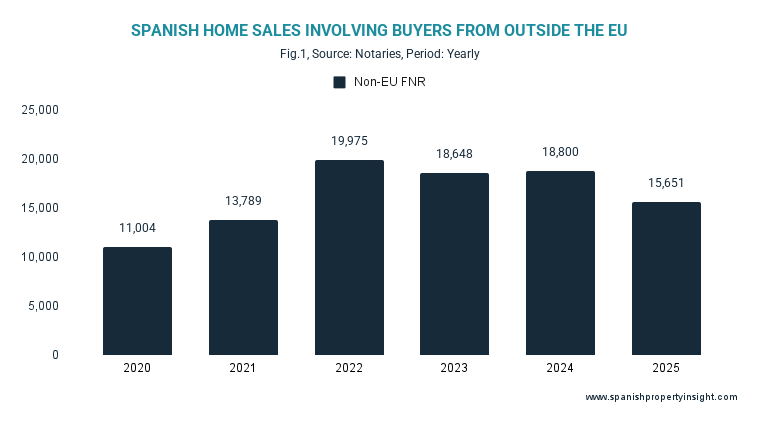
Spain’s campaign against foreign buyers may have been all talk—but the latest data suggests it still had consequences.
New figures from the Spanish Notaries Association reveal a sharp decline in home purchases by non-resident buyers from outside the EU in 2025—down 17% year-on-year. That’s a striking drop in a segment that had previously been relatively resilient.
What makes this more interesting is the timing.
At the start of the year, Spanish Prime Minister Pedro Sánchez launched a high-profile attack on this group, labelling them “speculators” and floating ideas like a 100% purchase tax or even an outright ban. None of those proposals have materialised into law. But the rhetoric was loud, clear—and widely reported.
Now the data raises an obvious question: did the message land?
A small segment, a big political target
Before jumping to conclusions, it’s worth putting this segment into perspective.
Non-EU, non-resident buyers—think British and American second-home purchasers—account for just over 11% of the foreign market, and barely 2% of the total Spanish housing market. In other words, they are highly visible, but economically marginal in the bigger picture.
That hasn’t stopped them becoming a convenient political target.
As the next two charts illustrate, the vast majority of foreign demand comes from other groups—EU buyers and expats—who are unaffected by any proposed measures. Yet it’s this small, external segment that has been singled out as a driver of Spain’s housing crisis.
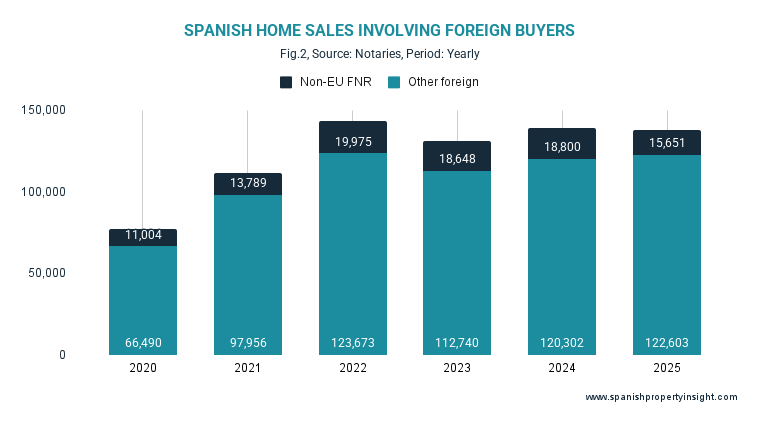
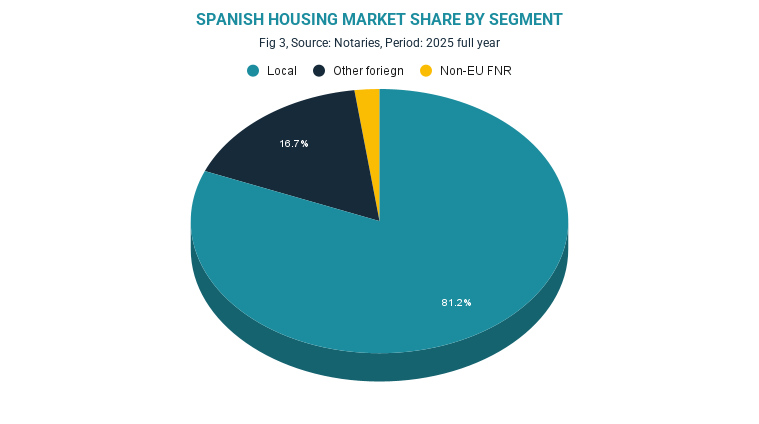
The numbers simply don’t support that claim.
Did rhetoric move the market?
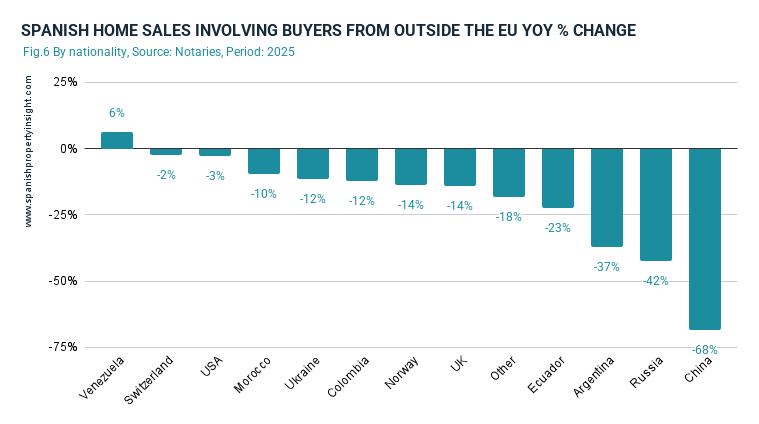
The 17% drop in 2025 suggests something changed—and quickly.
Across most non-EU nationalities, sales fell sharply, often by double digits. The only exceptions were the USA (down just 3%) and Venezuela (up 6%). Everyone else appears to have pulled back.
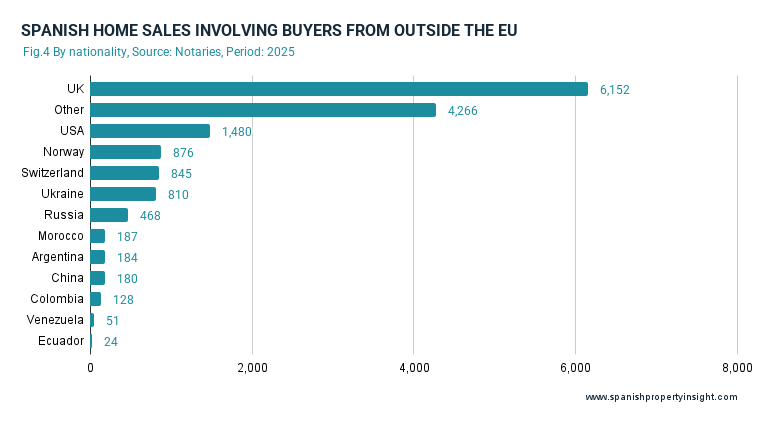
There are, of course, other factors at play. Higher prices, limited supply, and a natural cooling after the post-pandemic boom all help explain weaker demand.
But political signalling shouldn’t be dismissed.
When a government openly questions whether you should be allowed to buy property at all, it’s not unreasonable to hesitate—or look elsewhere. Buyers in this segment tend to have options, from Portugal to Italy to Greece. Spain suddenly looked less welcoming.
A solution in search of a problem
If the goal was to curb demand from non-EU second-home buyers, then arguably the rhetoric worked—at least in the short term.
But if the goal was to address Spain’s housing crisis, this changes nothing.
These buyers are overwhelmingly active in coastal and resort markets—Costa del Sol, Costa Blanca, the Balearics—not in the urban centres where affordability pressures are most acute. They are not competing with local workers for housing in Barcelona or Madrid.
So even if this segment disappears entirely, it won’t make homes more affordable where it matters most.
What it will do is weaken demand in parts of the market that depend on foreign buyers, with knock-on effects for local economies.
All talk, real impact
The irony is hard to miss.
A policy that never happened may already be having consequences. The data suggests that words alone—carefully chosen and politically timed—can influence international demand.
For now, the foreign market overall remains stable. But beneath the surface, it is shifting—and not necessarily in ways that solve the problems policymakers claim to be addressing.
