
Periodic reports on the Valencia property market (Valencia city and province)
This page offers data-driven reports on Valencia city’s property market, consolidating key data from public sources to highlight the latest trends and developments. Illustrated with charts and infographics, these reports provide critical insights into the residential real estate market of Valencia city and province. These reports are written for foreign investors, property buyers, vendors, professionals, and journalists looking for insight into Valencia’s property market to help inform big decisions with important financial consequences.
Valencia property market overview
Valencia is a prime destination for international property buyers looking for second homes, holiday properties, or investment opportunities. Renowned for its Mediterranean coastline, vibrant cultural life, and architectural heritage, the region attracts a significant share of Spain’s foreign property transactions. As one of the most dynamic housing markets in Spain, a focused report on the Valencia property market is invaluable for anyone with an interest in this region.
Located in eastern Spain, Valencia offers a diverse range of housing options, from modern apartments to restored historic homes in its iconic districts. The market presents unique opportunities and challenges worth analysing. Key districts like Extramurs, L’Eixample, and Ciutat Vella are among the most sought-after areas for buyers and investors.

The reports cover a wide range of topics to provide a comprehensive understanding of the market, including:
- Home sales across Valencia city and province.
- Foreign buyers: market share, residency status, and second-home investments.
- New-build properties: sales, pricing trends, and index data.
- House prices: general trends and specific insights into flagship districts like L’Eixample and Ciutat Vella.
- Mortgage lending: base rates, borrowing costs, and their influence on the market.
- Housing starts and key factors affecting supply and demand.
Subscribing to Spanish Property Insight provides full access to exclusive data and insights, empowering you to make informed decisions about property investments, sales, or purchases in Valencia. Stay ahead of the market—subscribe today to access the latest Valencia property market reports.
Want one-time access to the latest report without subscribing?
Fill in the form below to get access to this valuable report without subscribing.
Get the market report
"*" indicates required fields
Valencia City property market reports for previous periods
2025 Full Year
The Valencia housing market in 2025
Fill in the form above for one-off access to the latest report without subscribing.
2025 H1
Valencia housing market report – H1 2025
This report provides a data-driven overview of the housing market in Valencia province, with a particular focus on Valencia city. Based on official data sources, it covers sales, prices, mortgage lending, and construction activity in the first half of 2025. The aim is to help domestic and international market participants understand recent performance and longer-term trends in one of Spain’s most important urban housing markets.
Sales performance
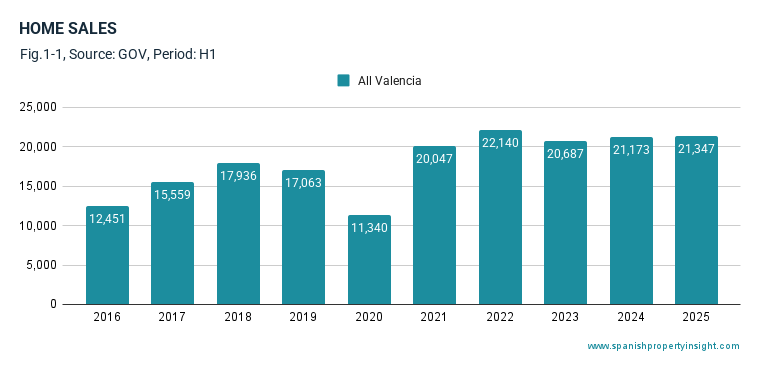
There were 21,347 home sales in Valencia province during the first half of 2025 (Fig. 1-1), representing a 1% increase year-on-year. Compared to the ten-year average, sales were 26% higher, while over the last decade transaction volumes have risen by 102%, underlining the strong structural expansion of the market.
Foreign buyers accounted for 4,097 purchases, a 5% decline year-on-year. Despite this short-term fall, foreign demand remains elevated, standing 34% above the ten-year average and 142% higher than a decade ago. By residency status (Fig. 1-2):
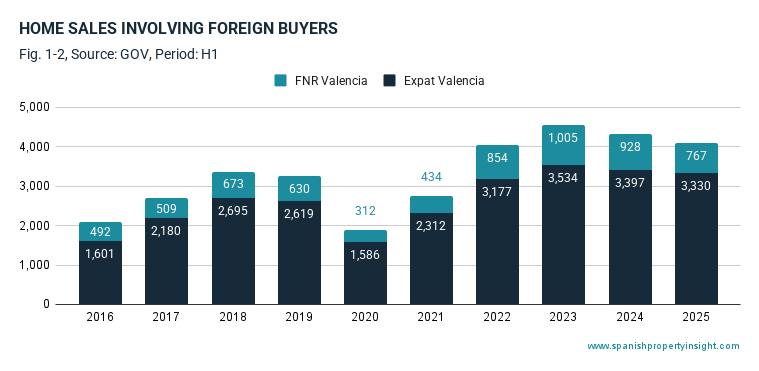
- 3,330 homes were bought by foreigners living in Spain (expats), down 2% year-on-year
- 767 homes were bought by foreign non-residents (FNRs), down 17% year-on-year
Over ten years, purchases by expats have increased by 155%, while FNR purchases are up 99%, highlighting the long-term importance of international demand, particularly resident foreigners.
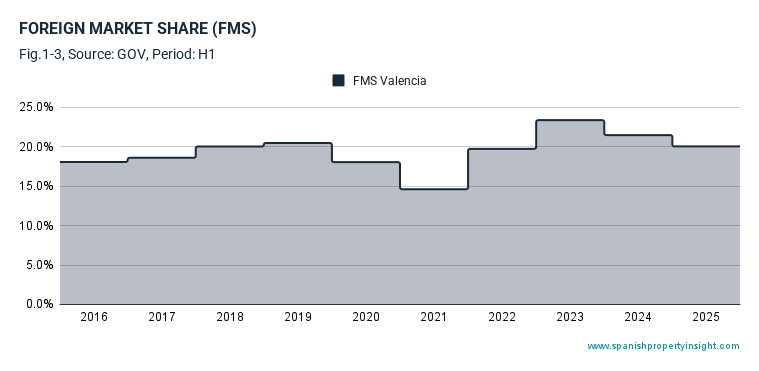
The market share of foreign buyers stood at 20% (Fig. 1-3), down from 21% a year earlier and below the highs seen earlier in the decade, reflecting a relative strengthening of domestic demand rather than a collapse in foreign interest.
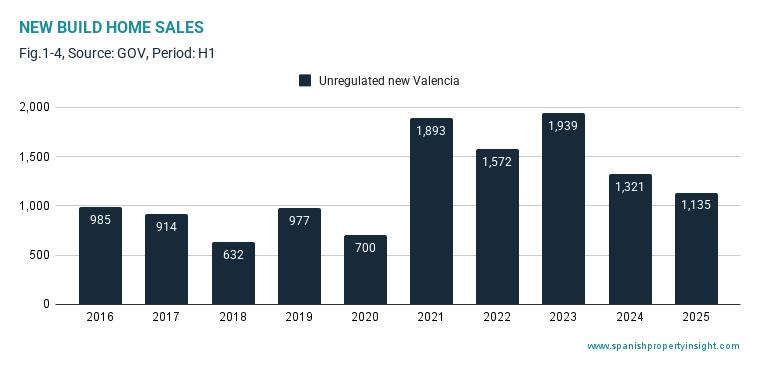
Sales of new-build homes totalled 1,135 transactions, a 14% decline year-on-year (Fig. 1-4). This was 5% below the ten-year average, though still 7% higher than ten years ago, suggesting a temporary softening after several strong years.
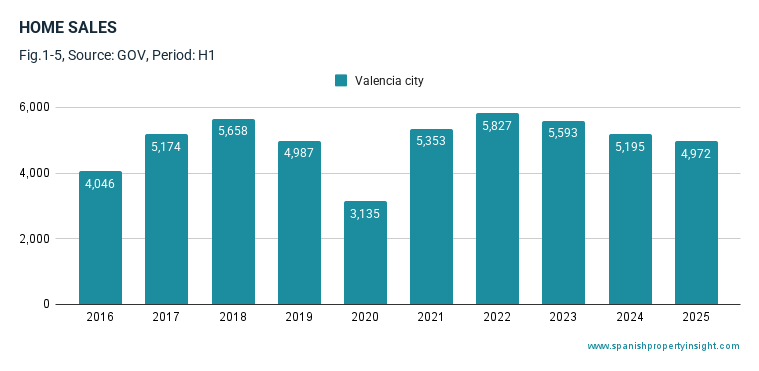
Focusing specifically on Valencia city, there were 4,972 home sales, down 4% year-on-year (Fig. 1-5). Volumes were broadly in line with the ten-year average and 23% higher than a decade ago, confirming steady long-term growth in the capital despite recent cooling.
Prices
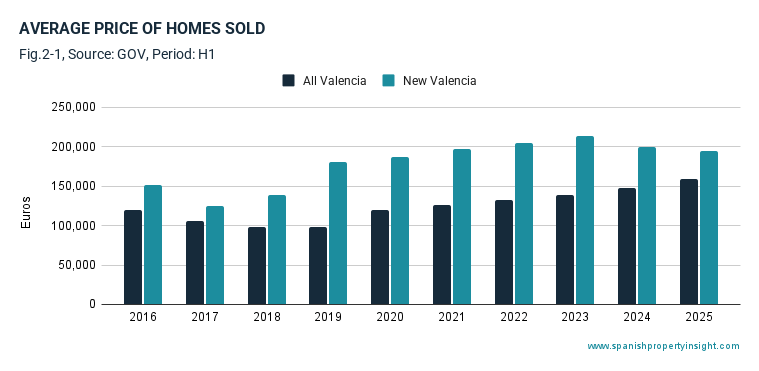
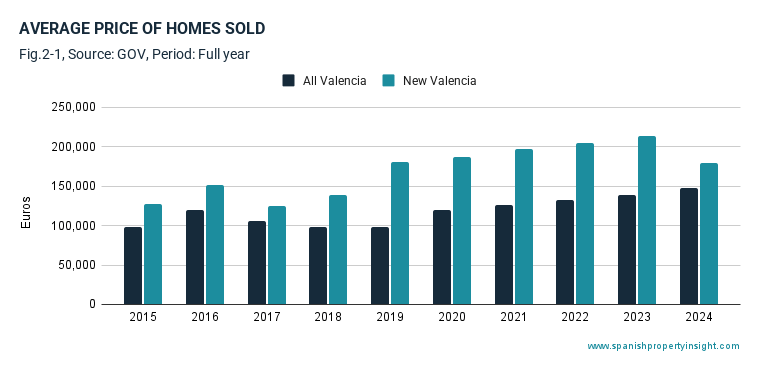
According to the Spanish Housing Ministry, the average price of homes sold in Valencia during the period was €159,086 (Fig. 2-1), an annualised increase of 7%. The average price of newly built homes was higher at €195,028, but down 2% year-on-year, pointing to short-term adjustment in the new-build segment.
Over ten years, the price index for all property has risen from 100 to 132, while the index for new homes stands at 129 (Fig. 2-2). This indicates that resale prices have increased slightly more than new-build prices over the decade. One likely explanation is stronger demand for existing homes in central urban areas, where supply is more constrained, while new-build prices have faced greater resistance in recent years due to affordability limits and softer sales.
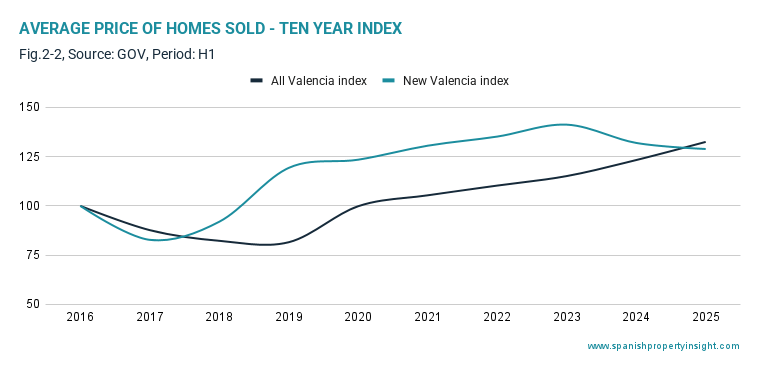
Over the last five years, prices for all property are up 33%, compared to just 4% for new homes, reinforcing the view that recent price growth has been driven primarily by the resale market.
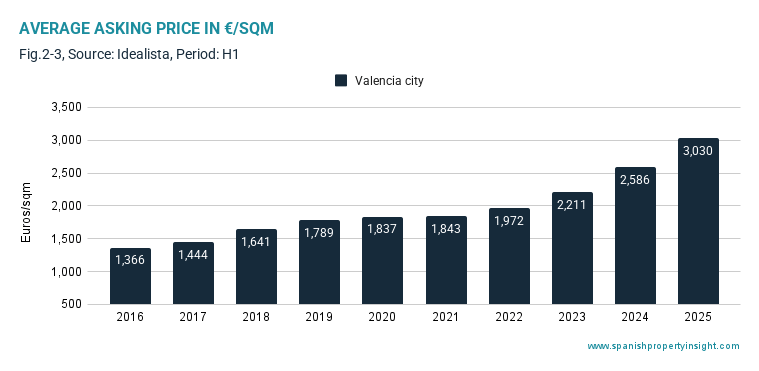
As illustrated in Fig. 2-3, asking prices in Valencia city have risen sharply. From €1,357 per square metre in 2015 to €3,030 in 2025, this represents a 123% increase over ten years and a 65% rise over five years. The steep acceleration since 2020 reflects strong urban demand, limited supply, and Valencia’s growing appeal as a lifestyle and investment destination.
Mortgage lending
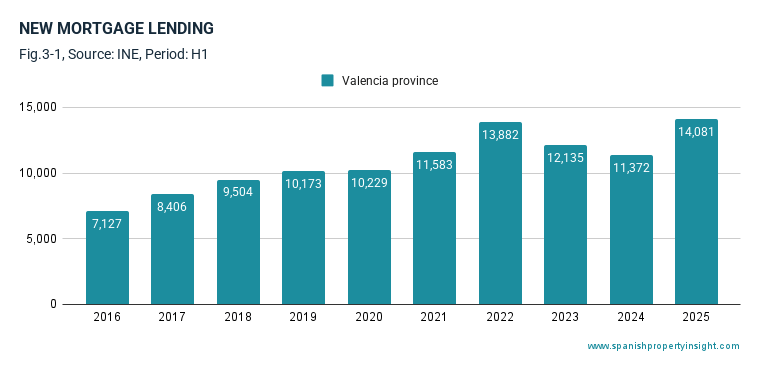
There were 14,081 new mortgages signed in Valencia province in the period (Fig. 3-1), up 24% year-on-year. Lending was 40% above the ten-year average and 137% higher than a decade ago, indicating a robust credit environment supporting transactions.
The average Euribor during the period was 2.27% (Fig. 3-2), down 38% year-on-year. This level sits well below the recent peak of 3.69% in 2023, but far above the historic low of -0.49% in 2021. The decline reflects the European Central Bank’s shift away from aggressive tightening as inflation pressures ease. During H1 2025, markets increasingly anticipated gradual interest rate cuts, which would improve affordability and support mortgage demand.

Housing starts
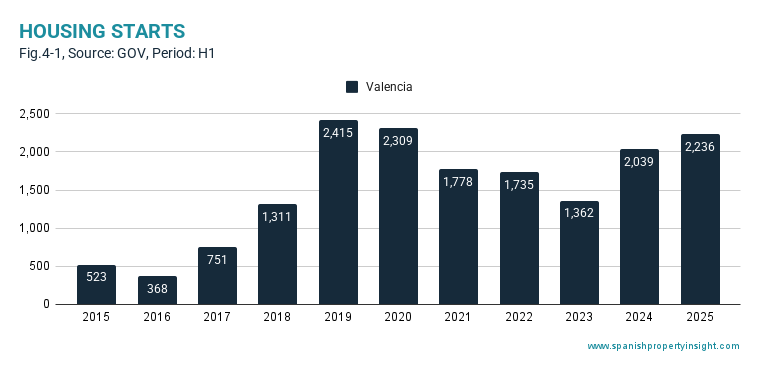
There were 2,236 housing starts based on planning approvals in Valencia during the period (Fig. 4-1), up 10% year-on-year. This represents a 53% increase compared to the ten-year average and a rise of 328% over the decade, highlighting a strong long-term recovery in development activity, albeit from a low base.
Outlook
The Valencia housing market enters the second half of 2025 in a position of relative strength. Sales volumes remain historically high, price growth in the city continues to outpace national averages, and mortgage lending is recovering as interest rates ease. While foreign buyer activity has softened in the short term, long-term trends remain supportive, particularly among resident foreigners. The key risks to monitor are affordability constraints, the pace of interest rate cuts, and whether the recent increase in housing starts translates into meaningful additions to supply. Overall, market conditions point to continued stability rather than a sharp slowdown.
2024 Full Year
[membership level=”0,-9″]
Fill in the form above for one-off access without subscribing.
[/membership] [membership level=”9″]
The Valencia city housing market in 2024 showed steady resilience, supported by robust demand from both domestic and foreign buyers, stable sales volumes, and a healthy pipeline of new housing development. While total sales remained broadly in line with the previous year, long-term growth trends remained positive, particularly in the resale segment. Property prices continued to edge upward overall, with asking prices in the city rising sharply. Meanwhile, the mortgage market held firm despite elevated interest rates, and new housing starts surged, reflecting growing confidence among developers. This report explores the key indicators and trends that defined Valencia’s property market over the past year.
Sales performance
The residential property market in Valencia province saw marginal growth in 2024, with total home sales reaching 42,120, representing a year-on-year increase of 7% (Fig. 1-1). This figure was 24% above the ten-year average and 94% higher than ten years ago, demonstrating a robust long-term upward trend.

Foreign demand
Foreign buyers continued to play a key role in the market, accounting for 8,540 transactions, up 1% year-on-year and 38% above the ten-year average, marking a 136% increase over a decade. Within this group, resident foreigners (expats) made up 6,645 of the purchases—up 2% year-on-year—while non-resident foreign nationals (those buying second homes or investment properties) accounted for 1,895, showing a slight decline of 1% (Fig. 1-2).

While foreign demand remains a significant driver, the market share of foreign buyers declined to 21% from 23% a year ago (Fig. 1-3), reflecting stronger relative activity from domestic buyers or a modest cooling in foreign demand.

New-build sales
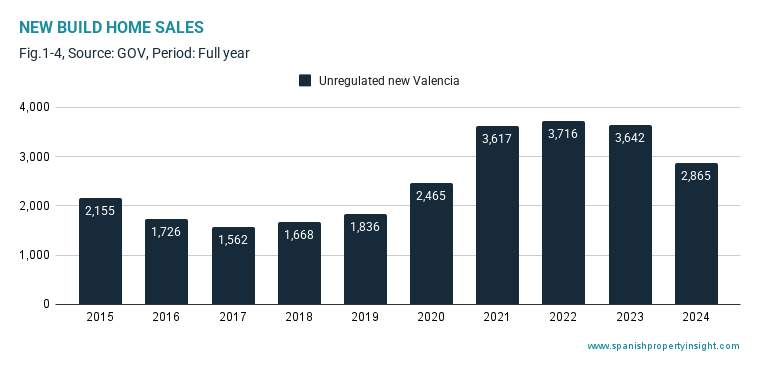
New builds saw a notable contraction in 2024, with just 2,865 units sold—a steep 21% decline year-on-year—though still 33% above the ten-year average (Fig. 1-4). Over ten years, sales in this segment have increased by 13%, suggesting longer-term market resilience despite short-term volatility.
Valencia city home sales
In Valencia city specifically, there were 10,236 home sales—a 3% decrease on the previous year and the second consecutive annual decrease (Fig. 1-5). However, sales were still 6% above the ten-year average and nearly 50% higher than a decade ago, reaffirming the city’s continued appeal to both domestic and international buyers.

House price trends
The average sale price of a home in Valencia province in 2024 reached €148,112, reflecting a modest annual increase of 7% (Fig. 2-1). In contrast, newly-built homes averaged €178,786—a sharp 16% year-on-year decline, indicating potential price corrections in that segment. A similar decline in new build house prices in 2024 has been seen in other areas of Spain.
Over the last decade, the price index for all property types rose from 100 to 151.2—an increase of 51%—while the index for new builds grew to 140.8, representing a 41% rise (Fig. 2-2). So thanks to the decline in new home prices in 2024, resale property prices have outpaced new builds in relative terms, perhaps due to stronger demand in consolidated neighbourhoods or limitations in new supply inflating values in the resale segment.
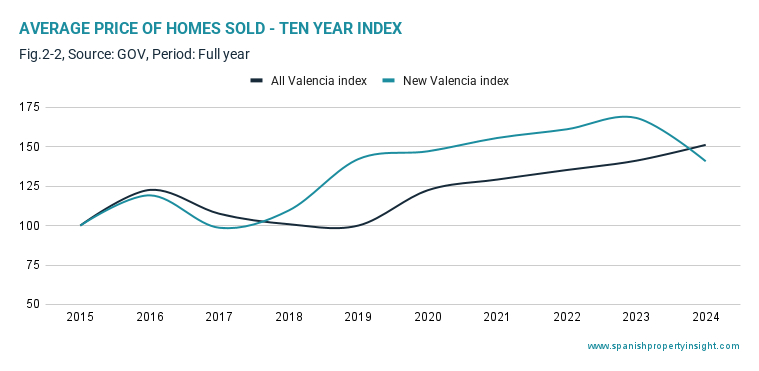
Looking just at the past five years, prices for all property rose by 51%, whereas prices for newly-built homes saw a slight decline of 1%. This disparity could reflect demand-side preferences, construction delays, or shifting buyer priorities away from new developments.
Asking prices in Valencia city
According to data from the property portal Idealista, asking prices in Valencia city, averaged €2,586 per square metre at the end of 2024, marking a 17% year-on-year increase (Fig. 2-3). Over the past five years, asking prices have risen 45%.
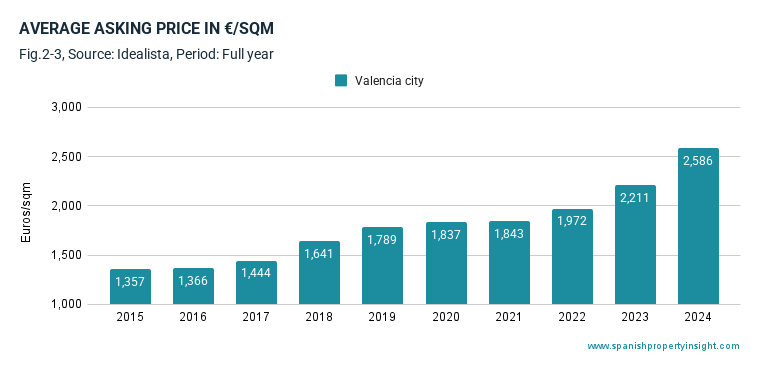
Over ten years there has been growth of over 90% in advertised prices in Valencia city. This strong growth outpaces that of actual transaction prices and may reflect optimistic seller expectations or the influence of high-demand, high-end districts.
Mortgage market
In 2024, 20,263 new mortgages were signed in the province, a 6% decrease year-on-year (Fig. 3-1). However, this remains 5% above the ten-year average, and mortgage market activity has grown by 69% compared to a decade ago.

The average 12-month Euribor—the benchmark rate for most mortgages in Spain—stood at 3.27% in 2024 (Fig. 3-2), down from its recent peak of 3.86% in 2023. This slight decline represents a 15% reduction year-on-year. The current rate contrasts starkly with the historical low of -0.49% in 2021, marking the end of a long cycle of ultra-low interest rates brought on by the European Central Bank’s (ECB) quantitative easing in response to the pandemic.
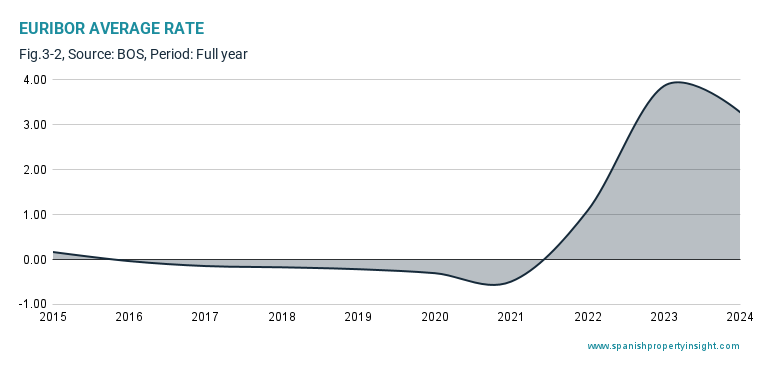
As inflation stabilises across the eurozone, the ECB has signalled a more dovish stance in monetary policy, and markets widely expect further rate cuts in the coming quarters. Should this materialise, lower borrowing costs could help invigorate demand among local buyers who rely on financing.
Housing starts
There were 4,273 housing starts (planning approvals) in 2024 across Valencia province—a 17% rise over the previous year (Fig. 4-1). Compared to the ten-year average, this is a 43% increase, and represents a remarkable 545% rise over ten years, pointing to significant recovery in development activity post-financial crisis.

The strong increase in approvals indicates developer confidence and could help ease supply constraints, especially in high-demand urban and coastal areas.
Summary
- Total home sales in Valencia rose 7% in 2024, with foreign buyers accounting for 21% of the market.
- Sales of new builds declined 21% year-on-year, but remain strong over the long term.
- Property prices rose 7% overall. New-build prices fell 16%, while resale homes led growth.
- Asking prices in Valencia city rose 17% year-on-year, and nearly doubled over ten years.
- New mortgage lending dropped 6% from the previous year but remains well above the decade average.
- Euribor fell slightly after peaking in 2023, pointing towards easing borrowing costs.
- Planning approvals rose 17% in 2024 and are more than five times higher than a decade ago.
Conclusion
The Valencia property market in 2024 demonstrated mixed results. Overall sales were stable with modest year-on-year growth, though structural changes point to evolving demand patterns—particularly in the foreign and new-build segments. Price growth remains firm in the resale market, especially in Valencia city, but the new-build sector showed signs of correction.
Mortgage activity contracted slightly, although falling interest rates are poised to support buyer confidence moving forward. Meanwhile, the sharp rise in housing starts signals robust pipeline development, which may help moderate future price inflation.
Looking ahead, the market appears to be adjusting from boom-year dynamics fuelled by historically low interest rates. With the ECB expected to begin a rate-cutting cycle and foreign interest still strong, Valencia is likely to remain one of Spain’s most attractive property destinations. However, supply constraints, global economic trends, and evolving buyer preferences will shape outcomes in the coming years.
[/membership]
Disclaimer
These reports are prepared in good faith using publicly available data. While efforts are made to ensure accuracy, no guarantees are provided regarding the completeness, reliability, or suitability of the information for any purpose. Use of this information is at your own risk.
