
The German market for Spanish property
Annual reports on the Spanish property market segment involving buyers from Germany giving you a quick overview of the key trends each year and how German demand compares with other major international markets for residential real estate in Spain.
2024 Full Year
The German market overview: German demand for Spanish property in 2024
This report provides an overview of German demand for Spanish property during the full year of 2024, using data primarily sourced from the Association of Spanish Notaries. It examines total sales, trends by residency status, expenditure patterns, and foreign market share. The report also places German buyer activity in a broader international context and explores key economic and regulatory factors affecting demand. Designed for property professionals, investors, and market observers, the analysis offers insights into how the German market segment has evolved and where it may be heading.
Sales performance
In 2024, buyers from Germany purchased a total of 9,360 properties in Spain (Fig. 1.) This represents a slight annual decrease of 3% compared to the previous year. When compared to the ten-year average, German purchases were marginally higher, rising by 0.1%.
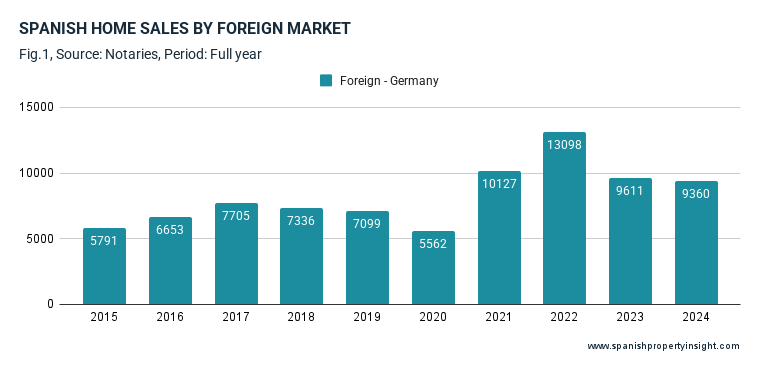
The data suggests that, although there was a minor contraction in the market in 2024, German demand for Spanish property has remained relatively stable over the long term.
Sales by residency status
Breaking the market down by residency status, foreign non-residents (FNRs) accounted for the majority of purchases, with 6,749 sales. This segment experienced a 2% decrease year-on-year but posted growth of 0.2% compared to the ten-year average (Fig. 2).
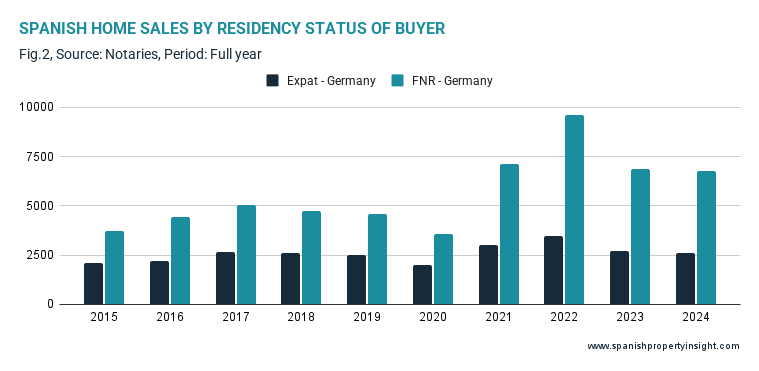
Meanwhile, German expatriates living in Spain bought 2,611 properties in 2024. This group saw a steeper annual decline of 4%, although compared to the decade-long average, sales were largely unchanged, rising by just 0.01%.
Looking at the ten-year evolution through an index (Fig. 3), sales activity among all German buyers has increased by 62% over the period, with the index rising from 100 to 162. FNRs saw even more substantial growth, with an increase of 82%, while expatriate purchases grew by 26%.
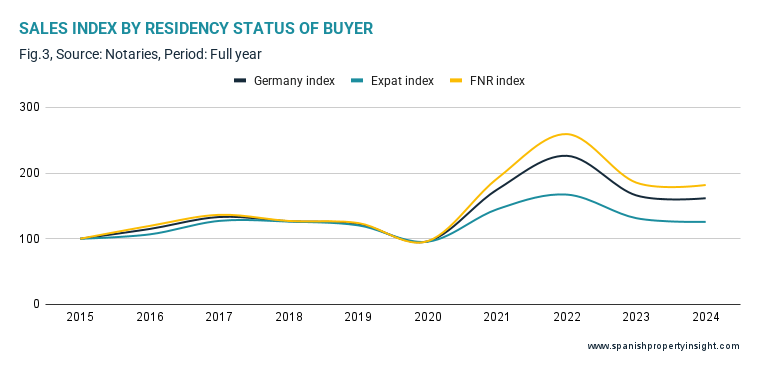
For readers unfamiliar with indices: an index shows how a value has changed over time relative to a starting point, which is usually set to 100. An index of 162 means that sales have increased by 62% compared to the starting point. These indices reveal that in the last decade, German non-residents have become a stronger force in the market, while expatriate demand has grown more modestly.
Foreign market share (FMS)
The foreign market share of German buyers declined slightly to 6.7% in 2024 from 7.0% the previous year (Fig. 4).
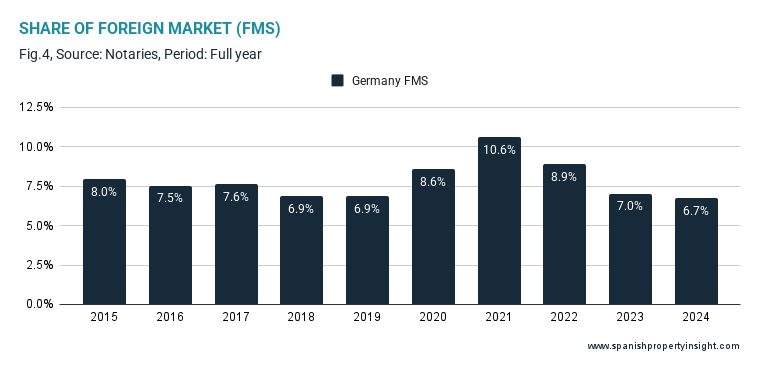
Over the past decade, the market share has fluctuated between a high of 10.6% and the current low of 6.7%, marking a significant decline from peak levels. This indicates that while Germany remains a key foreign market for Spain, its share of foreign demand has softened.
Expenditure trends
In 2024, German buyers paid an average of €3,114 per square metre for property in Spain. This reflects a 14% increase compared to the previous year, suggesting that while transaction volumes declined slightly, buyers were still spending significantly more on their acquisitions.
The rise in average expenditure could point to German buyers favouring higher-quality properties or more premium locations compared to previous years.
Relative performance
The final three charts presented in this report compare key metrics across nationalities:
- Total sales volume by nationality
- Year-on-year change in sales by nationality
- Foreign market share for all nationalities
These visualisations provide comparative context, helping to assess the UK’s performance in relation to other important foreign markets in Spain. Readers can use these charts to gauge how British demand measures up against other nationalities in terms of strength, direction, and market share.


Market drivers
Several factors contributed to the downturn in German demand for Spanish property in 2024:
- Domestic market challenges: Germany’s property market experienced a notable crisis, with falling house prices and broader economic uncertainty. These conditions affected both financial confidence and liquidity, reducing Germans’ capacity or willingness to invest in overseas property, including in Spain.
- Political and regulatory sentiment: Rising backlash against foreign buyers, particularly in popular areas like Mallorca, where German buyers have traditionally been a dominant group, likely had a disproportionate impact on this market segment.
Together, these factors help explain why German demand softened both in absolute terms and as part of the broader foreign market.
Conclusion
In summary, German demand for Spanish property in 2024 remained relatively resilient compared to the long-term trend, though it saw a modest year-on-year decline in sales. Non-resident German buyers demonstrated stronger growth than expatriates over the past decade, and spending levels rose sharply even as overall transaction numbers dipped.
External challenges in Germany’s domestic market and growing resistance to foreign buyers in certain Spanish areas are influencing demand patterns. Moving forward, unless economic conditions in Germany improve and regulatory tensions ease, it is likely that German demand will remain subdued compared to historical highs, even if underlying interest in Spanish property persists.
2024 H1
2,972 Spanish home sales inscribed in the Land Registry in the first half of 2024 (H1) involved a German buyer, down 12pc compared to the same period in the previous year, yet 17pc above the ten-year average, and the third best H1 on record for German buyers in Spain.

The Germans were the second biggest group of foreign buyers of property in Spain in H1, behind the British and ahead of the French.

The market share of German buyers (as a percentage of the overall number of foreigners buying property in Spain) fell to 6.9pc, down from a high of 9.3pc in 2022.

Looking at the year-on-year percentage change in sales in both H1 and Q2 compared to other countries, Germany was one of the markets to see the biggest decline in H1, behind only France and Russia, but the Q2 decline fell to -8pc, which was the second smallest decline in the period, suggesting a more positive trend developing as the year progresses.

Where do the Germans buy homes in Spain? There are no figures yet for H1 2024 but the picture from 2023 will be broadly similar, as illustrated by the final chart below.

Why are fewer Germans buying property this year? German buyer numbers surged in the wake of the pandemic, so to some extent a correction was inevitable. Amongst other headwinds and tailwinds it also looks like falling house prices back in Germany might be having a negative impact on the number of German buyers heading to Spain this year.
