
Are you thinking of selling your property in Spain?
Whether you are thinking of selling or simply want to understand the market around one of your most valuable assets, an SPI personalised market report gives you unique, expert insight into your local market segment and what it means for you, so you can make informed decisions. Fill in this form to find out more.
The Valencia housing market in 2025
The Valencia housing market performed well in 2025, with steady growth at both the provincial and city level. Most of the data in this report refers to Valencia province rather than Valencia municipality, but the capital is the economic and demographic centre of the region and tends to set the tone for wider market trends. Although Valencia city accounts for roughly a quarter of provincial sales, its size, population, and international profile mean provincial data broadly reflects conditions in the city market. Where available, this report also includes figures looking specifically at sales in Valencia municipality.
Sales
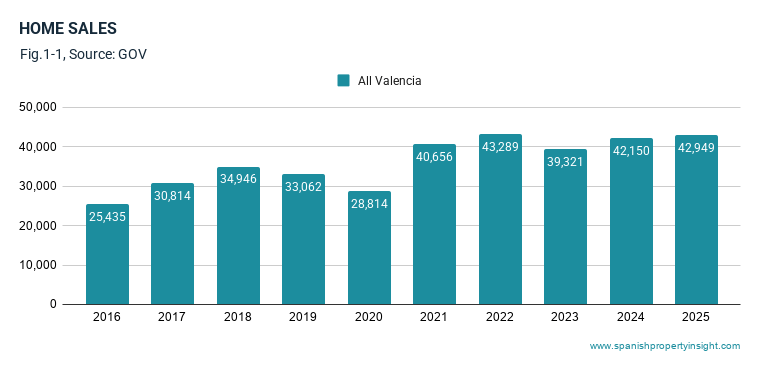
There were 42,949 home sales in Valencia province in 2025, up 2% year-on-year, 26% above the ten-year average, and 98% higher than ten years earlier. As illustrated in Fig. 1-1, that points to a market that continued to perform at a historically elevated level, even if annual growth was modest.
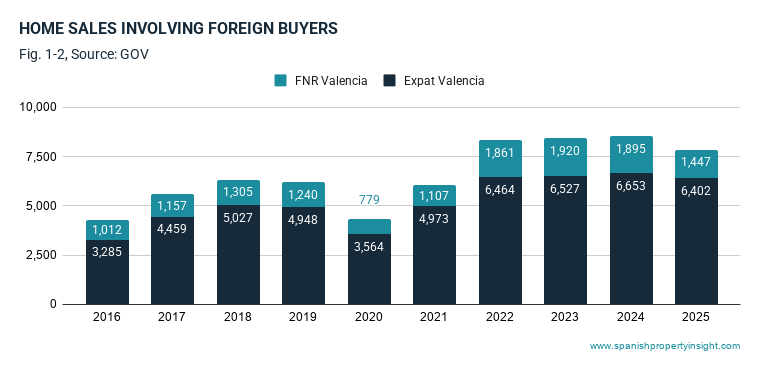
Foreign buyers accounted for 7,849 purchases in the period, down 8% on the year, though still 27% above the ten-year average and 117% higher than a decade ago. This demand was led by 6,402 foreign buyers resident in Spain, down 4% year-on-year but up 133% over ten years, while 1,447 foreign non-resident buyers were down 24% on the year and up 67% over the decade. As shown in Fig. 1-2, foreign demand weakened in annual terms but remained structurally important.
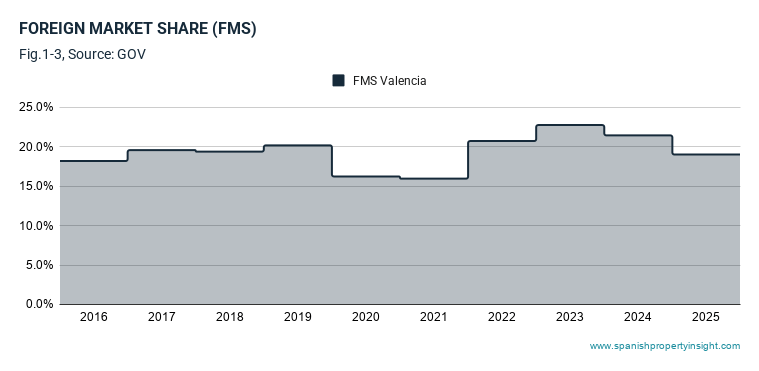
The foreign market share in Valencia was 19% in 2025, down from 21% a year earlier, as illustrated in Fig. 1-3. Even with that decline, nearly one in five purchases still involved an overseas buyer, underlining the continued relevance of international demand to the market.
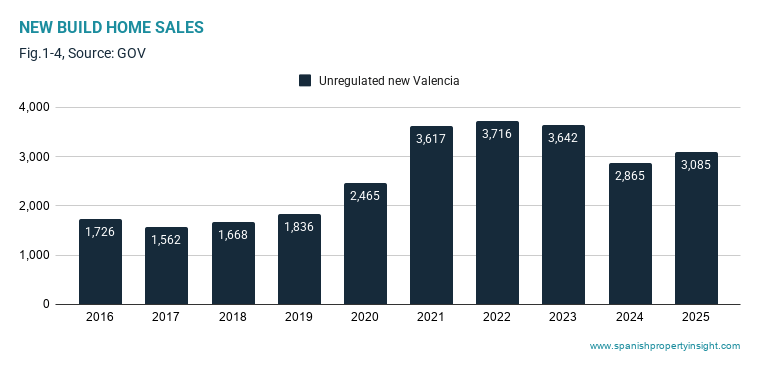
There were 3,085 new-build sales in the period, up 8% year-on-year, 22% above the ten-year average, and 43% higher than ten years ago. As illustrated in Fig. 1-4, new homes remained a relatively small but growing part of the market, supported by improving delivery and demand for more modern stock.
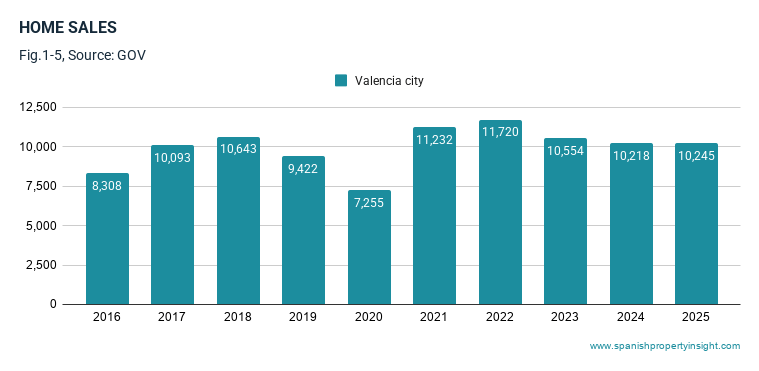
Looking just at sales in Valencia city there were 10,245 home sales in 2025, broadly flat on the year with growth of just 0%, 3% above the ten-year average, and 23% higher than ten years ago. As shown in Fig. 1-5, the city market was notably steadier than the wider provincial market, suggesting a mature urban core with less cyclical movement.
Prices
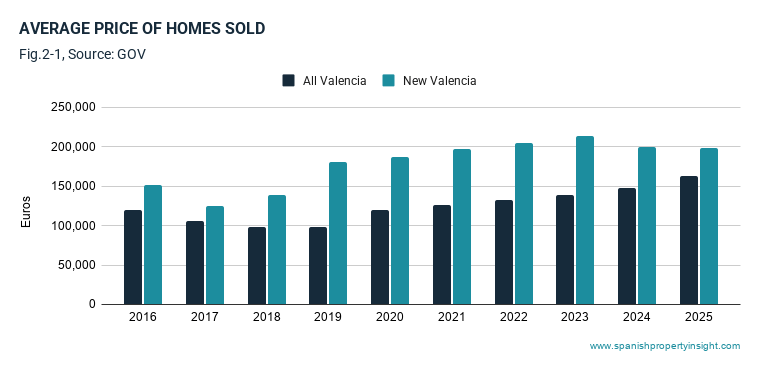
According to figures from the Spanish Housing Ministry, the average price of homes sold in Valencia in the period was €162,901, up 10% year-on-year, whilst the average price of newly-built homes sold was €198,080, down 1% on the year. As illustrated in Fig. 2-1, the price gap between all homes and new homes remained significant, but the stronger annual growth came from the market as a whole rather than the new-build segment.
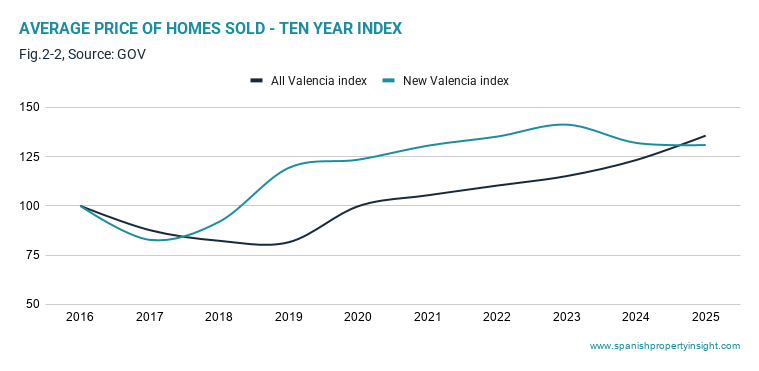
A ten-year index of prices for Valencia rose from 100 to 136 for all homes and to 131 for new homes, as illustrated in Fig. 2-2. In other words, all-property prices increased by around 36% over the decade, slightly more than the 31% increase for new homes. Over five years, the gap was wider, with all-property prices up 36% compared to just 6% for new homes. This suggests resale housing outperformed new builds, probably because tight supply in established locations pushed up second-hand values more strongly, while the new-build series may have been held back by product mix, where schemes were built, and a higher starting price base.
Mortgages and financing conditions
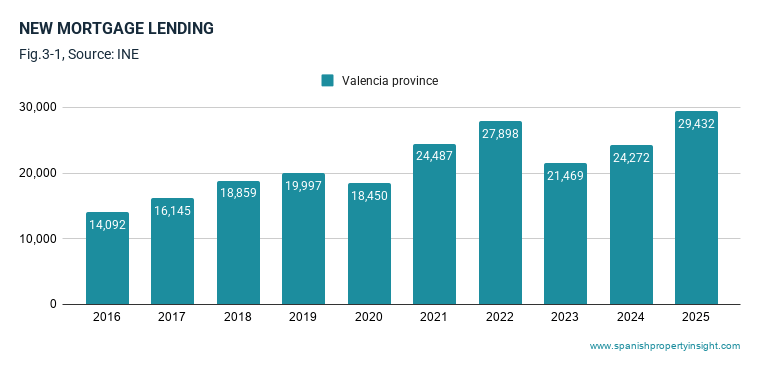
There were 29,432 new mortgages signed in Valencia province in 2025, up 21% year-on-year, 49% above the ten-year average, and 146% higher than ten years earlier. As shown in Fig. 3-1, mortgage lending recovered strongly, indicating that financing demand improved materially during the year.
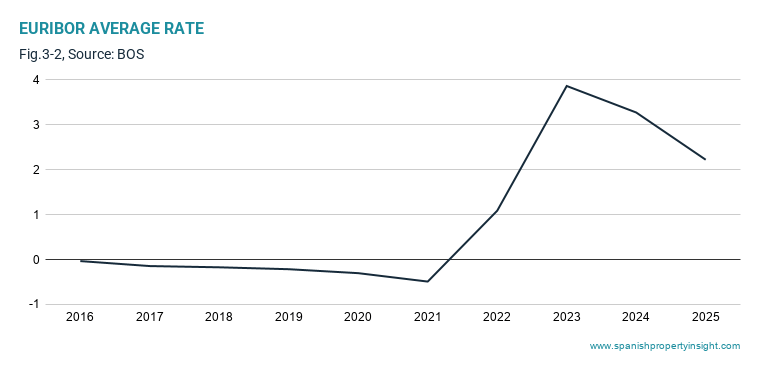
The average Euribor in the period was 2.22%, down 32% year-on-year. That left it well below the ten-year high of 3.86% in 2023 and far above the low of -0.49% in 2021, as illustrated in Fig. 3-2. Borrowing conditions therefore eased significantly from the recent peak, helping to support mortgage activity, though they remained much tighter than in the ultra-low-rate years. During 2025 the ECB cut its deposit facility rate in stages from 3.00% at the start of the year to 2.00% by June, and then kept rates unchanged through September and December as inflation moved close to target. Economists polled by Reuters in March 2026 still mostly expected the ECB to keep rates on hold through 2026, although some now saw a risk of hikes later in the year.
Housing starts
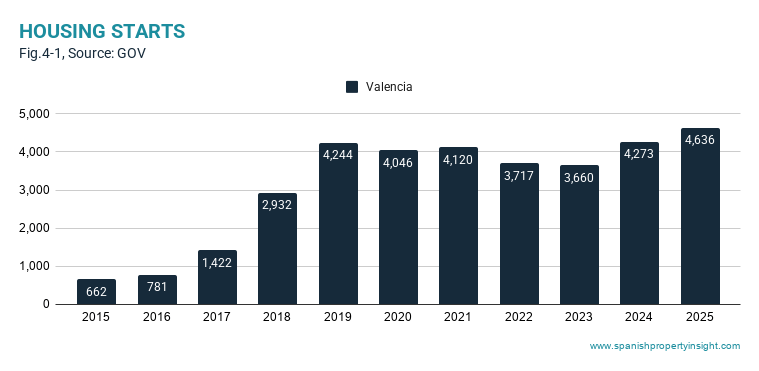
There were 4,636 housing starts based on planning approvals in Valencia in 2025, up 8% year-on-year, 55% above the ten-year average, and 600% higher than ten years ago. As illustrated in Fig. 4-1, residential development has recovered dramatically from very low levels, though the absolute volume still looks modest relative to the size of the market and its long-term demand drivers.
Summary
The Valencia housing market performed well in 2025, with sales holding up, prices rising strongly, mortgage lending rebounding, and housing starts continuing to recover. Foreign demand softened compared to the previous year, especially amongst non-resident buyers, but remained a major pillar of the market. Lower Euribor helped improve financing conditions, while limited supply in established areas appears to have supported price growth, particularly in the resale segment. The main opportunity ahead is that easier borrowing and still-solid underlying demand could support further activity, but risks remain around international demand, affordability, and whether new supply can expand fast enough to relieve pressure on prices.
