
Are you thinking of selling your property in Spain?
Whether you are thinking of selling or simply want to understand the market around one of your most valuable assets, an SPI personalised market report gives you unique, expert insight into your local market segment and what it means for you, so you can make informed decisions. Fill in this form to find out more.
East Costa del Sol housing market report – H1 2025
Sales performance

There were 18,360 home sales in Malaga province (home to the East Costa del Sol) during the first half of 2025 (Fig. 1‑1), a year-on-year decline of 1%. Compared to the ten-year average, this was an increase of 12%, and over the decade, sales have grown by 32%.
Foreign buyers accounted for 7,103 purchases, a small increase of 0.4% year-on-year (Fig. 1-2).

Compared to the ten-year average, this segment grew by 18%, and over the decade by 21%. By residency:
- 2,104 homes were bought by foreigners living in Spain (expats), up 2% year-on-year.
- 4,999 homes were bought by foreign non-residents (FNR), down 0.3% (Fig. 1‑2).
Over the last ten years, expat purchases have increased by 41%, while FNR purchases are up 14%.
The market share of foreign buyers stood at 39% (Fig. 1‑3), slightly above the same period last year (38%), showing that international demand remains a defining feature of the West Costa del Sol market.

New-build sales reached 2,296 units, up 12% year-on-year (Fig. 1‑4). Compared to the ten-year average, this represents an increase of 27%, and over the full decade, new-build transactions have risen by 72%—highlighting the growing importance of newly constructed homes in the sales mix, especially in areas with limited resale supply.

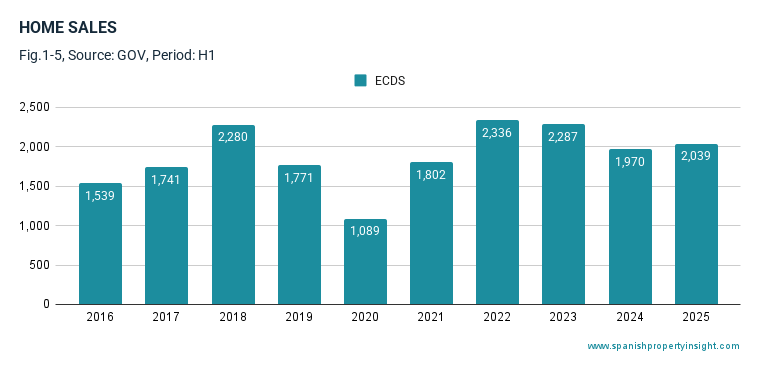
Looking just at the East Costa del Sol municipalities*, there were 10,056 home sales, total home sales reached 2,039, representing a 4% increase year-on-year (Fig. 1-5). Compared to the ten-year average, sales were 9% higher, underlining the market’s structural foundations. Over the past decade, transaction volumes have increased by 33%, highlighting the long-term expansion of housing demand in this part of Málaga province. That said, sales are still below the boom years of 2018 and 2022.
Price trends
According to the Spanish Housing Ministry, the average sale price in Malaga province reached €337,331, representing an annual increase of 7% (Fig. 2‑1). For newly built homes, the average price was €413,350, down 1% compared to H1 2024.

A ten-year index shows overall property prices have risen from 100 to 202, while new-build prices have increased to 213 (Fig. 2‑2). This indicates that resale properties have caught up with or even outperformed new builds in recent years. While new-build prices surged earlier in the cycle, strong demand and limited stock have driven up prices for existing homes, closing the gap.

Over five years, all property prices have risen by 48%, while new-build prices have increased by 45%.
Asking price trends on the East Costa del Sol represented by Nerja
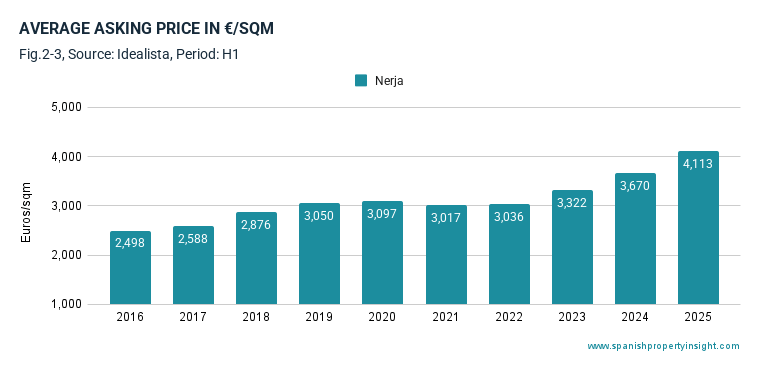
According to figures from the Spanish property portal Idealista, the average asking price for property for sale in Nerja stood at €4,113 per square metre, representing an annualised increase of 12% (Fig. 2-3).
Over ten years, asking prices have more than doubled in Marbella (+127%), risen by 155% in Estepona, and by 111% in Benahavís—highlighting the long-term appreciation in some of the coast’s most sought-after municipalities.
Mortgage activity
A total of 10,739 new mortgages were signed in Malaga province during H1 2025 (Fig. 3‑1), an increase of 19% year-on-year. This was 20% above the ten-year average and 82% higher than a decade ago—showing ongoing momentum despite recent rate pressures.

The average Euribor rate in the period was 2.27% (Fig. 3‑2), significantly lower than the 2023 high of 3.69% and well above the 2021 low of -0.49%. This sharp drop reflects a shift in European Central Bank (ECB) policy, with rate cuts introduced in the first half of 2025 as inflation came back under control. Markets expect further easing in the second half of the year, which could support additional lending and demand.

Construction activity
There were 5,157 housing starts approved in Malaga province during H1 2025 (Fig. 4‑1), up 6% year-on-year. This figure is 71% above the ten-year average and 621% higher than the low point of 2015, when only 628 starts were recorded.

Although starts have surpassed recent years, they still lag behind pre-pandemic levels, such as 2019 when there were 5,580 new approvals. The industry continues to face challenges related to build costs, labour shortages, and permitting delays, particularly acute in high-demand coastal areas like the West Costa del Sol.
Conclusion
Overall, the East Costa del Sol market entered the second half of 2025 on solid footing. Sales activity has eased slightly at the provincial level but continues to outperform long-term averages, with the eastern municipalities showing steady year-on-year growth despite remaining below previous cycle peaks. Foreign demand remains a structural pillar of the market, new-build homes are gaining importance, and price pressures persist amid limited supply. With mortgage activity rebounding and interest rates easing, underlying conditions point to continued resilience rather than a sharp slowdown in the period ahead.
* The municipalities included in this analysis are: Benahavís, Benalmádena, Casares, Estepona, Fuengirola, Manilva, Marbella, Mijas, and Torremolinos.
Previous reports
The East Costa del Sol property market in 2024 showed steady growth, driven by strong demand for new builds and continued interest from both local and international buyers. While overall sales rose slightly, there was a modest decline in sales within the core ECDS municipalities. Foreign buyer activity remained significant, although their market share dipped slightly. Price trends stayed positive, particularly for new properties, and construction levels reached a decade high. This report offers a concise overview of the region’s housing market in 2024, focusing on sales performance, pricing, mortgages, and development trends.
Sales performance
The East Costa del Sol (ECDS) is part of Malaga province where the data allows us to breakdown the market into segments such as local, foreign and new build sales, so first let’s look at sales in Malaga province before going onto sales in the municipalities of the ECDS (Rincón de la Victoria, Vélez-Málaga, Torrox and Nerja).
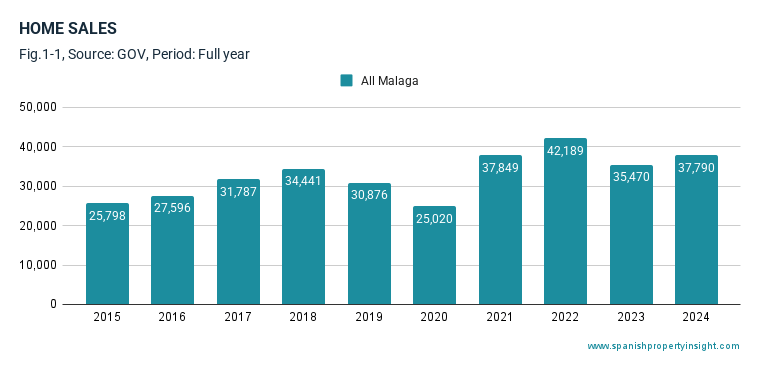
In Málaga province the housing market recorded a total of 37,790 home sales in 2024, showing a marginal increase of 7% year-on-year (Fig. 1-1). This figure was 15% higher than the ten-year average and represented an overall increase of 46% compared to a decade ago, reflecting sustained interest in the region’s property market.
Foreign buyers accounted for 14,475 sales—or 39% of all transactions—during the year (Fig. 1-2). This segment posted a 5% rise from 2023 and a strong 19% jump compared to the ten-year average. Over the past decade, foreign ownership has grown by 32%, underlining the area’s enduring appeal among international buyers. Within this group:
- 3,963 sales involved foreign residents (expats), representing a 3% year-on-year decline
- 10,512 were foreign non-residents (FNRs), who bought primarily for holiday use or investment, marking an increase of 8%
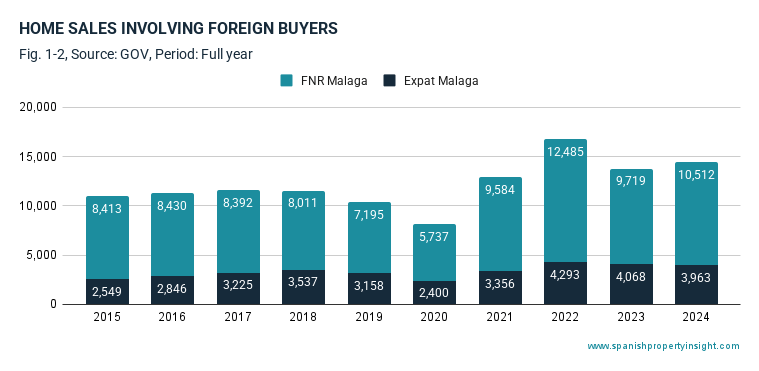
Sales by FNRs have grown 25% over the decade, while the expat segment surged by 55%, indicating a steady transition of some buyers from second-home ownership to residency.
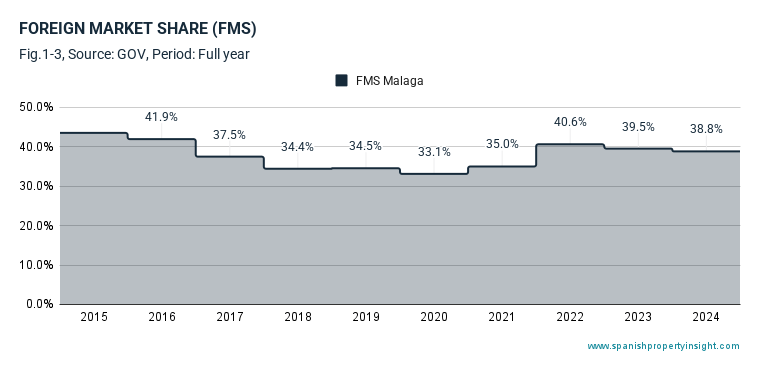
Although foreign buyers maintained a large share of the market, their proportion declined slightly from 39.5% in 2023 to 38.8% in 2024 (Fig. 1-3), suggesting strong growth among domestic buyers as well.
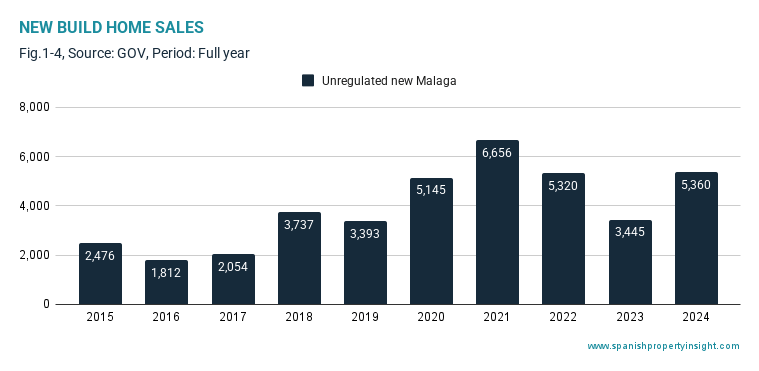
New build sales in the area surged by 56% year-on-year, reaching 5,360 units (Fig. 1-4). This volume was more than double the ten-year average, reflecting a 116% gain, and up 36% compared to ten years ago. Strong demand for new units is driving construction activity in the region, particularly in more popular towns along the coast.
East Costa del Sol home sales
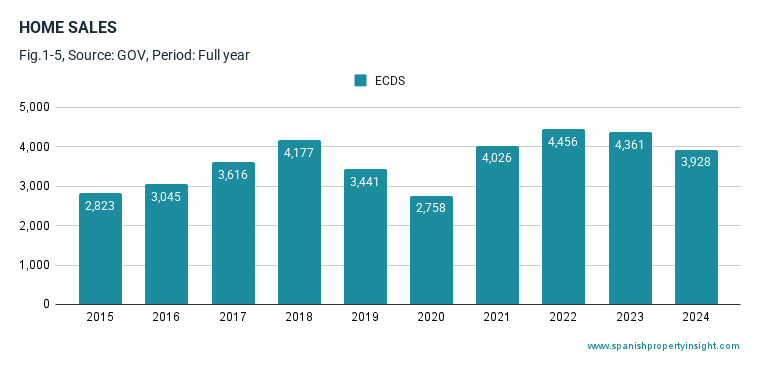
In ECDS municipalities specifically, 3,928 homes were sold during the year, showing a 10% decline from 2023 (Fig. 1-5). However, this figure was still 7% above the ten-year average and 39% higher than a decade ago, suggesting a longer-term upward trajectory despite the short-term dip.
House price trends in Malaga province
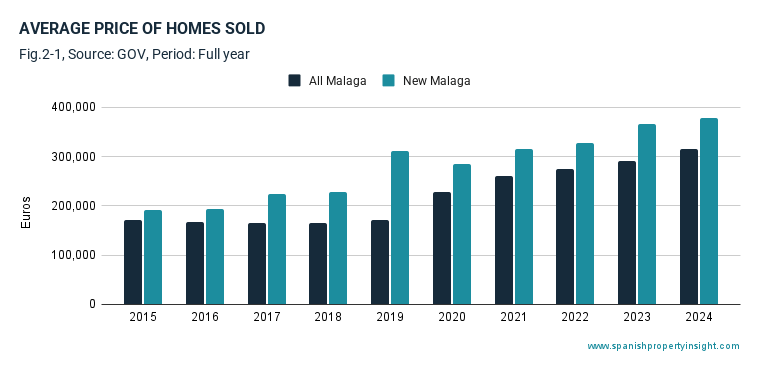
According to data from the Spanish Housing Ministry, the average sale price of homes in Malaga province during 2024 stood at €315,274 (Fig. 2-1), marking an 8% increase year-on-year. New builds sold at an average of €378,605, up 3%.
Price indices reflect even more pronounced long-term growth. Over the past ten years, the overall price index for the area rose from 100 to 183.8, an increase of 84%. For newly built homes, the index rose to 196.9, indicating a 97% increase over the same period (Fig. 2-2). This means that price appreciation has been significantly stronger in the new-build segment—by around 13 percentage points. This differential likely stems from higher construction costs, growing buyer preference for modern amenities, and energy efficiency concerns.
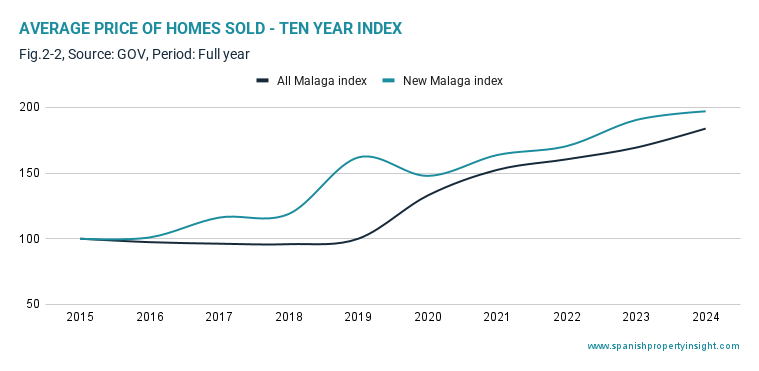
The five-year figures support this view, with all-property prices increasing by 84% and new homes by just 22%, suggesting that most of the value appreciation in the new-build segment occurred earlier in the decade.
Nerja case study
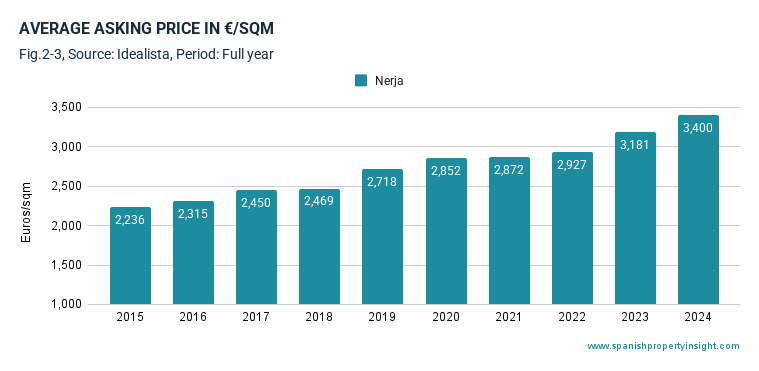
In the popular ECDS municipality of Nerja, the average asking price listed on Idealista was €3,400/m² during 2024 (Fig. 2-3), reflecting a 7% increase over the previous year and a 25% increase over five years. The ten-year index of asking prices moved from 100 to 152.1, indicating a 52% increase in advertised property values—a robust performance aligning with regional trends in demand.
Mortgage market
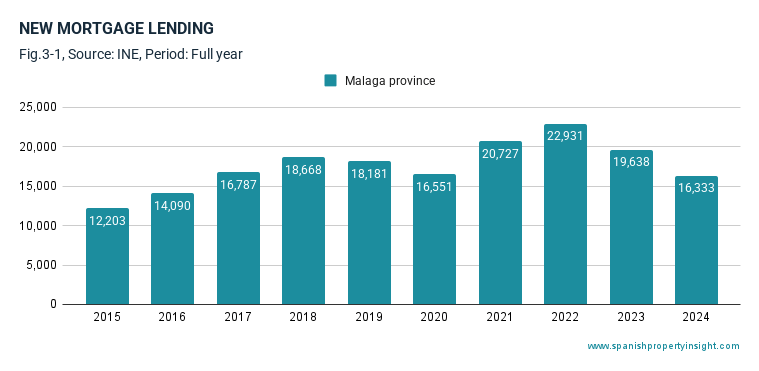
New mortgage lending in Malaga province totalled 16,333 contracts in 2024 (Fig. 3-1), a 17% decline compared to the previous year. This figure was 7% below the ten-year average but still represented a cumulative increase of 34% over the past decade, demonstrating a longer-term recovery despite recent constraint. Tighter lending conditions, higher interest rates, or reduced buyer demand for financing could explain the annual drop.
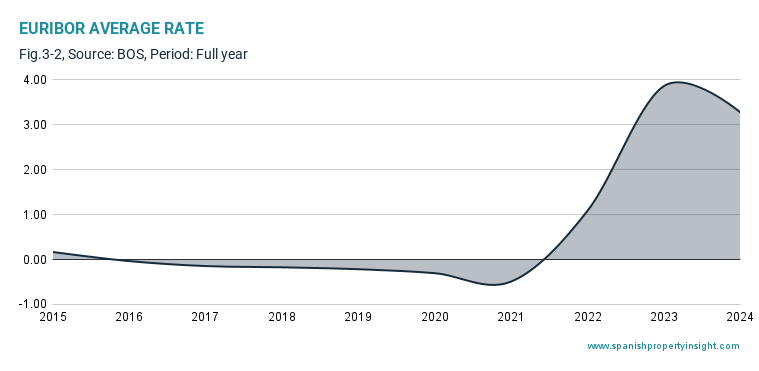
The average Euribor rate—used as a benchmark for most variable-rate mortgages in Spain—was 3.27% in 2024 (Fig. 3-2). This marked a significant decline from 2023’s peak of 3.86%, and a reversal from 2021’s historic low of -0.49%. The downward trend suggests softening monetary conditions, potentially in anticipation of interest rate cuts by the European Central Bank (ECB) in response to easing inflationary pressures and weaker economic growth forecasts across the eurozone.
Housing starts
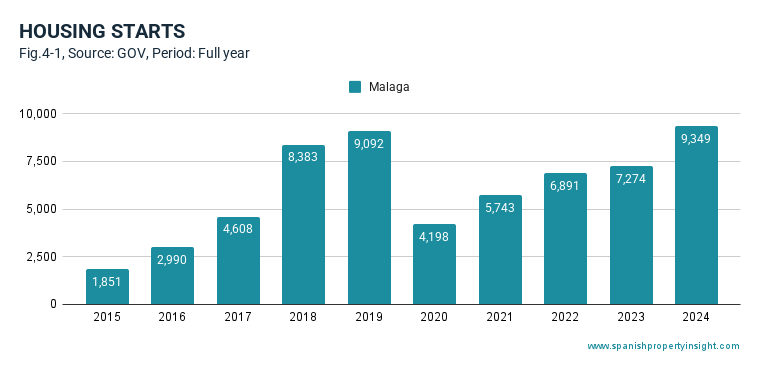
There were 9,349 new housing starts in Malaga province based on planning approvals in the period (Fig. 4-1), up 29% compared to 2023. This figure was 55% higher than the ten-year average and more than four times higher than what was recorded ten years ago. Such a strong growth trajectory clearly reflects rising developer confidence, sustained demand for new housing, and solid investor appetite.
Summary
- Total sales in Malaga province rose 7% year-on-year; new builds up 56% while resales fell locally
- However, in the ECDS sales fell 10%
- Foreign buyers made up 39% of transactions; non-resident purchases outpaced expat activity
- Average prices in Malaga reached €315,000; new builds averaged €378,600
- Over 10 years, all property prices rose 84%, with new builds up 97%
- Asking prices in Nerja increased by 7% YoY and 52% over ten years
- 16,333 new mortgages were signed, 17% lower YoY, but the ten-year trend remains positive
- Euribor dropped to 3.27%, reflecting anticipated ECB rate changes
- Housing starts reached 9,349, a 29% YoY rise and a 405% increase from a decade ago
Conclusion
The East Costa del Sol housing market in 2024 reflected a complex but broadly positive picture. Foreign demand, especially from non-residents, remains strong despite a small drop in market share. New builds are taking an increasingly prominent role, both in terms of sales volume and pricing dynamics. Mortgage activity softened in 2024, but the long-term trend is still upward, and interest rates appear to be at a turning point. Developers are responding rapidly, with housing starts surging in line with market appetite.
All signs suggest the ECDS market is poised for continued growth, especially in the new-build sector, supported by continued foreign interest, favourable pricing trends, and likely monetary easing in 2025.
