
Are you thinking of selling your property in Spain?
Whether you are thinking of selling or simply want to understand the market around one of your most valuable assets, an SPI personalised market report gives you unique, expert insight into your local market segment and what it means for you, so you can make informed decisions. Fill in this form to find out more.
The Murcia housing market in 2025, including the Costa Cálida
Sales
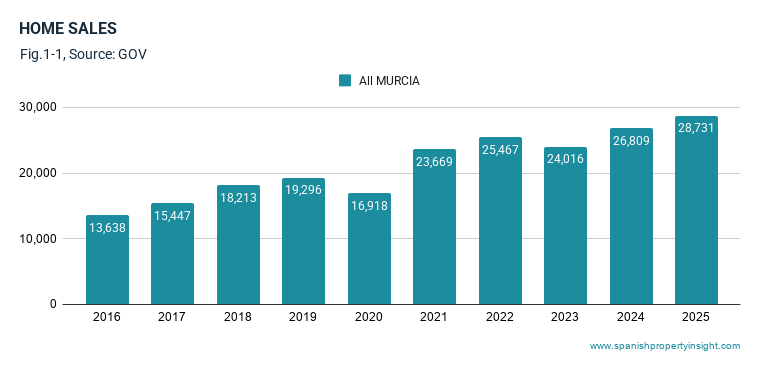
There were 28,731 home sales in Murcia in 2025, a 7% increase year-on-year. Activity was 46% above the ten-year average, and over the past decade sales have increased by 125%, indicating strong long-term growth in transaction levels (Fig. 1-1).
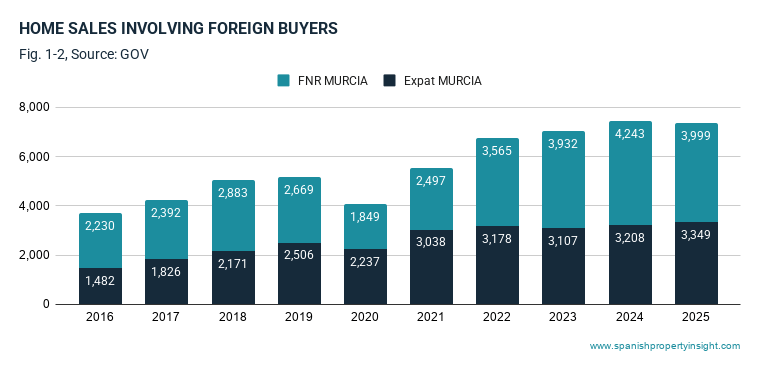
Foreign demand remained an important pillar of the market. There were 7,348 purchases by foreign buyers, a 1% decline year-on-year, though still 41% above the ten-year average and 133% higher than ten years ago. These purchases included 3,349 expats (foreigners living in Spain) and 3,999 foreign non-residents (FNR) buying second homes or investment properties. Expat demand increased 4% year-on-year, while FNR purchases fell 6%. Over ten years, expat demand has grown 204%, compared with 95% growth for non-resident buyers (Fig. 1-2).
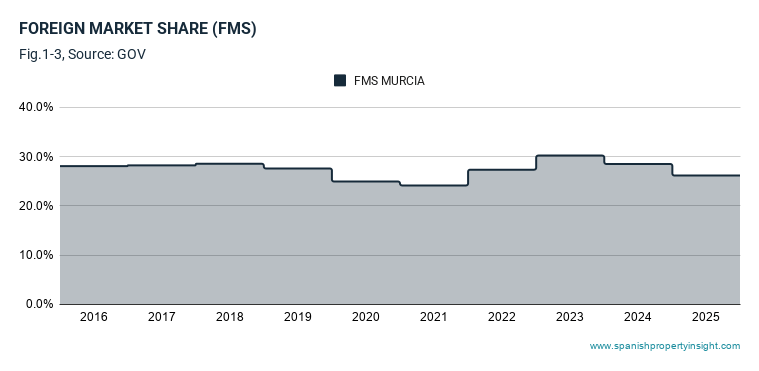
Foreign buyers accounted for 26% of the market, down from 28% a year earlier, though still representing a significant share of demand in the region. This highlights the continued importance of international buyers in Murcia’s housing market, particularly in coastal and lifestyle-oriented areas (Fig. 1-3).
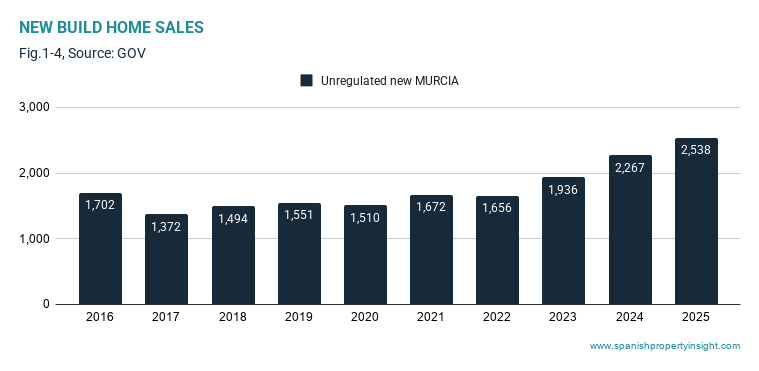
There were 2,538 new-build home sales, representing a 12% increase year-on-year. This was 53% above the ten-year average, and sales of new homes have increased 81% over the past decade, indicating growing demand for modern housing stock (Fig. 1-4).
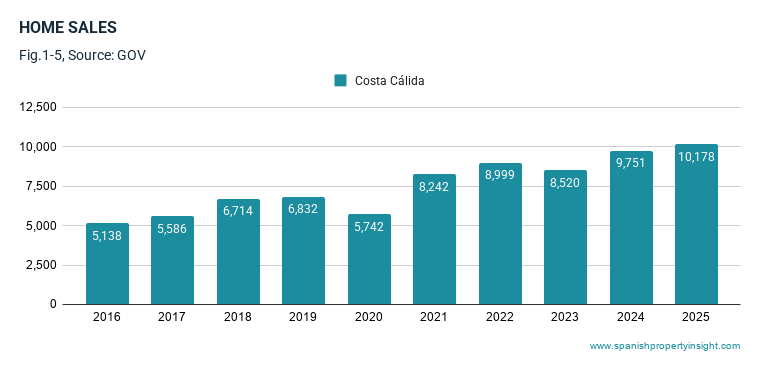
Looking specifically at municipalities along the Costa Cálida, there were 10,178 home sales, a 4% increase year-on-year. This level of activity was 34% above the ten-year average, while over the past decade sales in this coastal sub-market have increased 98%, highlighting the long-term expansion of housing demand in Murcia’s main coastal market (Fig. 1-5).
Prices
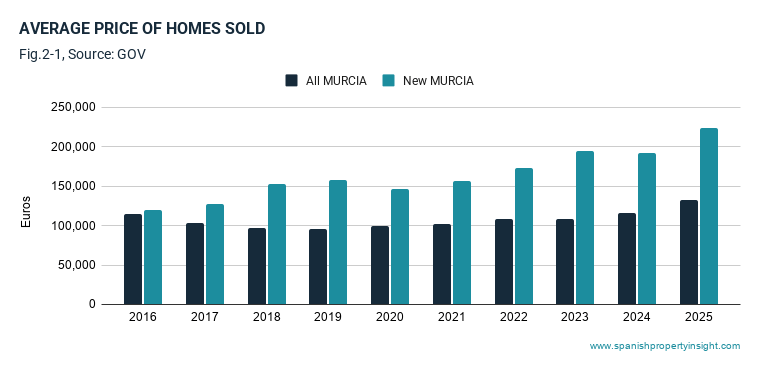
According to the Spanish Housing Ministry, the average price of homes sold in Murcia was €131,867, an annual increase of 14%. Newly-built homes sold for an average of €223,124, representing a 16% year-on-year increase, reflecting strong demand for modern properties (Fig. 2-1).
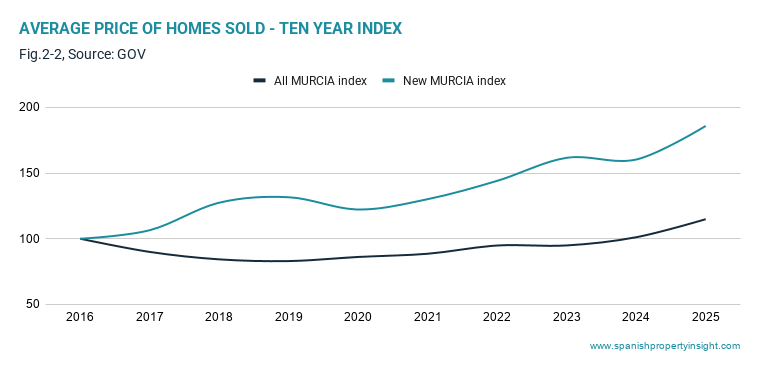
Over the past decade, the price index for all homes has increased from 100 to 115, indicating moderate long-term price growth. By contrast, the index for new homes has risen to 186, meaning prices for new property have increased far more rapidly. Over the last five years, prices have risen 33% for all property and 52% for new homes, highlighting the widening price gap between the two segments. This divergence likely reflects a combination of factors including rising construction costs, limited supply of new developments, and strong demand for modern energy-efficient housing (Fig. 2-2).
Mortgages and financing conditions
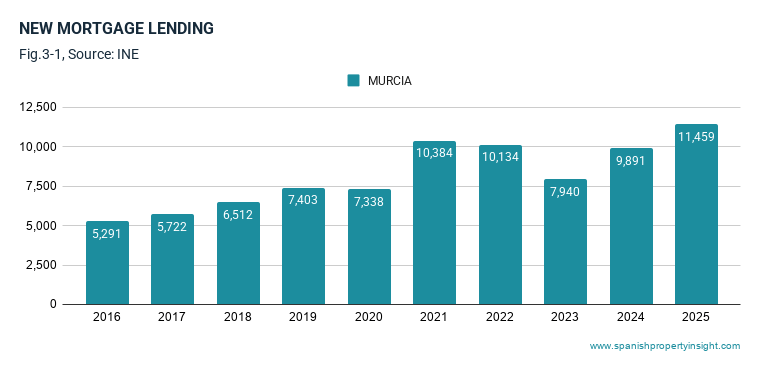
There were 11,459 new mortgages signed in Murcia during the period, an increase of 16% year-on-year. Mortgage lending was 52% above the ten-year average, and has increased 140% over the past decade, reflecting the strong expansion of housing transactions and borrowing in the region (Fig. 3-1).
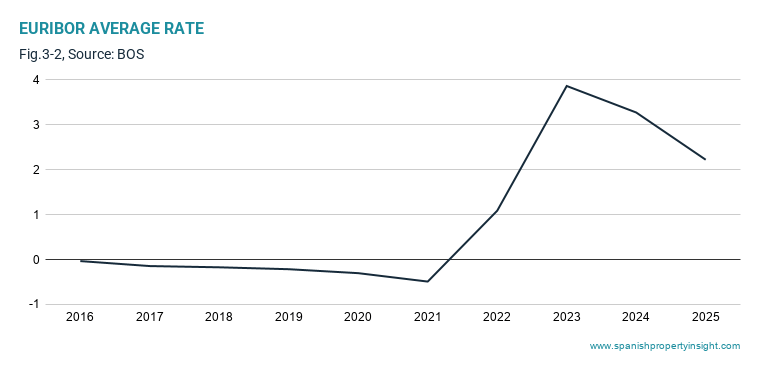
The average Euribor rate was 2.22%, the reference rate used for most mortgages in Spain. This represented a 32% decline year-on-year. Over the past decade, Euribor reached a high of 3.86% in 2023 and a low of -0.49% in 2021, placing the current level between those extremes but trending downward. The decline reflects the shift in European Central Bank monetary policy following the aggressive rate hikes of 2022–2023, with markets anticipating a gradual easing cycle as inflation pressures moderate (Fig. 3-2).
Housing starts
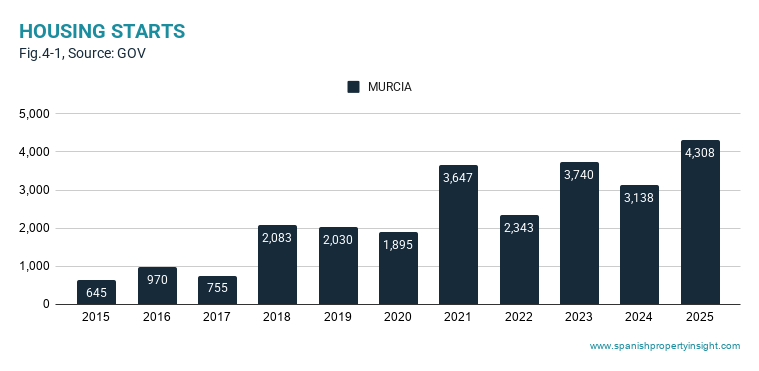
There were 4,308 housing starts in Murcia based on planning approvals, a 37% increase year-on-year. This was 103% above the ten-year average, and construction activity has increased 568% over the past decade, indicating a substantial recovery in development following the post-financial-crisis slowdown (Fig. 4-1).
Summary
The Murcia housing market performed strongly in 2025, with rising sales, growing mortgage lending, and a sharp increase in housing starts. Foreign demand remains a key driver of activity despite a slight decline in its market share, while the Costa Cálida continues to attract buyers seeking lifestyle and second-home properties. Prices are rising steadily, particularly in the new-build segment where supply constraints and higher construction costs are pushing values upward. With borrowing costs easing from recent peaks and construction activity accelerating, the outlook suggests continued market momentum, though affordability pressures and external economic conditions will remain important factors shaping demand.
