
Barcelona province & city housing market report 2025
The Barcelona housing market performed well in 2025, with a strong performance at both a provincial and city level. Most of the data in this report refers to Barcelona province rather than Barcelona municipality, but the capital is the bellwether of the regional market and tends to set the tone for wider trends. Although Barcelona city itself accounts for only around a fifth of provincial sales, its economic weight and influence mean provincial data broadly reflects conditions in the city market. Where available, this report also includes data looking specifically at sales in Barcelona municipality.
Sales
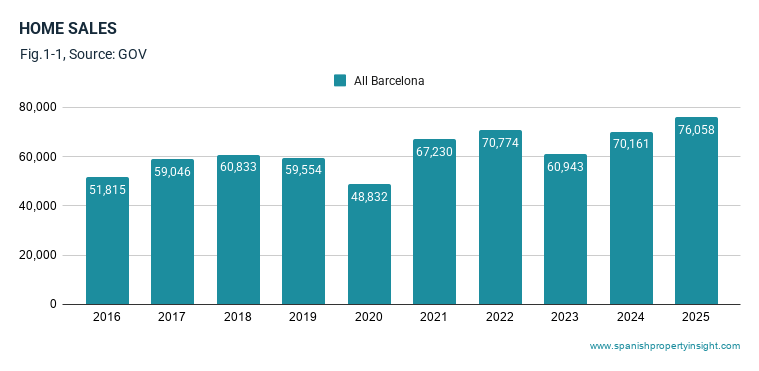
There were 76,058 home sales in the province, up 8% year-on-year, 29% above the ten-year average, and 84% higher than ten years earlier, as illustrated in Fig. 1-1.
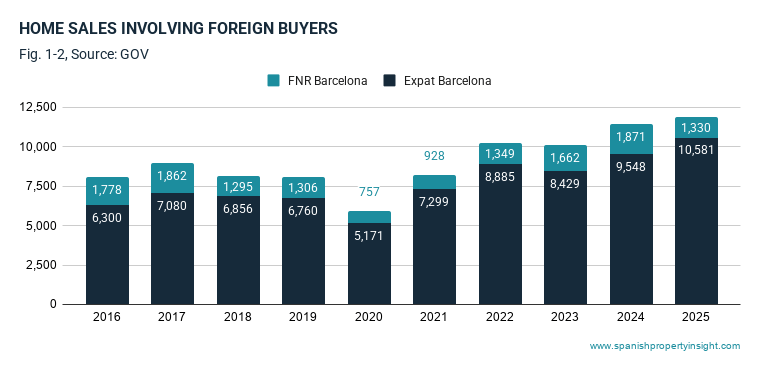
Foreign demand also increased at provincial level. There were 11,911 home sales involving foreign buyers, up 4% on the year and 73% higher than ten years ago. This total was made up of 10,581 purchases by foreigners living in Spain and 1,330 by foreign non-residents. Demand from expats was particularly strong, rising 11% year-on-year and 102% over ten years, while purchases by foreign non-residents fell 29% on the year and were 19% below the level of a decade earlier, as shown in Fig. 1-2.
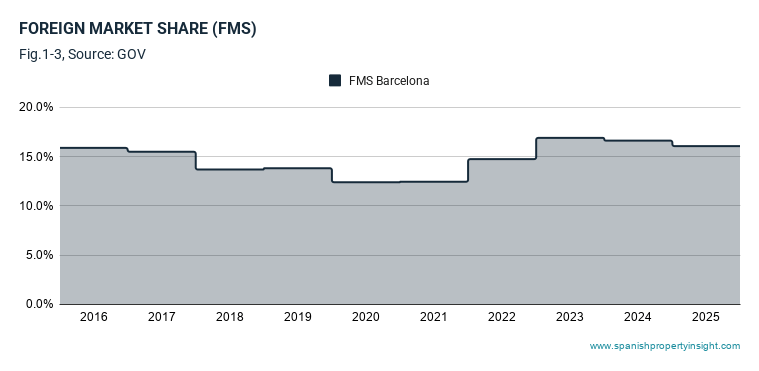
Foreign buyers accounted for 16% of all home sales in Barcelona province in 2025, down from 17% a year earlier, as illustrated in Fig. 1-3. That still represents a significant share of demand, underlining the importance of international buyers in the provincial market, even if the precise ten-year peak is not provided in the data.
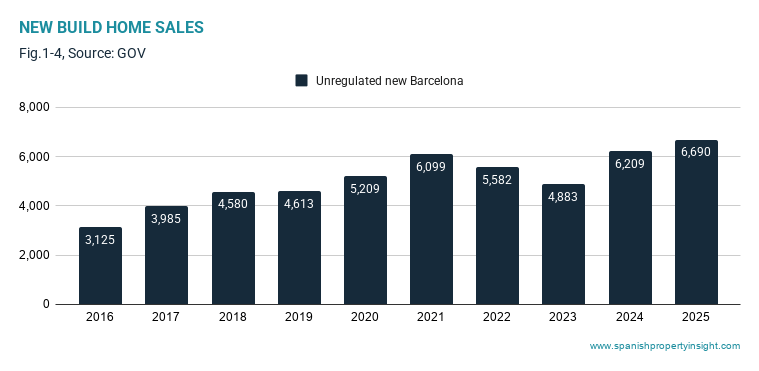
There were 6,690 new-build home sales in the province, up 8% year-on-year, 41% above the ten-year average, and 113% higher than ten years earlier, as shown in Fig. 1-4. New homes remain a relatively small part of the market, but this segment has expanded strongly over the long term.
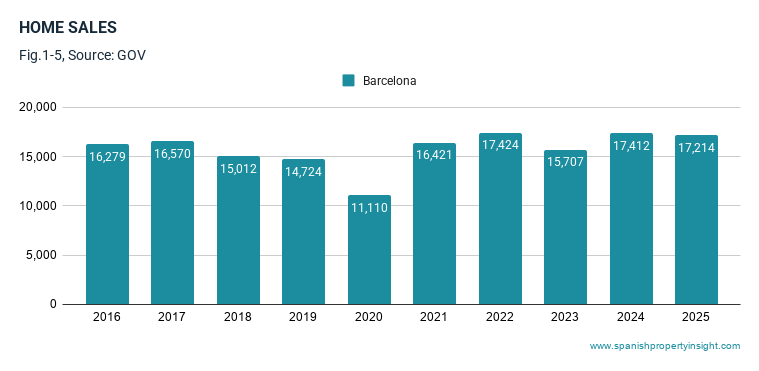
Looking just at Barcelona municipality rather than the wider province, there were 17,214 home sales in 2025, down 1% year-on-year, though still 9% above the ten-year average and 6% higher than ten years earlier, as illustrated in Fig. 1-5. This suggests the city itself underperformed the province, with growth concentrated more in the wider metropolitan and provincial market.
Prices
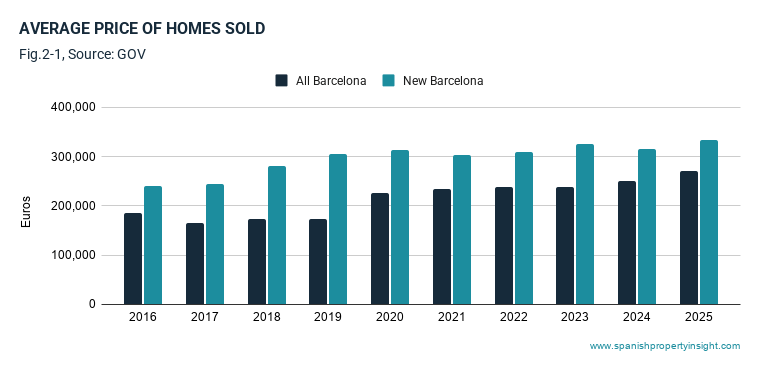
According to the Housing Ministry, the average price of homes sold in Barcelona was €271,069 in 2025, up 8% year-on-year. The average price of newly-built homes sold was €334,173, up 6% on the year, as shown in Fig. 2-1. New homes continued to command a clear premium over the market average.
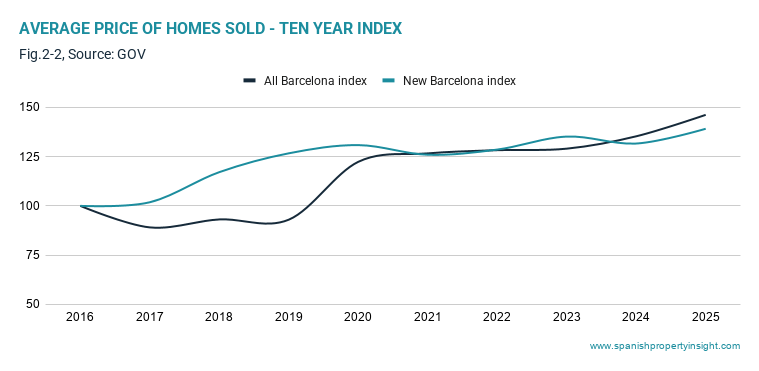
Over ten years, the price index for all homes rose from 100 to 146, while the index for new homes increased to 139, as illustrated in Fig. 2-2. In other words, average prices for all homes increased by around 46% over the decade, compared with 39% for new homes. Over five years, the gap is wider still, with all-home prices up 19% against 6% for new homes. This suggests resale housing has seen stronger price growth, likely reflecting tight supply in established locations, especially in mature urban areas, while the new-build segment may have started from a higher base and been constrained by limited volumes and a narrower product mix.
Mortgages and financing conditions
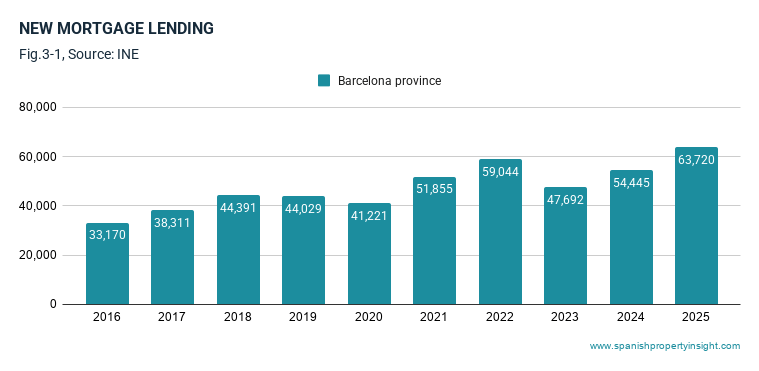
There were 63,720 new mortgages signed in Barcelona province in 2025, up 17% year-on-year, 44% above the ten-year average, and 127% higher than ten years earlier, as shown in Fig. 3-1. Mortgage lending grew faster than sales, pointing to improving credit conditions and resilient buyer confidence.
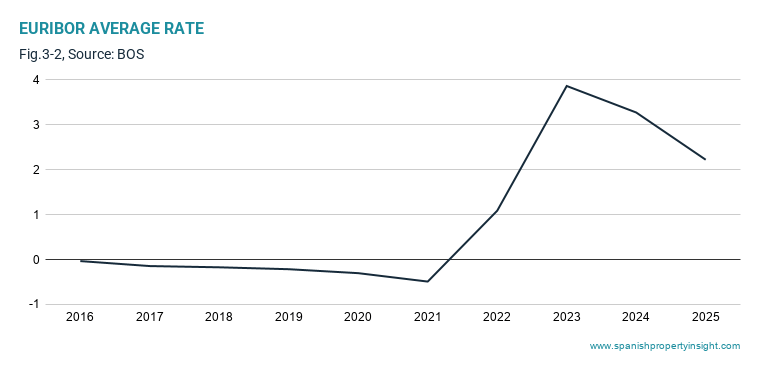
Average Euribor in the period was 2.22%, down 32% year-on-year, as illustrated in Fig. 3-2. That places it well below the ten-year high of 3.86% reached in 2023, but still above the ten-year low of -0.49% in 2021, so borrowing conditions improved in 2025 without returning to the ultra-cheap finance of the pre-inflation era. During 2025 the ECB continued easing, cutting its deposit facility rate to 2.50% in March 2025, and by February and March 2026 it was holding that rate at 2.00%. A Reuters poll published on 13 March 2026 found most economists still expected the ECB to stay on hold through 2026, although that outlook had become less certain as inflation risks re-emerged.
Housing starts
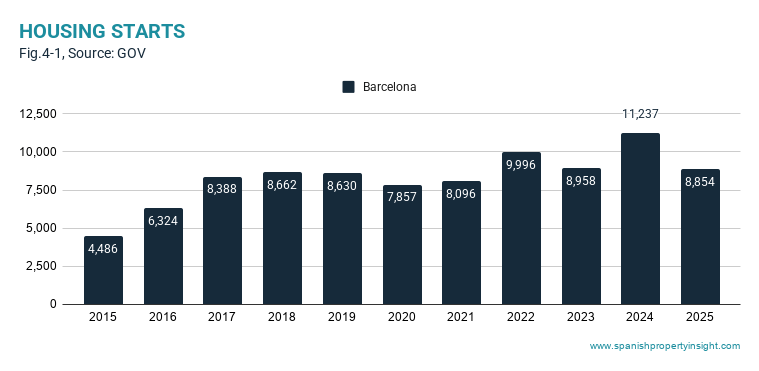
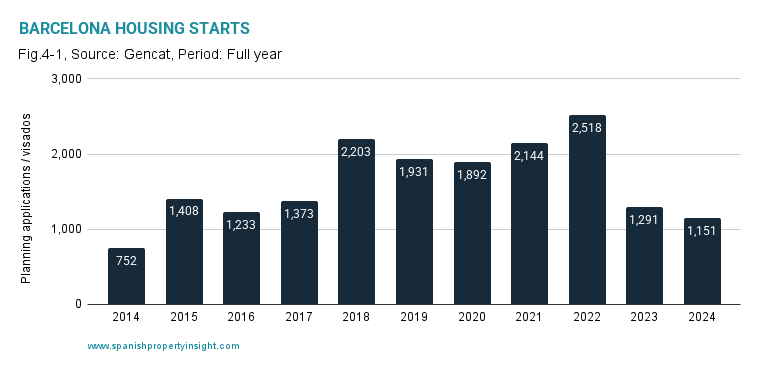
There were 8,854 housing starts based on planning approvals in Barcelona in 2025, down 21% year-on-year, though still 7% above the ten-year average and 97% higher than ten years earlier, as illustrated in Fig. 4-1. So while new development activity weakened over the year, the longer-term trend still points to a substantial expansion in supply compared with a decade ago.
Summary
The Barcelona housing market in 2025 was generally robust, with homes sales, foreign demand, prices and mortgage lending all rising, even if Barcelona municipality itself was slightly weaker than the wider province. Foreign demand remained an important support, especially from expats, while easier financing conditions helped sustain activity. Prices continued to rise, with resale homes outperforming new builds, and the main note of caution came from the drop in housing starts, which suggests supply-side constraints are far from resolved. Looking ahead, the balance of evidence points to a market that remains resilient, though much will depend on financing conditions, the strength of foreign demand, and whether new supply recovers.
Previous reports
You can read reports from previous periods (if available) by clicking on the buttons below.
Barcelona city housing market report – H1 2025
Sales
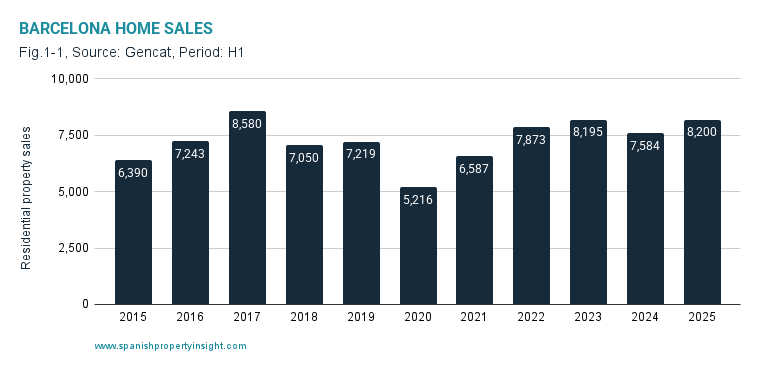
The Barcelona housing market recorded 8,200 home sales in the first half of 2025, an increase of 8% year-on-year, and the second-best year on record (Fig. 1-1). Compared to the ten-year average, this represents growth of 14%, and over the decade, sales have risen by 28%, confirming the city’s enduring appeal despite cyclical headwinds.
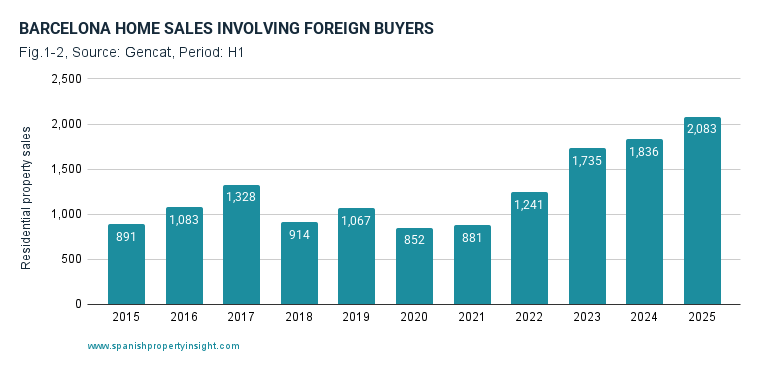
Foreign demand continued to grow in importance. There were 2,083 home sales involving foreign buyers (Fig. 1-2), an increase of 13% year-on-year, and 76% above the ten-year average. Over ten years, foreign sales have more than doubled, rising by 134%.
As illustrated in Fig. 1-3, foreign buyers have been growing in number steadily over the last five years, while local demand has shown more cyclical behaviour.
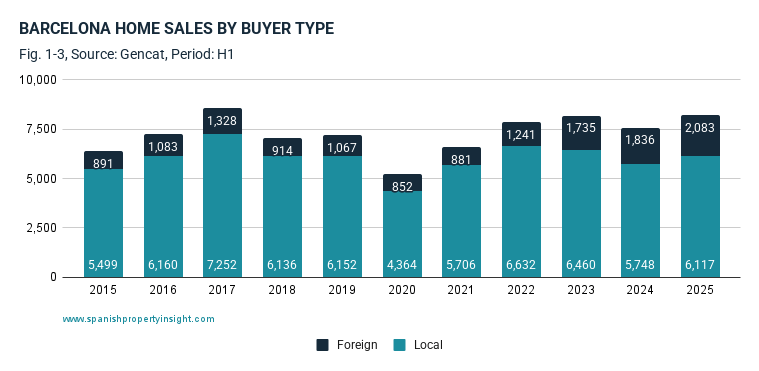
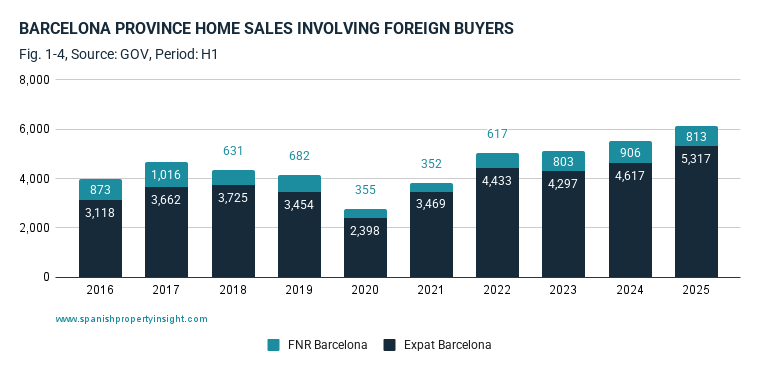
Fig. 1-4, which shows the breakdown of foreign buyers in the wider province (not just the city), highlights the dominance of foreign residents (expats) in this segment. Though not city-specific, this data offers useful insight into the likely composition of foreign demand in Barcelona city, where most international buyers in the province are likely to be are concentrated.
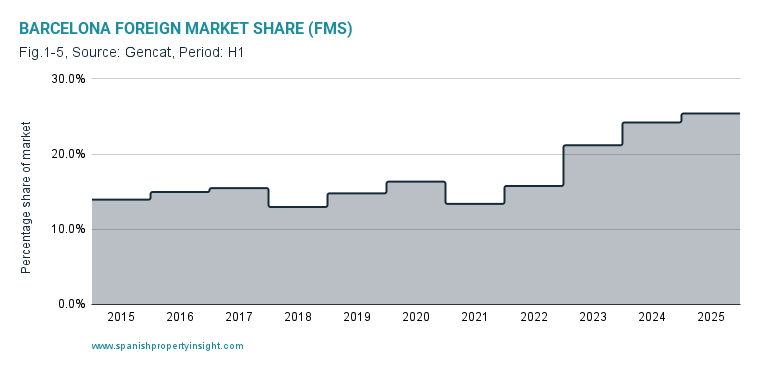
Foreign buyers now represent 25% of the city’s housing market (Fig. 1-5), up from 24% a year earlier and significantly above the ten-year average of 16%.
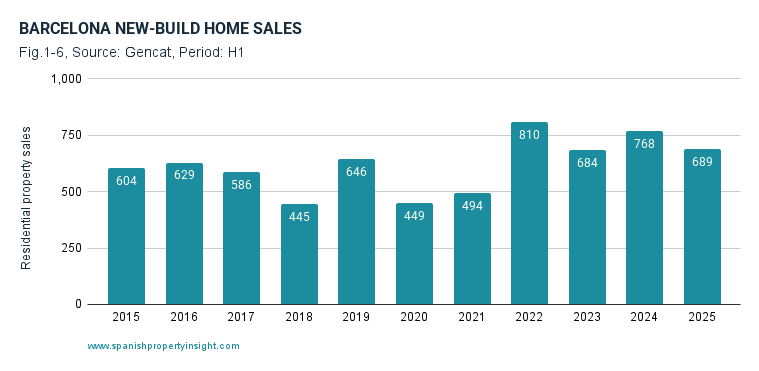
In contrast, the new-build segment saw 689 home sales, down 10% year-on-year (Fig. 1-6). Despite the drop, this figure is still 13% above the ten-year average, and 14% above levels from a decade ago, suggesting continued demand for new homes where available.
Prices
The average price of homes sold in Barcelona city in H1 2025 was €4,673.89 per sqm (Fig. 2-1), up 6% year-on-year, and 60% higher than a decade ago. Newly-built homes achieved an average price of €5,319.88 per sqm, also up 6% annually, with a 79% increase over ten years.
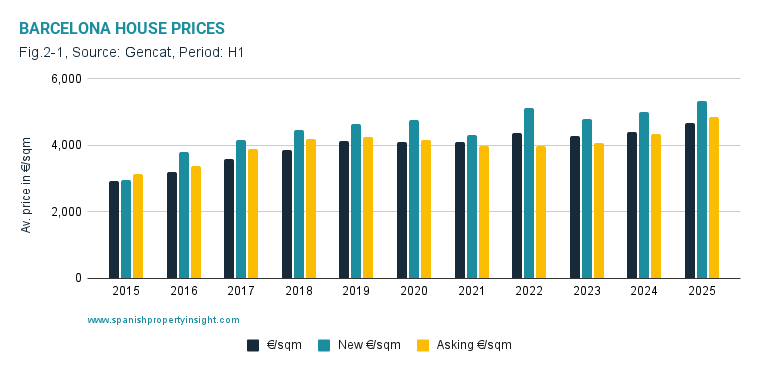
Asking prices based on Idealista data averaged €4,844.75 per sqm, a 11% year-on-year rise, and 55% higher than a decade ago. These increases suggest ongoing upward pressure on prices, particularly in the resale segment.
When comparing average sale prices by property type, newly-built homes have appreciated 59% in a decade to reach €427,450, while resale homes have increased 38%, reaching €385,650. The stronger growth in the new-build segment highlights buyer preference for modern stock, despite limited supply.
Housing starts
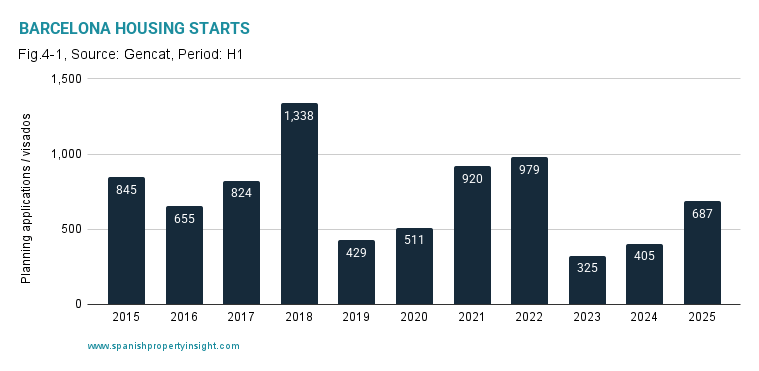
There were 687 housing starts approved in Barcelona city in H1 2025 (Fig. 4-1), a significant increase of 70% year-on-year, although still 5% below the ten-year average. This marks a notable improvement on recent lows, but overall levels remain well below what is needed to meet demand, particularly in the face of policy constraints that continue to hinder residential development.
Mortgage activity
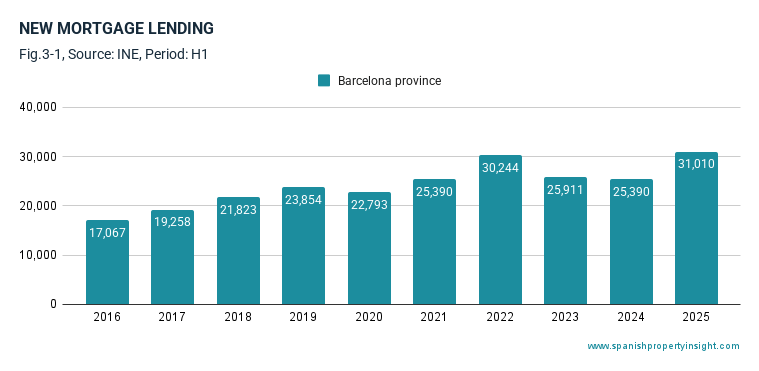
Mortgage lending remained strong, with 31,010 new mortgages signed in Barcelona province in H1 2025 (Fig. 3-1), an increase of 22% year-on-year. Compared to the ten-year average, activity was up 37%, and more than double the level of a decade ago (122% increase), underscoring the continued role of credit in fuelling demand.
The average Euribor rate during the period was 2.27% (Fig. 3-2), a marked decline from the 3.69% peak recorded in H1 2023, and far above the decade low of -0.49% in 2021. The drop from last year’s peak reflects a shift in monetary policy, as the European Central Bank began cutting interest rates in mid-2025 following progress in controlling inflation. Market expectations at the time suggested further rate reductions could follow, which may support mortgage activity in the second half of the year.

Summary
- Sales: 8,200 home sales, up 8% YoY and 14% above the ten-year average
- Foreign buyers: 2,083 sales, 25% market share, highest on record
- New builds: 689 sales, down 10% YoY but still above the long-run average
- Prices: Average sales price €4,674/sqm (+6% YoY); new builds €5,320/sqm
- Asking prices: €4,845/sqm, up 11% YoY
- Housing starts: 687, up 70% YoY, but still low relative to need
- Mortgages: 31,010 new loans, up 22% YoY; Euribor at 2.27%, trending down
Conclusion
The Barcelona property market made further gains in H1 2025, with rising sales, strong foreign demand, and sustained price growth across both new and resale segments. The mortgage market remained buoyant, supported by falling interest rates and renewed buyer confidence
However, the ongoing weakness in housing starts, despite a short-term bounce, continues to limit supply, keeping upward pressure on prices.
Unless regulatory barriers to new development are addressed, affordability will remain a growing concern, especially for local buyers. For now, though, Barcelona remains a highly attractive and competitive market, particularly for international buyers with access to capital.
Year 2024
The Barcelona housing market in 2024 displayed steady resilience, underpinned by stable sales volumes, sustained foreign interest, and moderate price appreciation across most segments.
The market continued to attract a significant share of international buyers, contributing to nearly a quarter of all home purchases, though the growth in foreign demand tapered slightly compared to previous years. Newly-built homes saw strong transactional growth, but average prices softened, reflecting potential shifts in buyer expectations or increased stock availability. Resale prices continued to rise, albeit at a slower pace, while housing starts declined, suggesting possible future supply constraints. This report explores the key trends and performance metrics that defined Barcelona’s residential real estate market over the course of 2024.
Sales performance
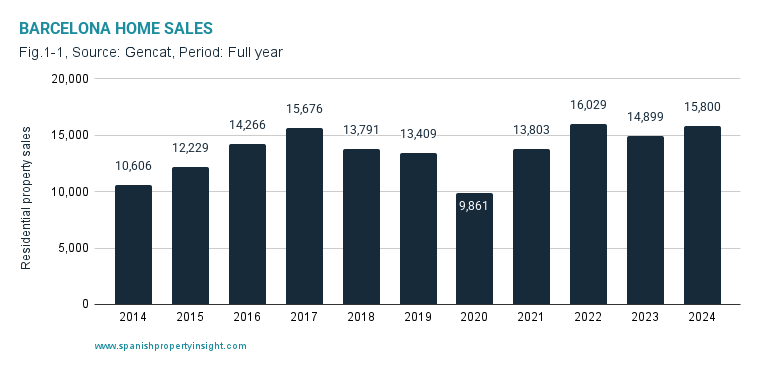
In 2024, the Barcelona housing market recorded a total of 15,800 residential property sales (Fig. 1-1), reflecting a modest year-on-year increase of 6%. This figure also stands 13% above the ten-year average, and nearly 49% higher than total sales a decade ago, indicating a strong long-term recovery in transaction volumes.
Foreign buyers were a key driver of this growth, accounting for 3,919 transactions during the year (Fig. 1-2). This segment grew by 13% compared to 2023 and by 63% against the ten-year average. Over the last decade, foreign buyer transactions have surged by approximately 149%, underscoring Barcelona’s ongoing appeal to international property investors and lifestyle buyers.
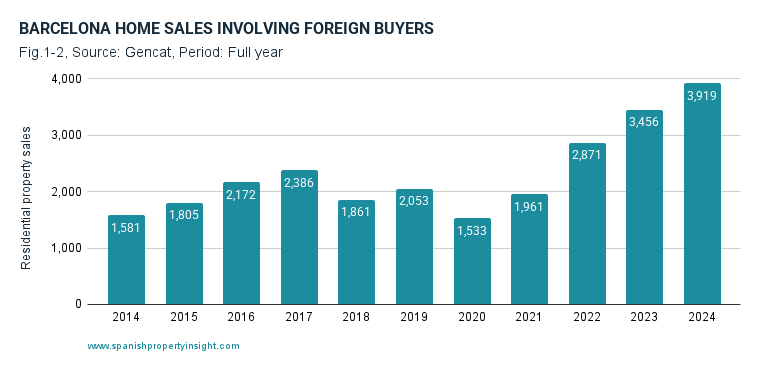
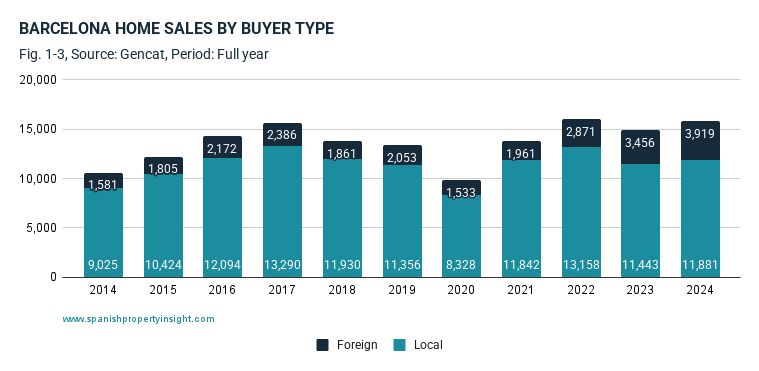
Foreign demand has steadily gained ground in recent years (Fig.1-3). The Barcelona housing market continues to attract international interest, with foreign buyers maintaining a strong presence despite signs of stabilisation in growth.
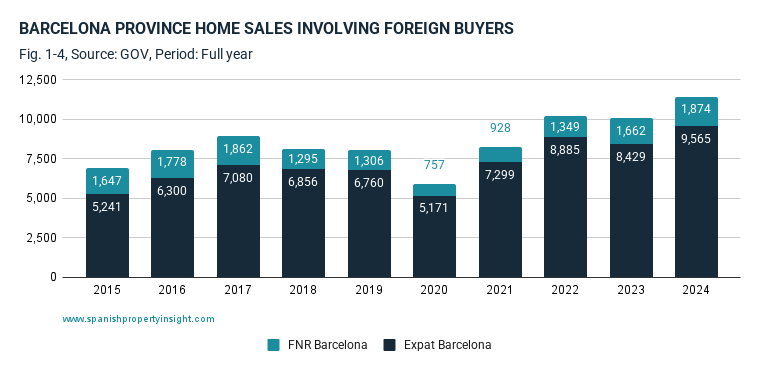
Foreign demand is composed of both foreign residents (expats) and foreign non-residents (FNRs) purchasing second homes or investment properties (Fig. 1-4). Although the data reflects the wider province, it offers valuable insights into the dynamics of Barcelona city, where the majority of foreign buyers are concentrated.
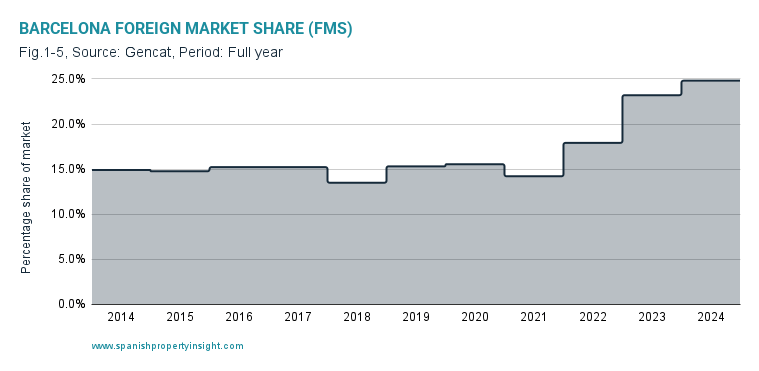
In 2024, foreign buyers accounted for nearly 25% of all home sales—up from 23% the previous year and well above the ten-year average of 17% (Fig. 1-5). This sustained increase in foreign market share underscores Barcelona’s ongoing appeal as a global property destination.
New-build sales
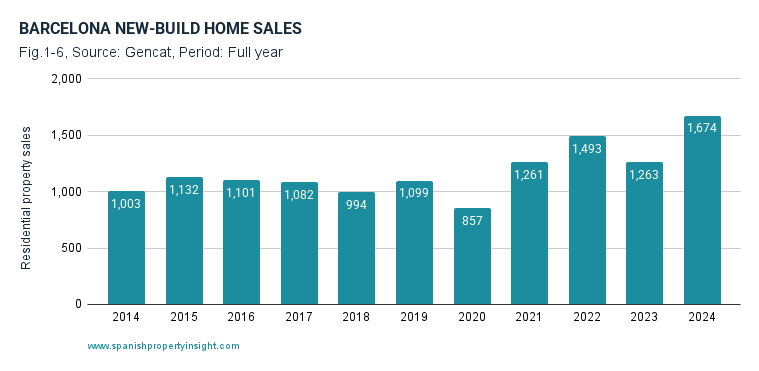
New-build transactions also performed strongly, reaching 1,674 in 2024. This represents a 33% increase year-on-year, 40% above the ten-year average, and 67% higher than in 2014 (Fig. 1-6). Demand for modern homes remains strong both among locals and foreign buyers, particularly in the face of tight resale inventory in prime areas.
House price trends
The average sale price in the Barcelona market in 2024 reached €4,476 per square metre (Fig. 2-1), registering a modest annual increase of 2%. Over the past decade, prices have risen by 62%, demonstrating solid and sustained appreciation.
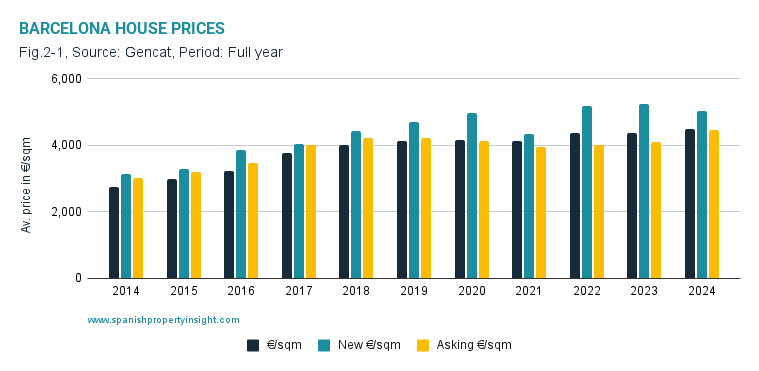
For newly-built homes, the average price was higher at €5,024 per square metre, despite recording a 4% decline compared to last year. Over ten years, however, prices have risen by 60%. Why are new-build prices falling in a city facing an acute shortage of new housing? The likely explanation lies in data volatility. With new home building at historically low levels, the volume of sales is so limited that average prices are easily skewed by one-off events—such as the launch of a project aimed at lower-budget buyers—which may not reflect the broader market trend.
According to the property portal Idealista, average asking prices reached €4,467 per square metre in 2024—an annual increase of 9% and 48% higher than a decade ago. The divergence between asking prices and actual sale prices suggests sellers’ expectations remain confident, even in a shifting interest rate environment.
In absolute terms, the average new-build property now sells for €424,550, up 47% from 2014. Resale homes averaged €370,175, an increase of 46% over the decade. Despite coming from a lower base, resales have kept pace with new-builds in terms of price growth, showing healthy demand across all market segments.
Mortgage market
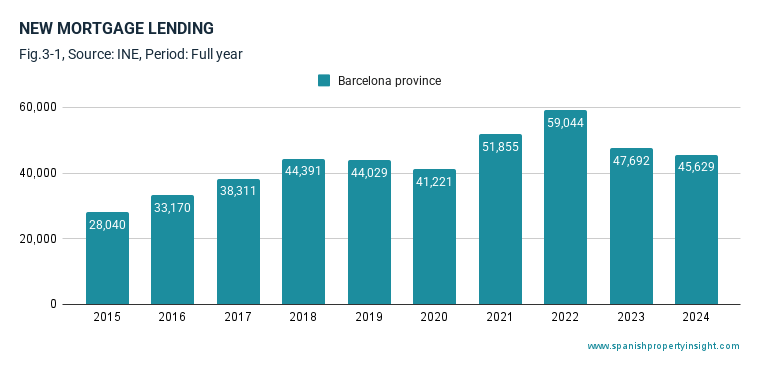
In 2024, a total of 45,629 new mortgages were signed in the Barcelona province (Fig.3-1). This represents a yearly decline of 4%, reflecting a softening in the mortgage market following a period of elevated interest rates. Despite the annual decrease, the number of new loans was still 5% higher than the ten-year average and 63% above 2014 levels—indicating that underlying mortgage activity remains relatively strong from a longer-term perspective.
Euribor, the key reference rate for most variable-rate mortgages in Spain, averaged 3.27% in 2024 (Fig. 3-2). This figure represents a slight decline of 15% compared to the previous year, when Euribor reached a peak average of 3.86%—its highest level in the past decade. In contrast, the lowest level was recorded in 2021, when Euribor was in negative territory at -0.49%.
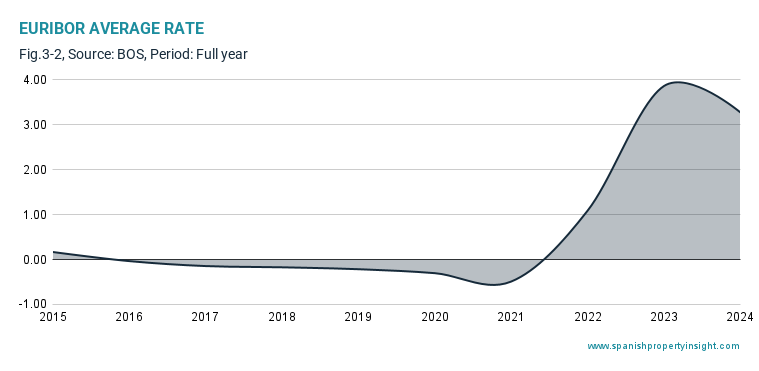
The current rate positions Euribor toward the higher end of its recent historical range, though the decline from 2023 suggests that upward pressure has begun to ease. This shift is closely tied to broader European Central Bank (ECB) monetary policy trends. After a prolonged cycle of interest rate hikes aimed at curbing inflation, the ECB paused further increases in the second half of 2024. With inflation trends cooling across the eurozone, market expectations are now pointing toward a potential series of rate cuts in 2025, which could bring mortgage rates down and further support housing demand.
Housing starts
A total of 1,151 housing starts were recorded in 2024, based on planning approvals (Fig. 4-1). This marks an 11% decline compared to 2023 and a 33% drop relative to the ten-year average. The continued slowdown in construction starts could restrict housing supply in the coming years and may contribute to upward pressure on prices, particularly in high-demand segments.
Summary
- Total property sales in Barcelona reached 15,800 in 2024, up 6% year-on-year.
- Foreign buyers made up nearly 25% of the market, with foreign demand rising 13% annually.
- New-build sales grew 33% and were 67% higher than in 2014.
- Average property prices rose by 2% to €4,476/m², and by 62% over the decade.
- Asking prices increased by 9% year-on-year, reaching €4,467/m².
- Housing starts declined 11% annually and were 33% below the ten-year average.
Conclusion
The Barcelona housing market closed 2024 on a strong footing, sustained by robust foreign demand. However, there are warning signs suggesting challenges ahead. While prices continued to rise and sales grew moderately, the sharp decline in mortgage lending—crucial for local buyers, who typically rely on financing—raises concerns. Foreign buyers, more likely to purchase with cash, are less affected by borrowing costs, but the crash in new home building exacerbates an already tight supply, particularly for new-build homes in central areas. If current levels of demand persist, the resulting imbalance could continue to push prices higher in the years to come.
For both international and local buyers, Barcelona remains an appealing market for now, but risks are growing. Mounting local frustration over affordability may trigger political or regulatory responses, while increasing reliance on property as a fiscal target raises the risk of higher taxes on ownership and transactions.
