
Periodic reports on the property market in Mallorca, Menorca & Ibiza (Balearic Islands)
This page offers data-driven reports on the Balearics property market – the islands of Mallorca (Majorca), Menorca (Minorca), and Ibiza – consolidating key data from public sources to highlight the latest trends and developments. These reports are written for foreign investors, property buyers, vendors, professionals, and journalists looking for insight into the Balearics property market to help inform big decisions with important financial consequences.
Balearics property market overview
The Balearics are a prime destination for international property buyers looking for homes, holiday properties, or investment opportunities. Renowned for its stunning scenery, Mediterranean lifestyle, and vibrant cultural scene, the region attracts a significant share of Spain’s foreign property transactions. As one of the most dynamic housing markets in Spain, a focused report on the Balearic property market is invaluable for anyone with an interest in this region.
The Balearic archipelago made up of the islands of Mallorca, Menorca, Ibiza and Formentera offers a diverse range of housing options, from luxurious villas to charming apartments in historic towns. The market presents unique opportunities and challenges worth analysing. Key municipalities like Andratx, Calviá, Palma, & Santanyí in Mallorca, Ciutadella and Mahón in Menorca, and Ibiza city and Santa Eulalia in Ibiza, are among the most sought-after areas for buyers and investors.

The reports cover a wide range of metrics to provide a comprehensive understanding of the market, including:
- Home sales across the Balearic Islands
- Foreign buyers: market share, residency status, and second-home investments.
- New-build properties: sales, pricing trends, and index data.
- House prices: general trends and specific insights into flagship municipalities like Palma and Andratx.
- Mortgage lending: base rates, borrowing costs, and their influence on the market.
- Housing starts and key factors affecting supply and demand.
Subscribing to Spanish Property Insight provides full access to exclusive data and insights, empowering you to make informed decisions about property investments, sales, or purchases in Mallorca. Stay ahead of the market—subscribe today to access the latest Mallorca property market reports.
Want one-time access to the latest report without subscribing?
Fill in the form below to get access to this valuable report without subscribing.
Get the market report
"*" indicates required fields
Balearic property market reports from previous periods
2025
The Balearic housing market in 2025
Fill in the form above for one-off access without subscribing.
2025 H1
The Balearic housing market in the first half of 2025
Sales
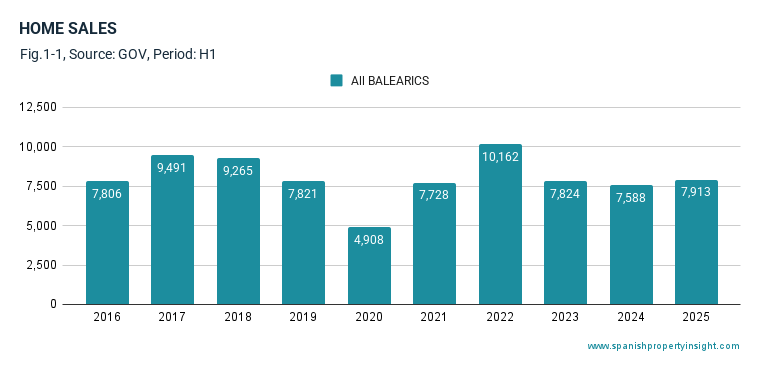
The Balearic housing market registered 7,913 home sales in the first half of 2025, up 4% year-on-year (Fig. 1-1). Compared to the ten-year average, activity was broadly stable (1% above), while over the decade sales have increased 33%, confirming the islands’ enduring appeal and resilience despite cyclical swings.
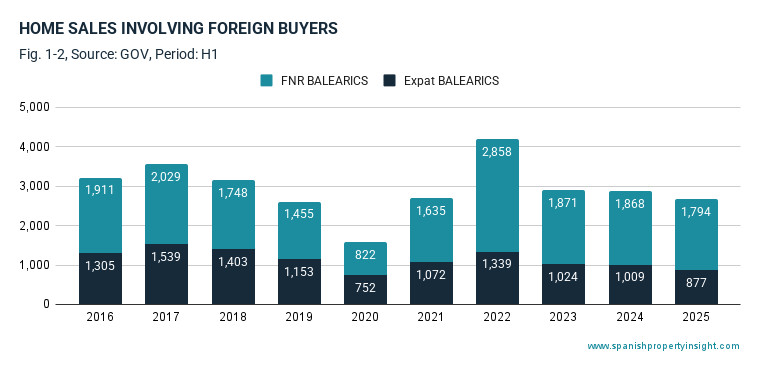
Foreign demand remains a defining feature of the Balearic market. As illustrated in Fig. 1-2, there were 2,671 home purchases by foreign buyers in the period. Of these, 877 were foreigners living in Spain (expats) and 1,794 were foreign non-residents (FNR) acquiring second homes or investments. Year-on-year, expat demand declined 13%, while non-resident purchases fell 4%. Over ten years, expat transactions are down 14%, whereas non-resident purchases have risen 23%. This confirms that the long-term growth in foreign demand has been driven mainly by second-home and investment buyers rather than relocation purchasers.
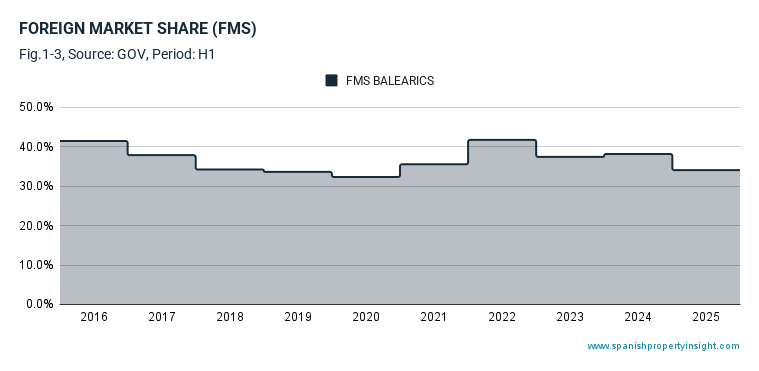
Foreign buyers as a group accounted for 34% of all home sales (Fig. 1-3), down from 38% a year earlier as domestic demand recovers some ground. Even so, the Balearics remain among the most internationally driven housing markets in Spain.
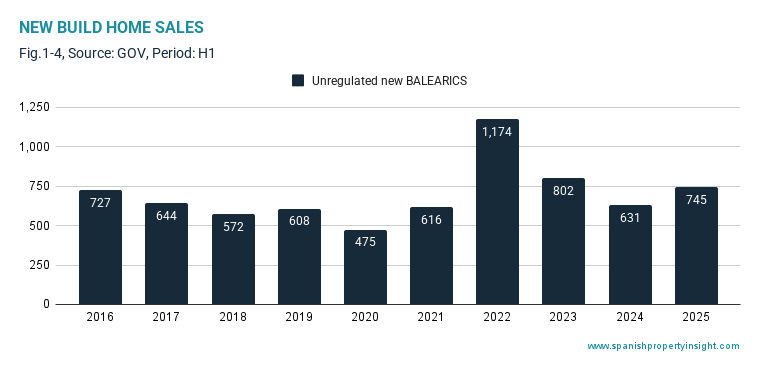
New-build sales showed strong momentum with 745 transactions in H1 2025, up 18% year-on-year (Fig. 1-4). Compared with the ten-year average, new-build activity is 9% higher and 29% above its level a decade ago. The increase highlights solid developer confidence despite planning constraints and high construction costs.
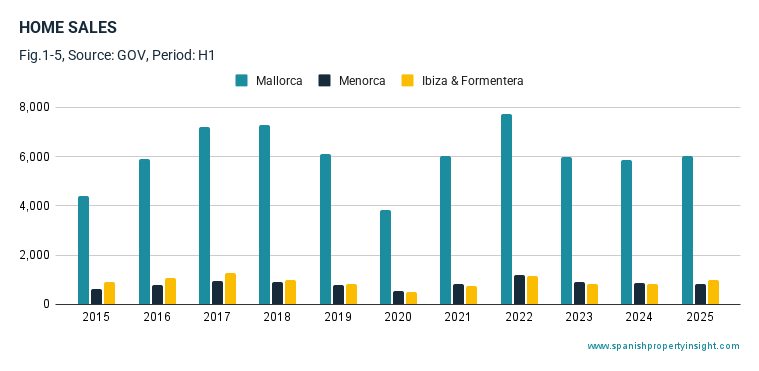
At island level, Mallorca continues to dominate the market with 6,021 sales, representing 77% of the provincial total (Fig. 1-5). Sales on Mallorca rose 3% year-on-year and stand 2% above their 2015 level. Menorca accounted for 817 sales (12% share), down 8% on the year and 14% lower than a decade ago. Ibiza and Formentera together contributed 1,006 sales (11% share), up 13% year-on-year but 7% below their 2015 volume. The data underline Mallorca’s greater depth and stability, while Menorca and the smaller islands remain more sensitive to fluctuations in overseas demand and limited new supply.
Prices
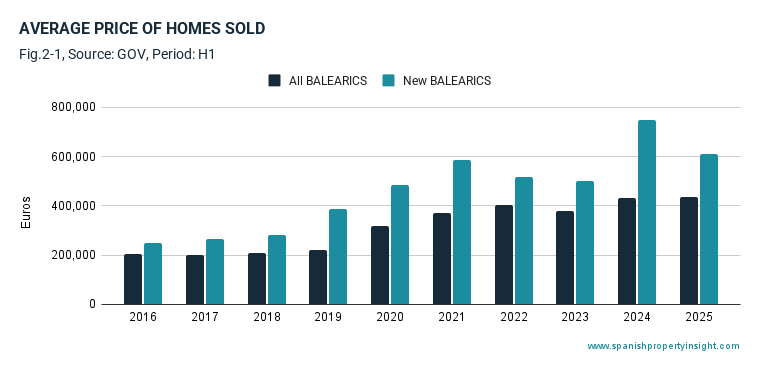
According to figures from the Housing Ministry, the average sale price in the Balearics during H1 2025 was €435,321 (Fig. 2-1), showing a modest annual increase of 1%. The average price of newly built homes stood at €609,932, down 19% year-on-year, suggesting a correction from exceptionally high levels in 2024 when luxury new developments dominated sales.
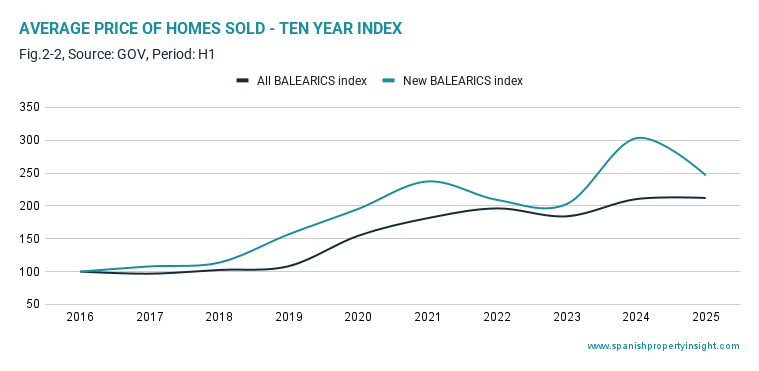
Over ten years, average sale prices have more than doubled, with the price index for all property rising from 100 to 212, and for new property to 246 (Fig. 2-2). This means new-build prices have increased 17% more than resales over the decade, likely due to escalating land, labour, and material costs and the dominance of premium projects aimed at high-end foreign buyers. Over the past five years, overall prices have increased by 37%, compared with 26% for new homes, pointing to some convergence in the latest phase.
Asking price trends by municipality
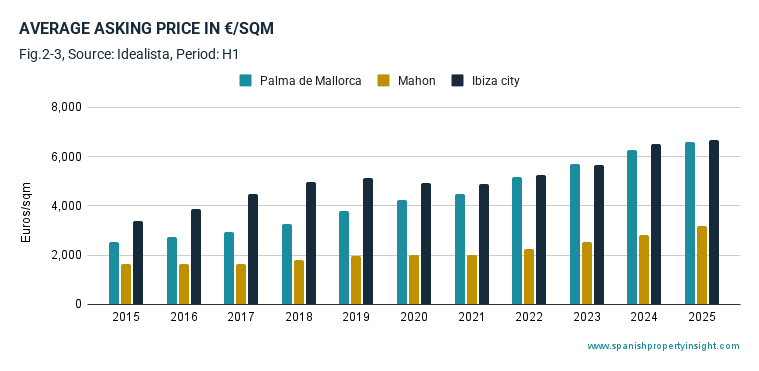
As illustrated in Fig. 2-3, asking prices continue to climb across the main markets. Palma de Mallorca reached €6,602 per square metre in H1 2025, up 5% year-on-year and 56% over five years. Mahón prices rose even faster, up 13% year-on-year and 60% over five years to €3,188/m², reflecting growing interest in Menorca’s quieter appeal. Ibiza City remains the most expensive market at €6,687/m², 3% higher than a year earlier and 35% above 2020 levels. Over the past decade, Palma prices have risen 159%, Mahón 94%, and Ibiza City 97%, underscoring the long-term strength of the islands’ housing markets despite recent moderation.
Mortgages and financing conditions
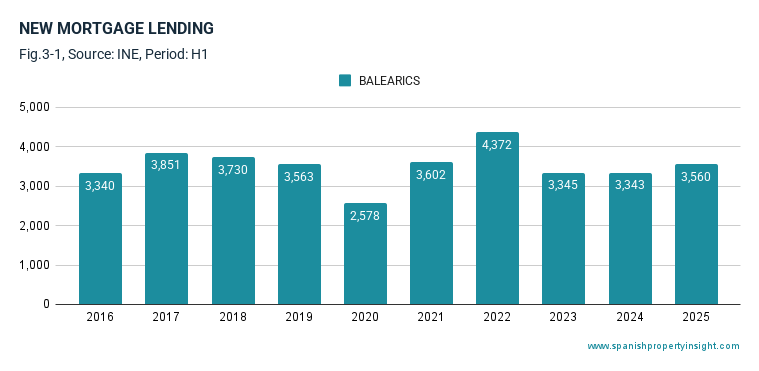
Mortgage lending activity increased by 6% year-on-year, with 3,560 new loans signed in the period (Fig. 3-1). This represents a 5% rise on the ten-year average and a 55% increase over the decade, highlighting improved access to credit and sustained investor confidence.
The average Euribor rate in H1 2025 was 2.27% (Fig. 3-2), down sharply from 3.69% in 2023 and well above the negative rates seen in 2021. This places current borrowing costs roughly midway between the decade’s extremes. The decline reflects the European Central Bank’s shift towards a more accommodative monetary stance following the inflation peak of 2023. Market consensus expects gradual further reductions in 2025, supporting demand and refinancing activity.

Housing starts
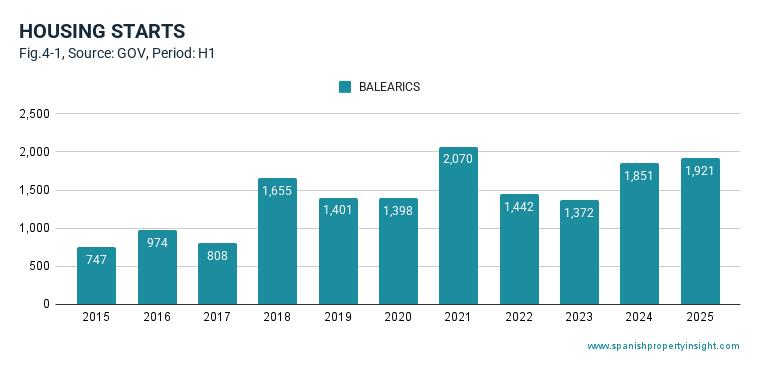
There were 1,921 new housing starts in the Balearic Islands during H1 2025 (Fig. 4-1), an increase of 4% year-on-year. Compared to the ten-year average, this is up 40%, and over the decade construction activity has expanded more than fifteenfold. While still modest in absolute terms, the rebound in planning approvals signals renewed development confidence, particularly in Mallorca and Ibiza, where developer appetite remains strong despite planning and environmental constraints.
Summary
The Balearic housing market in H1 2025 demonstrates renewed vitality, with moderate sales growth, stabilising prices, and a strong rebound in new-build and mortgage activity. The market remains driven by Mallorca, while Menorca continues to cool slightly. Foreign demand remains high but is adjusting from its recent peaks, and falling interest rates are likely to underpin steady demand in the second half of the year.
Disclaimer
These reports are prepared in good faith using publicly available data. While efforts are made to ensure accuracy, no guarantees are provided regarding the completeness, reliability, or suitability of the information for any purpose. Use of this information is at your own risk.
