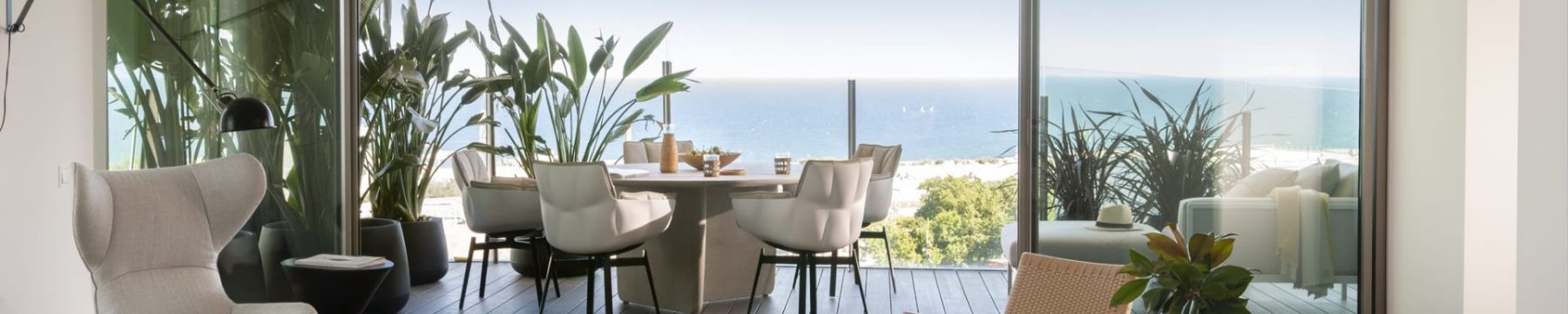
How terraces are measured by estate agents, notaries, registrars, the Cadastre and bank valuers — and why it matters when comparing property prices in Spain
A Spanish apartment advertised as having 140m² might have just 100m² of indoor built area. Look at its description in the Cadastre, the Land Registry, a notarial transaction report or a bank valuation, and you could find several different floor areas for exactly the same property.
These differences are not necessarily mistakes. Spain’s property market uses several definitions of floor area, and the institutions involved do not all measure properties in the same way.
Terraces are one of the biggest sources of confusion. An uncovered terrace might contribute nothing to a property’s official built area, while a covered terrace might contribute half its physical size. Yet both can add substantial value to the property.
This matters because floor area is used to calculate the price per square metre (€/m²), one of the most widely used benchmarks for comparing properties.
If you are buying, selling or valuing a home in Spain, understanding what is included in the floor area can help you avoid misleading comparisons and expensive mistakes.
Why your 100m² apartment might be advertised as 140m²
Imagine a coastal apartment with 100m² of indoor built area, a 50m² covered terrace and another 50m² of uncovered terrace.
The property has 200m² of private indoor and outdoor space in total. However, under Spain’s cadastral rules, the covered terrace would normally contribute just 25m² towards the built area, while the uncovered terrace would contribute nothing.
Add an illustrative allocation of 15m² for communal areas, and the cadastral total becomes 140m².
Meanwhile, notarial recording guidance excludes terraces from the floor-area calculation used in transaction statistics.
An estate agent might advertise the property as 140m², using the cadastral total, or present the indoor area and terraces separately.
The property has not changed. Only the way its floor area is measured and reported has changed.
The result is that identical properties can appear to have different prices per square metre simply because different measurements have been used.
Understanding the different types of floor area in Spain
Before comparing figures, it helps to understand four commonly used measurements.
Usable area (superficie útil)
This is the floor space available for use inside the home, excluding the area occupied by walls, structural elements and certain other features.
It is generally smaller than the built area.
Built area (superficie construida)
This includes the space occupied by internal and external walls, according to the applicable measurement rules.
It is usually larger than the usable area and is the measurement commonly encountered in Spanish property listings and official statistics.
Built area including communal elements (superficie construida con elementos comunes)
In apartment buildings, an allocated share of common areas, such as entrances, corridors and staircases, may be added to the private built area.
This produces a larger figure without providing the owner with any additional private accommodation.
Private outdoor space
Terraces, balconies, patios and gardens may belong to a property or be available for its exclusive use.
Their treatment in floor-area calculations varies according to the source and the characteristics of the space.
Importantly, ownership or exclusive-use rights, physical size and the area counted for statistical purposes are three different questions.

How Spain’s main property information sources count terraces
There is no single floor-area measurement used consistently throughout Spain’s property market.
| Source | Floor-area approach | Treatment of terraces |
|---|---|---|
| Cadastre (Catastro) | Private constructed area plus allocated communal elements | Covered terraces generally count at 50%; covered terraces enclosed on three sides at 100%; uncovered terraces at 0%. |
| Notaries | Preference for built area excluding communal elements | Published recording guidance excludes terraces and adjoining land. |
| Property registrars | Built area recorded in the relevant public document, adjusted where necessary | No universal terrace treatment specified in the published statistical methodology. |
| Bank valuations | Verified measurements and justified valuation areas | Since August 2025, outdoor spaces are excluded from usable area and must be separately identified. |
| Ministry of Housing | Depends on the statistical series and underlying source | No independently established universal terrace formula across its published series. |
| Estate agents | Usually advertised built area, often obtained from existing documentation | No uniform industry convention; practices and sources vary. |
These differences become particularly important when comparing asking prices with official sale-price statistics.
1. The Cadastre: Clear rules for covered and uncovered terraces
Spain’s Cadastre (Catastro) is an administrative register containing information about properties, including their location, use, constructed area and cadastral value.
It has some of the clearest rules for counting terraces.
Under Rule 11 of Royal Decree 1020/1993:
- Uncovered terraces: 0% of their area is counted towards constructed floor area.
- Covered terraces: 50% is counted.
- Covered terraces enclosed on three of four sides: 100% is counted.
For example, a 40m² covered terrace would normally contribute 20m² to the property’s cadastral built area.
The Cadastre also adds an allocated share of communal elements where applicable.
A cadastral certificate can therefore show a total constructed area significantly larger than the indoor accommodation, particularly in apartment buildings.
These rules depend on how the particular terrace is classified and recorded. It is worth checking the detailed breakdown rather than relying only on the headline figure.
Crucially, the cadastral percentages are accounting rules, not valuations. A covered terrace counted at 50% does not necessarily have half the market value per square metre of an indoor room.
Source: Cadastre descriptive and graphic certification guide, page 7.
2. Notaries: Terraces are excluded under the published methodology
Spain’s notaries are an important source of property market information because their statistics are based on completed transactions rather than asking prices.
Their published statistical methodology gives preference to the actual area recorded in the transaction documentation where available, followed by cadastral and registry measurements.
Where different types of floor area are available, the preferred measurement is built area excluding communal elements.
The methodological guidance also explicitly excludes terraces and adjoining land, without distinguishing between covered and uncovered terraces.
This is an important difference from the Cadastre, where covered terraces contribute to constructed area.
However, notarial information comes from transaction documents rather than a fresh physical measurement of every property. When the preferred information is unavailable, alternative recorded measurements may be used.
This raises a potential consistency issue where the underlying documentation includes areas calculated using different rules.
The published methodology establishes the intended treatment of terraces, but it does not by itself prove that every historical record or every calculation displayed by the current notarial statistical portal excludes them consistently.
This distinction matters when using notarial average sale prices per square metre as a benchmark for an individual home.
Source: Notaries’ statistical methodology, page 10.
3. Property registrars: Built area recorded in the property documents
Spain’s property registrars also publish extensive transaction statistics, including average sale prices per square metre.
According to their published methodology, the starting point for residential property is the built area recorded in the relevant public document.
If only usable area is available, the registrars apply a statistical conversion factor to estimate an equivalent built area.
However, the methodology does not establish an explicit universal rule for whether covered or uncovered terraces are included in the recorded built area.
This creates another potential source of inconsistency.
Older deeds and registry descriptions may use different measurements, and a Land Registry record is not necessarily based on a recent physical survey.
Consequently, registry statistics and notarial statistics cannot automatically be assumed to use identical floor-area definitions.
Source: Property Registry Statistics Yearbook 2025, methodology, page 177.
4. Bank valuations: New rules since August 2025
Mortgage valuations follow a separate regulatory framework, principally Order ECO/805/2003, which was significantly amended in 2025.
The changes affecting floor-area definitions took effect on 12 August 2025.
Previously, the definition of usable area included 50% of certain covered private outdoor spaces.
The revised definition expressly excludes outdoor spaces from usable area.
The amended regulations also require valuation reports to identify private outdoor areas, whether covered or uncovered. Spaces with distinct values must be valued independently, with the approach justified.
This does not mean terraces are ignored or considered worthless.
A substantial terrace can still contribute significantly to the overall valuation. The difference is that it is identified separately rather than being treated as part of the property’s usable indoor space.
Valuers may also use different permitted area measurements for valuation calculations, provided the regulatory requirements are met and the choice is justified.
Anyone comparing an older valuation with a report prepared under the new rules should therefore check the area definitions carefully.
Source: Order ECO/805/2003, consolidated text.
5. Ministry of Housing: Different statistics use different sources
Spain’s Ministry of Housing publishes several useful statistical series, but they should not all be treated as interchangeable.
Its property transaction statistics are based on notarial transaction information, while its quarterly appraised-value statistics draw on property valuation data.
These measure different things:
- Transaction prices reflect completed property sales.
- Appraised values reflect professional valuations, rather than necessarily the prices achieved in transactions.
The underlying floor-area definitions also depend on the source data and the particular statistical methodology.
Although the notarial and mortgage-valuation systems have published rules, these should not be taken as proof that every Ministry series treats terraces in exactly the same way.
Before comparing €/m² figures from Ministry statistics with other sources, establish which series is being used and what its area measurement represents.
6. Estate agents: Advertised floor area can vary
Estate agents generally advertise Spanish properties using built area (superficie construida), but the source of that measurement can vary.
It may come from the Cadastre, the title deeds, information supplied by the owner or a separate measurement.
Some listings distinguish indoor built area from terraces. Others use a cadastral total that includes communal elements and part of any covered terraces.
The listing platform Idealista confirms in its professional guidance that published area figures commonly correspond to the larger measurement associated with a property, often the cadastral figure, although the source cannot be guaranteed.
This creates opportunities for misleading comparisons, particularly where two similar properties are advertised using different definitions.
However, there are legal obligations concerning property information.
Article 31 of Spain’s 2023 Housing Law provides prospective buyers with the right to request documented usable and built areas, distinguishing private and communal elements.
That does not establish a single nationwide formula for how terraces must be displayed in every property advertisement.
Buyers should always ask what the advertised floor area includes rather than assuming it means indoor accommodation.
Worked example: One property, several prices per square metre
Consider the following hypothetical apartment on the Spanish coast.
| Property characteristic | Area |
|---|---|
| Indoor built area | 100m² |
| Covered terrace | 50m² |
| Uncovered terrace | 50m² |
| Total private indoor and outdoor space | 200m² |
| Illustrative communal allocation | 15m² |
Assume the property sells for €600,000.
The price per square metre changes dramatically depending on which measurement is used.
| Measurement | Area | Price per m² |
|---|---|---|
| Indoor built area excluding terraces | 100m² | €6,000 |
| Cadastral private built area, including 50% of covered terrace | 125m² | €4,800 |
| Cadastral total, including communal allocation | 140m² | €4,286 |
| All private indoor and outdoor space, unweighted | 200m² | €3,000 |
These figures illustrate different possible calculations, not verified measurements for a real property. The final row is a simple physical-space calculation, not a standard valuation measure. The actual registry area, bank valuation area and advertised figure would depend on the documentation.
Notice what happens when comparing just the first and third measurements.
€600,000 ÷ 100m² = €6,000/m²
€600,000 ÷ 140m² = €4,286/m²
The larger denominator produces a price per square metre approximately 29% lower.
Nothing about the property or its sale price has changed.
Now imagine comparing this apartment with another advertised at €5,000/m². Without knowing how each floor area was calculated, you cannot reliably conclude which represents better value.
This is one reason why apparently straightforward comparisons between estate-agent listings and official sale-price statistics can be misleading.
How much is a terrace actually worth?
A terrace can be extremely valuable, especially in coastal and prime residential markets where buyers place a premium on outdoor living.
But its market value is not determined by how the Cadastre counts its floor area.
A large uncovered terrace with panoramic sea views could make a property substantially more desirable, despite contributing nothing to its cadastral built area.
Conversely, a covered terrace counted at 50% might have limited value if it is dark, overlooked or inconvenient to use.
Factors affecting terrace value include:
- Size, shape and practical usability.
- Views, privacy and orientation.
- Sunlight, shade and exposure to wind.
- Access from the main living areas.
- Location and local buyer preferences.
- Whether the terrace is legally private, communal or subject to exclusive-use rights.
There is no universal percentage that reliably converts terrace space into market value throughout Spain.
The best evidence comes from comparable properties with similar indoor accommodation, outdoor space, location and characteristics — ideally using completed sale prices rather than asking prices alone.
Why this matters when buying or selling
For buyers
A property advertised with a generous floor area might have considerably less indoor accommodation than expected.
This can distort comparisons and potentially lead you to overpay if you rely on a headline €/m² figure without checking what is included.
You should also establish the legal status of any terrace, particularly where it forms part of a communal roof or another element of the building.
For sellers
Inconsistent measurements can make a property appear unusually cheap or expensive when compared with competing listings.
Using a larger floor-area figure may lower the apparent €/m² asking price, but buyers who later discover that much of the advertised area is outdoor or communal space may lose confidence.
A clear description separating indoor accommodation, terraces and communal elements is generally more useful than one large headline figure.
For anyone valuing property
Floor area is an important input, but it is not a valuation in itself.
Comparing properties using inconsistent measurements produces unreliable €/m² benchmarks, even when the underlying prices are accurate.
Checklist: What to verify before relying on floor-area figures
- Check the Cadastre. Obtain the cadastral description and identify private constructed area, communal allocations and any recorded terraces.
- Check the Land Registry. Obtain a recent nota simple and compare the recorded property description with cadastral information.
- Establish the indoor measurements. Ask for usable and built floor areas, excluding communal elements.
- Measure terraces separately. Distinguish covered and uncovered areas, checking whether their legal status and physical characteristics match the documentation.
- Clarify advertised figures. Ask the estate agent which measurement is being used and what it includes.
- Check comparable prices. Establish the floor-area basis of any €/m² benchmark and assess terrace value using genuinely comparable properties.
If the discrepancies are substantial, consider obtaining an independent measurement from an architect or other appropriately qualified professional.
Documents and resources
The main documents for checking floor areas are the cadastral descriptive and graphic certificate (certificación catastral descriptiva y gráfica), the Land Registry extract (nota simple), the title deeds (escritura) and any available plans or valuation reports.
Official resources include:
- Spanish Cadastre — property information and cadastral descriptions.
- Property Registrars — Land Registry information and transaction statistics.
- General Council of Notaries — transaction statistics and methodology.
- Spanish mortgage valuation regulations — official valuation definitions and rules.
The bottom line: Physical area, recorded area and market value are different things
A Spanish property can legitimately have several reported floor areas because the Cadastre, notaries, registrars, bank valuers and estate agents use different methods and sources.
Terraces are a particularly important source of variation.
The differences can have a significant effect on the price per square metre, making properties appear more or less expensive without any difference in their actual value.
The lesson for buyers and sellers is simple: Before comparing prices per square metre, make sure you are comparing the same type of floor area.
And remember that a terrace’s market value depends on what buyers are willing to pay for it, not the percentage counted by an administrative system.
Get a clearer picture of your local property market
Understanding floor-area measurements is only one part of establishing a realistic property value. The most useful comparisons also account for location, condition, views, outdoor space and actual transaction prices.
Spanish Property Insight can help you understand your local market with a personalised property market report, providing a starting point for more informed buying or selling decisions.
Are you thinking of selling your property in Spain?
Whether you are thinking of selling or simply want to understand the market around one of your most valuable assets, an SPI personalised market report gives you unique, expert insight into your local market segment and what it means for you, so you can make informed decisions. Fill in this form to find out more.
