 Mark Stücklin
Spain’s controversial housing decrees are back, and Prime Minister Pedro Sánchez has called a snap general election for 29 November, gambling that public anger over housing will save his government.
Just three days after Parliament rejected the government’s two emergency housing decrees on Friday 2 October, Sánchez announced a snap general election. His government then promptly reintroduced revised versions of the same decrees, taking advantage of parliamentary procedures that could allow them to survive despite having been rejected by the full Congress.
As I argued in my previous article (linked above), the decrees appeared to be as much about political positioning as housing policy. Events since then have only strengthened that impression.
Housing becomes the election battleground
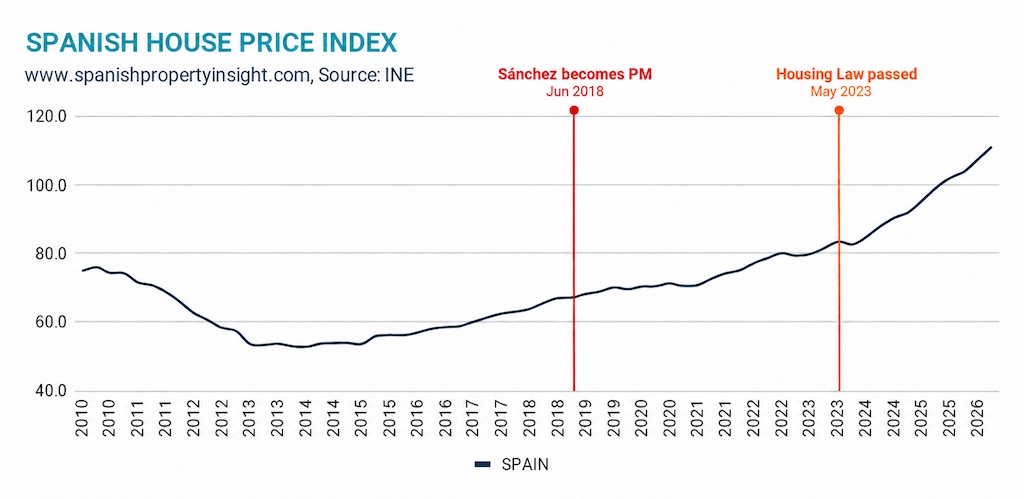
Sánchez has been Prime Minister for eight years, during which Spain’s housing crisis has steadily worsened, as is clear from this house price chart showing when he came to power and when he introduced his Housing Law (Ley de Vivienda) of 2023, after which house prices really took off.
With corruption scandals, controversy over events in Ceuta and unfavourable opinion polls threatening his political survival, the eviction of 87-year-old Maricarmen from her long-term home in Madrid provided an opportunity to change the political conversation.
Her death in hospital on 7 October has made the issue even more emotionally charged, with demonstrations and accusations against the property investors and political parties held responsible for her eviction.
Sánchez now appears determined to fight the election on housing, but not on his government’s record or the underlying causes of the crisis. Instead, he wants to frame it as a simple moral choice between ordinary people, whom he claims to defend, and property speculators or “vulture funds”, supposedly protected by his political opponents. This tweet by his Housing Minister Isabel Rodríguez sums it up nicely. “Either with the people, or with the vultures” she says.
The two decrees fit neatly into this narrative. Drafted under pressure from his coalition partners on the hard left and militant tenants’ unions, they would significantly strengthen tenants’ rights at the expense of landlords, especially the second decree, which would make it much harder or more expensive to recover possession at the end of a rental contract.
Their rejection by Parliament gave Sánchez the opportunity to accuse his opponents of siding with “speculators” against vulnerable tenants. Whether he deliberately engineered that defeat is impossible to prove, but the political advantage is obvious. He can now try to energise his base, attract voters from parties further to the left and shift attention away from his government’s record.
It is a clever political gamble, but one that reduces a complex housing crisis to a simplistic contest between good and evil, with little room for serious debate about what might actually work.
The decrees return, and uncertainty grows
The government has reintroduced both decrees, including extended eviction protections, tighter restrictions on landlords and investors, and automatic renewal of residential tenancies with substantial fines for landlords who refuse to renew without an accepted reason.
The first decree came into force on 8 October, whilst the second is scheduled to take effect on 15 November. Both still require approval by the Permanent Deputation, the smaller parliamentary body that operates whilst Congress is dissolved. The first might now pass despite having been rejected by the full Parliament, though the second remains less likely to survive. The manoeuvre has prompted accusations of constitutional fraud.
Opinion polls currently point towards a victory for the PP and Vox, but Sánchez is gambling that his housing campaign will change the result. If the opposition wins, it may reverse the surviving decrees. If Sánchez stays in power, further intervention in the rental market looks likely.
Either way, Spain now faces an extended period of uncertainty over housing policy until after the election and the formation of a new government. Landlords, investors and developers have good reason to put decisions on hold until they know which rules they will be operating under. The truth is that, right now, nobody really knows what the rules are or will be, and that includes a measure to introduce VAT on holiday-lettings (more on that another day). That can only make the housing situation worse in the meantime.
More homes, less political theatre
Whoever wins the election, Spain’s housing crisis will not be solved overnight. It will take at least five years, probably longer, of sustained reform to increase supply where people want to live. That means freeing up land, simplifying planning and building regulations, making better use of urban space, investing in transport and utility infrastructure, and deregulating the rental market to encourage private landlords to supply and maintain more homes.
Such reforms require political courage, investor confidence and patience, none of which offers the immediate electoral rewards of rent freezes, eviction bans or restrictions on investors. It is doubtful that any political bloc has the policies or determination to deliver what is needed against resistance from entrenched interests. Even a more market-friendly government might achieve little more than modest improvements.
If the current Socialist and hard-left coalition remains in power, however, I fear the outlook will be considerably worse. Its policies risk further discouraging private investment and shrinking the quantity and quality of rental housing. Sitting tenants would enjoy greater protection, but those looking for somewhere to live would face an increasingly difficult market.
And as the shortage persists and public frustration grows, the temptation to blame convenient scapegoats will only increase. Property investors, foreign buyers and second-home owners are obvious targets, even though penalising them will do little to address the underlying shortage.
With housing now an election battleground, political theatre looks set to take precedence over practical solutions. Whoever wins, Spain faces years of difficult reform at best, or more policies that make the problem worse at worst.
Are you thinking of selling your property in Spain?
Whether you are thinking of selling or simply want to understand the market around one of your most valuable assets, an SPI personalised market report gives you unique, expert insight into your local market segment and what it means for you, so you can make informed decisions. Fill in this form to find out more.
